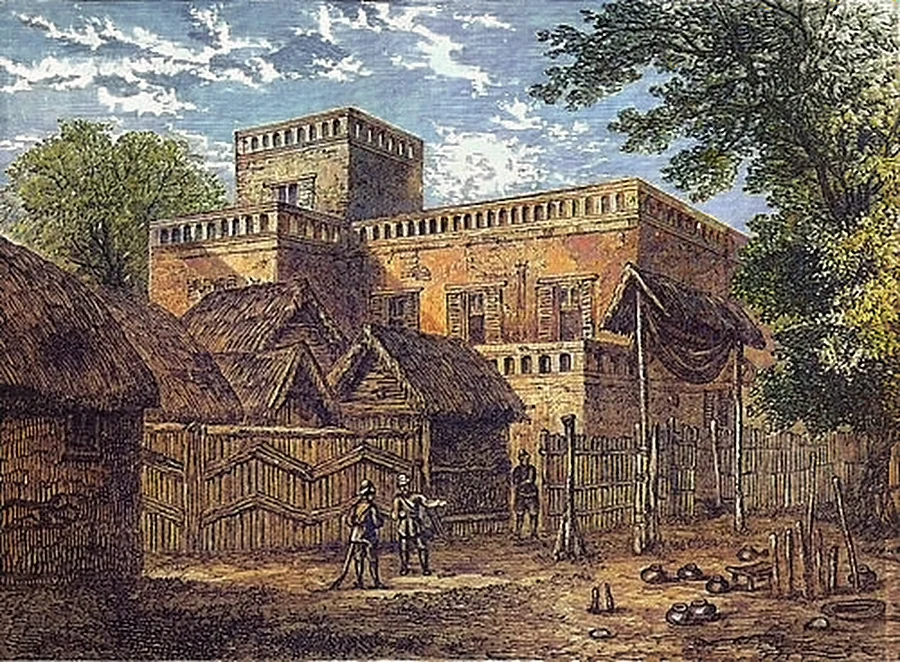
1867-1874
Kofi Karikari's accession and the turn to war
The sudden death of Kwaku Dua I in April 1867 opened a disputed succession. A rival was removed - Edgerton says the general Owusu Koko was seized and exiled - and Kofi Karikari (Kakari), a son of the Asantehemaa Afua Kobi then aged about thirty, was chosen by a majority of the electors and enstooled that year. Europeans called him 'King Coffee'. He inherited a full treasury. The Basel missionaries held at his court in 1869-74 described a government in which the king shared power with an inner council known as Asante Kotoko: the queen mother, the rulers of Juaben, Bekwai and Mampon and a group of Kumasi office-holders. In 1868-69 one army operated west towards Elmina in support of Asante's Dutch-protected allies, while another under Adu Bofo campaigned east of the Volta. The British takeover of Elmina in 1872 decided the argument in Kumasi: the national assembly voted for war in October 1872 and the army marched in December. Defeat in 1874, and the charge that he had taken gold from the royal mausoleum at Bantama, cost him the stool later that year.
Wikipedia dates his reign from 28 May 1867; Edgerton makes him about 30 at accession and 37 in 1873, which do not agree with each other or with Wikipedia's 'born c. 1837'.
Key facts
- Reign from 1867 to 1874; mother Afua Kobi.
- The national assembly approved war in October 1872.
- Tordoff (after Ramseyer and Kuhne) describes the ruling council as Asante Kotoko.