Culture › Custom, step by step
Rites and customs
Naming, coming of age, marriage, funerals, widowhood, enstoolment, the Adae and the great festivals, oaths and taboos: each rite set out in order, with who performs it, what is used, how it differs from state to state, how it has changed and how it stands today.
127 sourced entries · every source listed

Birth and naming
Lying-in after a birth and the father's gifts
obaatan (nursing mother); ofiri no tan (he brings her out of confinement); funuma-tam (navel cloth)T. E. Kyei, an Asante teacher working on the Ashanti Social Survey of 1945, set down what a husband owed at the birth of a child. Most expectant mothers who lived in their husband's house…
Note on the sourcesrecorded 1945Din to: giving the name on the eighth day
din to / edin-too (name giving); nnawotwe-da (eighth day); dadu-nna-num (a fortnight)In Kyei's 1945 account the name is the father's to give. The naming generally fell on the eighth day of the child's life (nnawotwe-da), or a fortnight after the birth, and could be put off…
Note on the sourcesrecorded 1945Whom a child is named after
-waa (feminine ending, as in Osei / Oseiwaa)Kyei set out the pattern an Asante father followed in choosing a name in the 1940s. As a rule he named the child after one of his own parents or their near relatives: his father, his…
recorded 1945Names from events, sacred days, rivers and gods
Afriyie; Antobre; Bediako; Dwira; Adae; Fodwoo; Fofie; Dapaa; abosom-ba (child given by a god)Beside the formal name, Kyei recorded several kinds of name that mark how or when a child arrived. Incidental names recall something that happened while the mother was pregnant or just…
recorded 1945Birth-order names, Konto, and Badu the tenth child
Piesie; Manu / Maanu; Mensa / Mansa; Anane; Num; Nsia; Nkroma; Badu / Baduaa; Duku; Adusa; Kaakyire; KontoKyei calls these 'sequential' names: they come by themselves from a child's place among its mother's children. His rule is narrower than the lists found online. Second to sixth are counted…
Note on the sourcesrecorded 1929 and 1945Twins: Ata and Ataa, the children after them, and the palace
Ata (m), Ataa (f); Tawia; Nyankomago; ntaa (twins); ahen-nyere ntaa (twin stool-wives); Abamon (god of twins)In Kyei's list twins are Ata (boy) and Ataa (girl). The children born after them also have fixed names: Tawia is the first child after twins, Nyankomago the second, and two rarely heard…
Note on the sourcesrecorded 1929 and 1945Bagyina-ba: names to keep a child alive
bagyina-ba (a child 'propped to stand'); Donko; Sumina; Oyo-guo; Bisa-owuo; Nka-nso; obusu-yenii (the Evil One)When a mother had lost one or two babies in a row, the next child was given what Kyei calls a queer or uncomplimentary name. The belief he recorded in 1945 was that repeated infant deaths…
Note on the sourcesrecorded 1929What a father gives: ntoro, name and upbringing
ntoro / nton (the father's spirit); agya (father); wofa (mother's brother)A child belongs to its mother's lineage, and its heir and legal guardian is the mother's brother. Rattray's chapter on father and children (1929) explains what the father nonetheless holds.…
tradition of c. 1700; recorded 1929 and 1945Ofiri: the albino in name and in stool tradition
ofiri (albino)Kyei lists Ofiri among the names a child bears automatically: it is simply the name for an albino, boy or girl. Rattray's chapter on Komfo Anotche (1929) records the tradition behind the…
Note on the sourcesChildhood and coming of age
Etiyidie: the child's first full head-shaving
etiyidie (shaving of the head); sewa / sewaa (father's sister)Rattray describes a small rite of early childhood that again shows the father's side at work. When a child's head was to be fully shaved for the first time, at about four or five, the…
Note on the sourcesrecorded 1929, describing the nineteenth centuryHow a boy was brought up
'mpere (small tawse); gyadua (the town's shade tree); anansesem (spider stories); ntam kese (the great oath)There was no initiation rite for Asante boys. Rattray's informants in the 1920s described instead a long apprenticeship to the father. From infancy the boy went with him to the farm and on…
recorded 1929 and 1945How a girl was brought up
kwasea (fool); abosom (gods)Daughters were the mother's province. Rattray records that the mother watched over a girl from birth, made offerings to the gods to protect her from witches, and promised them a sheep when…
witnessed 1945Bragoro: when it was held and who was told
bra-goro (menses ceremony); yeka n'ano (her mouth is being touched); yebo n'asom (her hoe is being struck); waye saa ('she has done so')Kyei watched three coming-of-age ceremonies for girls during the 1945 survey, one of them inside Kumasi, and found them almost identical in order; only the expense differed. He gives the…
witnessed 1945Bragoro, first morning: striking the hoe
asom-bo (hoe-striking); abonten-tuo (romping through the streets); bra-dwom (songs of the rite); donno (hourglass drum)At cock-crow on the Friday the girl's mother, the senior women of her family and their friends gathered in front of the house to 'strike the hoe'. A hoe blade was beaten as a bell and the…
witnessed 1945Bragoro: the white stool, the gifts and the shaving
anyame-dee / akra-sika (soul money); dwetire (capital); adwera (purslane leaves); tiri-ho-bo (close shaving); sewaa (father's sister)Before dawn the girl bathed. The elder women of her lineage dressed her in costly cloth, wrist beads, a gold necklace and trinkets, and at daybreak sat her on a white stool in the open…
Note on the sourceswitnessed 1945Bragoro: the bath in the stream
toma (waist beads); dowa (raffia fibre); too-bre (plantain-fibre towel); nwera (white calico); edwen (camwood shrub)After the shaving a woman carried the girl on her back to the nearest running stream. A young girl walked ahead with the white stool, the initiate's head was covered with cloth so that no…
witnessed 1945Bragoro: anoka, the touching of the mouth
ano-ka (mouth-touching); bra-to (the mashed yam or plantain of the rite); eto; apatere (a Lake Bosomtwe fish); sonweree (elephant skin)Back at the house the girl sat again on her washed white stool with her grandmother on her right. The grandmother prayed to God and to the earth: may she have a peaceful womanhood, may she…
1945 to presentBragoro: the rest of the week, and the rite's decline
bra-goro; brapueFor the four days after the first, Saturday to Tuesday in the ceremony Kyei watched, the new woman did no work. Friends of her own age waited on her. She bathed three times a day, wore…
recorded 1929 and 1945Kyiribra: pregnancy before the rite, and cleansing the earth
kyiri-bra (one who shuns the menses rite); mmusuo (calamity); Asase Yaa; odekuro (village head); opitire (a fish, emblem of stubbornness)A girl who became pregnant before her first menses had been announced and her mouth 'touched' was a kyiri-bra. Kyei explains that the act was held to defile Asase Yaa, the earth, and so to…
Note on the sources1817 to 1945Bra dan: the room apart
bra-dan (room for menstruating women); bra-fie (house for the same); bra-duane (food cooked by a woman in her period)Bowdich noted in 1817 that women withdrew to the outlying villages during their periods. Rattray (1923) records that a woman whose period began after she had crossed the Tano ford could not…
1817 to 1945Asiwaa: a girl promised in childhood
asiwaa (pl. nsiwaa); do-yere (a wife offered to a man)Bowdich reported in 1817 that infants were sometimes married to tie families together: a cloth was sent to the child and gold to her mother. Kyei, in 1945, describes the same custom as…
Marriage
Five ways a man came by a wife (1945)
mpena-twee (courting); asiwaa (child betrothal); do-yere (offered wife); kuna-yere (inherited wife); ayete (stool-wife replaced on death); awowa-yere (wife taken as a pledge)Kyei's survey of 1945 sorted Asante marriages by how the wife was acquired. First, by courting and wooing, mpena-twee, the ordinary way. Second, by betrothal of a girl in early childhood,…
recorded 1929, describing the nineteenth centuryRattray's six kinds of marriage (1929)
adehye awadie; afona awadie; awowa awadie; ayete; kuna awadie; mpena awadieSixteen years before Kyei, the colonial anthropologist R. S. Rattray classified Asante marriage not by how the wife was found but by her status. He lists six kinds. Adehye awadie is the…
Note on the sourcesrecorded 1945Courtship and the first moves
mpena (lover, concubine); mpena-twee (courting); otwe-sre (antelope thigh)Kyei follows one couple, whom he calls Kwaku and Afua, from courtship to marriage. Parental consent mattered at every step, and the man tested it before spending money. While the two were…
after 1896 to presentThe 'knocking': ahu-dee or aboboom-bo-dee
ahu-dee (the seeing thing); aboboom-bo-dee (the door-knocking thing); ayefare (adultery compensation)The first formal step in Kyei's list is the gift by which the man 'introduces' himself to his future in-laws. He sends one bottle of gin or schnapps to the girl's father and another to the…
Note on the sourcesrecorded 1945Ayeyo-dee: the marriage gifts and the brothers' share
ayeyo-dee (gift-presentation thing); nkontagye-sekan (the brothers-in-law's share, literally their 'cutlass')The second formality is the handing over of customary gifts. One of Kyei's elders remembered that in his youth the gift was meat, and in one district Kyei still saw a whole antelope and…
recorded 1945Ko-sre: the formal asking between two lineage heads
ko-sre (go and beg for); abusua-panyin (lineage head); odehyee (blood relation)With the third step the matter passes from the couple to the two lineages. In some districts the person approached is the woman's father and in others the head of her lineage; the procedure…
Note on the sourcesrecorded 1929 and 1945Tiri nsa: the head-drink that makes the marriage
tiri-nsa (head drink); wada ne tiri ase (he has given thanks for her head); kyigyina-nii (the husband's 'backstander' or surety)Kyei calls the head-drink the most important of all the formalities: it alone establishes a marriage recognised by society. Rattray's word for the same payment in 1929 is simply aseda, the…
Note on the sourcesnineteenth century to 1945Aseda: how a 'drink' sealed any agreement
aseda (thanks); aseda-nsa (thank-offering drink); tu so nsa (put a drink on it); doma, domafa, nsano (old gold-weight values)Kyei pauses in his account of marriage to explain the principle behind the head-drink. Before written documents, a deal was 'stamped' by producing a drink that the relatives of both sides…
c. 1900 to 1945The bride's big meal and the first night
aduan-kesee (big meal); abe-nkwan (palm-nut soup); nkate-nkwan (groundnut soup); afayi-dee (gift for taking her from her mother's bedside); oko da nkun-kyire (she goes to sleep at her husband's back)Soon after the head-drink the new wife sent her husband a great meal. Kyei was told that about twenty years before 1945 it was an essential formality, the bride's chance to show the town…
Note on the sourcesrecorded 1945Anyame-dwan: the sheep for the father's soul and gods
anyame-dwan (God's sheep); obosom-nsa / obosom-dwan (drink or sheep for a household god); ne kraa ne n'abosom (his soul and his gods)The sixth formality is a payment to the bride's father alone. It was held, Kyei writes, that a father's soul and his gods had guarded his daughter from childhood, and for that he must be…
nineteenth century to 1945Tiri sika: 'head money' as a loan to in-laws
tiri-sika (head money); ode ne tiri-sika akye no (he has made her a gift of her head money)The last of Kyei's seven formalities is not always asked for, and he is at pains to say it is not a bride-price. Tiri sika was a sum a husband lent to his wife's family when they were hard…
Note on the sources1935 to 1945Telling the chief, and registration from 1935
ahemfie (chief's house)Custom did not require a chief to witness a marriage, but in some places he was told. In one locality Kyei recorded that one of the six pots of palm wine given as head-drink was sent to the…
recorded 1945Taking a second wife: mpata, the pacification
mpata (pacification payment); one no begoro (she and she will play together)A man could marry as many wives as he could maintain. Kyei describes the etiquette that surrounded a second marriage in 1945. The husband sent an apology to his first wife through one of…
nineteenth century to 1945Marrying the uncle's child
wofa ba aware (marriage with the mother's brother's child); wofa (mother's brother); wofaase (sister's child)Rattray compared the authority of the mother's brother over his nephews and nieces to that of the Roman father. Among his powers, Rattray was told, was the choice of their spouses. In old…
recorded 1945Divorce begins with arbitration
awaree gu nkuro (a marriage is dissolved only after arbitration); badwa-foo (the panel of arbitrators)In Kyei's account neither spouse could be held in a marriage against his or her will, but nobody could simply walk out. The governing rule was that a marriage is dissolved only after…
nineteenth century to 1945Ending a marriage: the head-drink returned, the white clay, the oath
hyire (white clay); n'awan-mu (between the shoulders); tiri-nsaOnce the panel gave way, three things were settled in order. Any head-money lent to the wife's family had to be repaid or a date agreed, often the end of the main cocoa season; if the wife…
Note on the sourcesto c. 1935Aware-dee: the return of a husband's gifts, abolished about 1935
aware-dee (marriage things); yemmu aware-dee (marriage things are not accounted for)Until about 1935 a divorcing wife had to hand back everything her husband had given her since the day of the head-drink: cloths, headkerchiefs, beads, earrings and other personal things. If…
Note on the sourcesrecorded 1945Nse-die: swearing fidelity at a shrine before parting
nse-die / di nse (to swear by a god); to kesua (throw an egg)A suspicious husband could ask one more thing before, or in some places just after, a divorce: that his wife swear by a god that she had been faithful throughout the marriage. Kyei…
1817 to 1945Ayefare: adultery compensation and how it was claimed
ayefare (adultery compensation); ninkun-sa (the 'jealousy drink'); pata (to pacify)Bowdich set down the scale of damages for 'intrigue' in 1817: ten peredwans of gold if the husband was a captain, one and a half ackies and a pot of palm wine if he was a poor man. Rattray,…
to c. 1900Krawa-goro: the rite for a childless husband
krawa-goro; krawa (a sterile man); nkwankwaa-hene (leader of the young men)Kyei recorded a rite that had died out within his informants' lifetime. Until the end of the nineteenth century, and a few years after in some places, a man whose young first wife, a virgin…
1817Marriage rules as an envoy heard them in 1817
T. E. Bowdich spent four months in Kumase in 1817 as a British envoy and wrote down the rules of marriage as they were explained to him through interpreters. His account is an outsider's…
Note on the sourcesWidowhood and inheritance
Kuna, day one: the attendant, the three seatings and the outfit
kuna (widowhood rites); okunafoo (widow or widower); okunafoo-gyegye-foo (the attendant); kuna-suman (wrist talisman); gyabum (charm bundle); hwere-poma (staff of elephant grass); kuna-kete (mat); abotire (headband); danta (loincloth); sasa (the haunting spirit)Kyei describes the rites of a surviving spouse as they were kept in 1945; his worked example is a widower, with notes where a widow's part differed. From the moment of death the survivor…
recorded 1945 and 2003Kuna: the street wailing and the breaking of the pot
abonten-tuo (going out to wail); osi abatwe (she sets her elbows); kuna-kukuo (the widow's or widower's pot); asie-dee (burial things); nsaman-pom (burial grove); nkumaa-foo (husband's sisters)Led by the attendant and followed by his kinswomen, the widower went out into the street to wail. A man wailed with both hands on his head; a widow with hands on hips, elbows swinging. He…
Note on the sourcesrecorded 1945Kuna: shaving, the stream and the touching of the lips
anoka (lip-touching); atwefo-duro / abem-duro (the soup given on the second day); gyebirie (charcoal); kyemfere (potsherd); sumina (rubbish heap); asaase-duane (food dug from the ground)On the second day the fast went on. The dead wife's lineage gave the widower drink, and palm wine was drunk with a piece of charcoal in the calabash, charcoal being held to drive off…
Note on the sources2003Kunaye as widows described it in 2003
kunaye; kuna suman (talisman); kuna toma (waistband with padlock); kuna kukuo (pot); adesiedie (burial items); ntwoma (red clay); edoahye (raffia whisk); nkuto (shea butter)In June and July 2003 the National Commission for Civic Education held six focus groups, fifty-one people in all, at Manhyia in Kumasi and in Ejisu-Juaben: widows, the women who supervise…
Note on the sourcesnineteenth century to 1945Kuna awadie: the widow and the heir
kuna awadie; fa ne kunafo (take his widows); musuo (ill fortune); akyekyere-basoo (the widow's wrist charm); kuna-baa (inherited wife)Rattray's account of 1929 sets out the old rule. The heir who took a dead man's property took his widows too, and to refuse was thought unlucky. A year had to pass first. The heir poured…
1817 to presentWho inherits, and the dying wish
samansie (a dying person's declaration); agyapadie (inherited family property); abusua (lineage); fie-wura (master of the house)Bowdich gave the order of succession as he understood it in 1817: brother, then sister's son, then son, then a chief slave. Rattray, a century later, described the principle behind it. The…
Note on the sourceseighteenth century to c. 1900Ayibuadie and muhoma: the chief's share of the dead
ayibuadie (death duty); muhoma (a successor's gift to the chief); awunyadie (escheat); nsa (funeral contribution)Bowdich wrote in 1817 that the king was heir to the gold of every subject, and that he gave towards the funeral and usually returned ten peredwans of gold dust to a rich man's successor to…
Note on the sourcesDeath, burial and funerals
A great funeral in Kumase, 2 August 1817
Bowdich watched the funeral custom for the mother of the war captain he calls Quatchie Quofie on 2 August 1817 and described it at length. It is the earliest eyewitness account of an Asante…
Note on the sourcesJuly and September 1871National mourning in 1871: red earth, fasting and the names of the fallen
The Basel missionaries Ramseyer and Kuhne were held in Kumase when the army came back from the war east of the Volta in 1871, and they saw how a whole town mourned its war dead. On 6 July…
recorded 1929, describing the nineteenth centuryA chief lying in state: the banquet with the dead
asipim (a chief's chair); pato (open-fronted room); ahenkwa (palace attendants); birempon (great chief)Rattray's general account of a head chief's death, built up from the elders of several states in the 1920s, begins after the washing and dressing of the body. The dead chief was put into…
recorded 1929, describing the nineteenth centuryThe elders' oath before the dead chief
afona (ceremonial sword); mpanyimfo (elders); abadiakyiri (heir apparent)Before a chief was buried each of his elders swore before the body. Rattray gives the form: after the banquet with the dead the elders came forward one by one, stripped to the waist, drew a…
Note on the sourcesrecorded 1929, describing the nineteenth centuryThe Wirempefo: those who carry off the stools
wirempefo (also printed firempefo); nsa (a striped northern cloth); gyadua (the town's shade tree)When a chief died a body of officials called the Wirempefo took charge of the blackened stools. Their name, Rattray was told, might not be spoken while a chief lived. No member of the royal…
Note on the sourcesrecorded 1929, describing the nineteenth centurySora day: the dead chief's stool is blackened
sora da; ayiyo (funeral); barim (royal mausoleum); edan kesie (the great house, at Juaben); barimfo (mausoleum attendants)Every chief had a white stool on which he ate and on which his body was washed at death. Rattray's Asumegya elders told him that this stool was not seized by the Wirempefo with the others.…
Note on the sourcesrecorded 1929When a chief dies the gods fall silent (Juaben)
abosom (gods); okomfo (priest); nkomoa (the possessing spirits)Rattray's Juaben informants described what a chief's death did to the gods of the state. The spirits that possess the priests were said to flee. No priest could fall into possession until…
nineteenth century; 2025The Asantehene's part when a head chief died
nsa (funeral gift); akyere (a person held for execution); nkwankwa hene (unconfirmed chief)The death of a head chief was reported to Kumasi at once, by a messenger with a sword-bearer. Rattray's stool histories record what came back. For Asumegya the Asantehene sent a treasurer…
Note on the sourcesrecorded 1929Where the dead were laid: clan groves and house floors
samanpow (burial grove); samanfo (ancestral spirits); nsaman-pomRattray's chapters on the house and the clan describe two places of burial. Each clan in a town had its own plot in the burial grove, the samanpow, marked off from the others by fences of…
1945 to presentThe eighth day: funeral accounts and nsawa
nsawa (donations at a funeral); ayie-ase-ka (funeral debt); nnawotwe (eighth day); abusua-panyin (lineage head)Kyei states plainly who pays for an Asante funeral: the dead person's lineage. The body belongs to the lineage and the lineage must give it a funeral that does it credit. The eighth day…
Note on the sourcesrecorded 1927; in use 1999-2025How a king's death is spoken of
odupon atutu (a mighty tree has been uprooted); Breman; Ban mu / Baamu (the royal mausoleum)The death of an Asantehene or Asantehemaa is not announced in plain words. John Mack, summarising Rattray's 1927 account, lists the phrases that were used instead: the great tree has fallen…
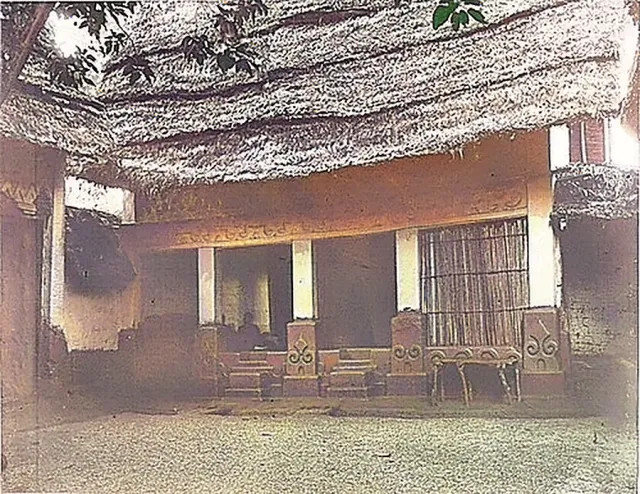 May 1931 to 1932
The funeral of Prempeh I, 1931, and the rites a year later
Aya Kesee (the great brass basin of Bantama)Agyeman Prempeh I died in May 1931, seven years after his return from exile. He had been recognised by the British only as Kumasihene. John Mack's study of royal burial under colonial rule…
Note on the sources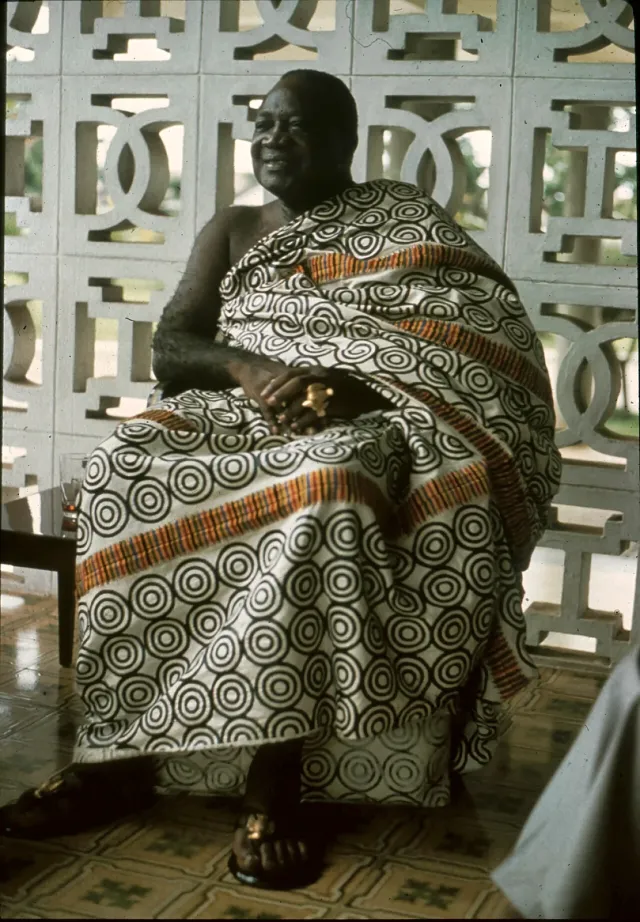 19-25 March 1999; final rites March-April 2000
The burial of Opoku Ware II, 25 March 1999
odupon atutuOtumfuo Opoku Ware II died in late February 1999. Search summaries of news reports give 19 March as the start of a week of funeral and burial rites at Manhyia. A report datelined Kumasi, 26…
Note on the sources16-19 January 2017The burial of the Asantehemaa, January 2017
dote yie (the burial rite)Nana Afia Kobi Serwaa Ampem II, mother of the reigning Asantehene and Asantehemaa since 1977, died on 14 or 15 November 2016. Search summaries of the palace's announcement give 16 to 19…
Note on the sources1-11 December 2017Ayie kese: the great funeral of December 2017, day by day
ayie kesee (great funeral); abuada (fast); adae dwoada; batakari kesie (the great war coat); kobene / kobini (red mourning cloth); awisiado (gold necklace); adosoa (procession with gifts); sura (purification); abusua kuruwa (the lineage pot)The final funeral rites for Nana Afia Kobi Serwaa Ampem II were held in December 2017, eleven months after her burial. The Kumasi Traditional Council banned other funerals and noisy outdoor…
Note on the sources7-21 August 2025The one-week observance for Nana Konadu Yiadom III, 21 August 2025
nnawotwe-da (the eighth day, 'one week'); BogyaweNana Konadu Yiadom III, fourteenth Asantehemaa and elder sister of the Asantehene, died on 7 August 2025; Graphic gives her age as 98. The one-week observance was held on Thursday 21 August…
Note on the sources14-18 September 2025Doteyie, September 2025: lying in state, filing past, and the night burial
dote yie (dote: soil; ayie: funeral); adesiedie (burial gifts); Dwabrem; Ban muDote yie, Graphic explained in 2025, joins the words for soil and funeral: it is the rite of putting the body in the ground, held before the final funeral. For a chief or queen mother it is…
Note on the sources17 August 2025Kuntunkuni Dae: an Adae kept in mourning, 17 August 2025
Kuntunkuni Dae; Akwasidae tuntum (black Akwasidae); kuntunkuni (dark mourning cloth)The sixth Akwasidae of 2025 fell on Sunday 17 August, ten days after the death of the Asantehemaa and four days before her one-week observance. It was not cancelled. It was kept as what…
Note on the sourcesEnstoolment and destoolment
What a new chief is told: the 'we do not wish' list
yempe (we do not wish); okyeame (spokesman); ka kyere no se (tell him that)Before a chief-elect took his oath, the great chiefs and captains of the state rose and, through the spokesman, told him what they would not have. Rattray gives the general list as ten…
recorded 1929Choosing the successor: the queen mother names, the elders decide
abadiakyiri (heir apparent); odehye nsi hene (a royal does not place a chief on the stool); Ko'ntire and Akwamu (the two senior commanders); asafoIn every state Rattray studied, the public form was that the queen mother named the new chief. In every state the elders said that the real choice was theirs. An heir apparent was marked…
Note on the sourcesrecorded 1929, describing the nineteenth centuryEnstoolment at Asumegya
Bosomtwe afona (the oath sword); Bose (the state song); Asantemanso; nkwankwa heneAsumegya, guardian of the grove at Asantemanso, gave Rattray one of his fullest sequences. The chief-elect was presented. The spokesman demanded a payment and he promised half. He was told…
recorded 1929, describing the nineteenth centuryEnstoolment at Bekwai
ahensie (enstoolment); Ahenboboano (the place before the chief's door); adinkra; ntwuma (red clay); hyire (white clay); peredwan (a weight of gold, about £8)At Bekwai the ceremony was held on the eighth day after the funeral, at the open place before the palace doorway; by Rattray's time a police station stood there. Messages passed formally…
Note on the sourcesrecorded 1929, describing the nineteenth centuryEnstoolment at Juaben
Ahemaho (the queen mother's place); Bosomtwuru afona; edan kesie (the great house); barim hene (chief of the mausoleum); ntanu (two units of gold, about £16)At Juaben the people assembled at sundown at the queen mother's place. The head of the palace household presented the candidate and the elders assented. The spokesman asked for sixteen…
recorded 1929, describing the nineteenth centuryEnstoolment at Kokofu, and the stone called Ahantan 'Bo
Ahantan 'Bo (the proud stone); gyadua; eto; summe leaves; asia (a gold weight, about £1 6s); adaduoKokofu's rites, as its elders gave them to Rattray, put weight on cleansing. Until the palace had been purified the chief-elect lived at the house of the deputy head of the household. Each…
recorded 1929; witnessed August 1925Enstoolment at Kumawu and Mampon
Kyenkuduase (the Ko'ntire chief's quarter at Mampon); nkwankwa heneAt Kumawu the choice lay with the two senior commanders. The oath followed about fifteen days after the death, on a Monday after a Sunday Adae; the thank-offering was paid on the Tuesday…
Note on the sourcesrecorded 1929How a queen mother was enstooled at Bekwai
ohemaa (queen mother); gyase (the palace household and its courtyard); barimfoRattray took down the procedure for installing a queen mother from the late queen mother of Bekwai, Abena Kete. The choice belonged to the Ko'ntire and Akwamu chiefs and the other elders…
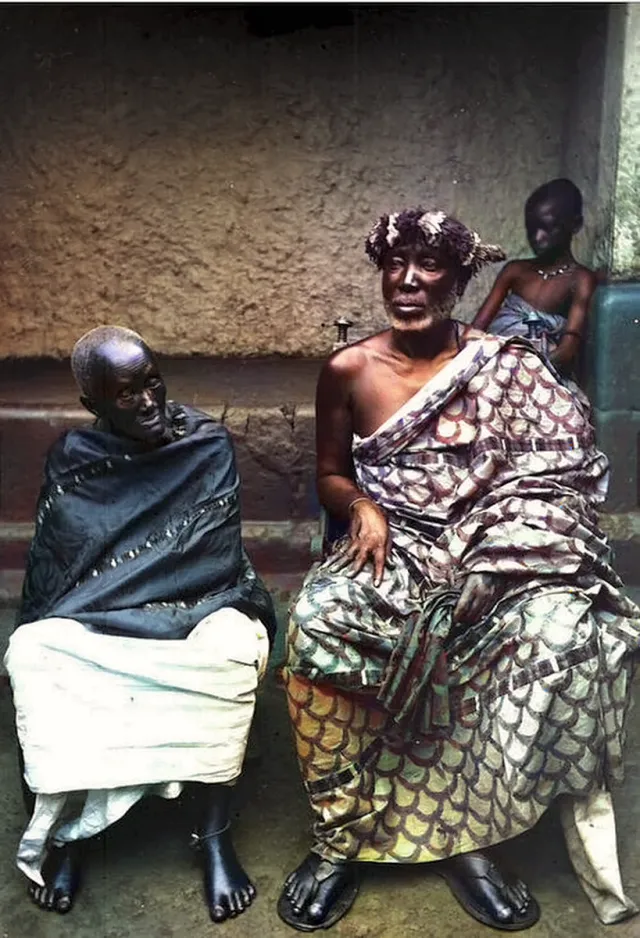 c. 1874-1883 (recorded 1929)
Swearing before the king: an eyewitness of Mensa Bonsu's court
Mponponsuo (the oath sword); Premoso (a palace courtyard); nkwankwa hene; mpereguan nsia (six peredwans); adinkraRattray obtained from an eyewitness the story of how a Mampon chief, Atakora Kwaku Kuma, swore allegiance before Asantehene Mensa Bonsu, who reigned from 1874 to 1883. The king sat in the…
Note on the sourcesrecorded 1929, describing the nineteenth centuryThe unconfirmed chief and his gifts to the king
nkwankwa hene (literally 'chief of the young men'); adamfo (friend at court)Between his enstoolment at home and his oath in Kumasi a head chief had an in-between rank. He was called nkwankwa hene and had no standing in the national organisation. Rattray says that…
recorded 1929, describing the nineteenth centuryHow a chief was removed
Rattray's states agree on the grounds for removing a chief and differ on the manner. The ground was always breach of the admonitions he had accepted, above all refusing his councillors'…
Note on the sourceseighteenth century to 1925Charges on record: why named chiefs lost their stools
The stool histories Rattray collected in the 1920s name chiefs who were removed and say why. They are the states' own memories and show what counted as a fault. Bekwai remembered three:…
Note on the sources1817Raised to a stool in 1817: fees and privileges
Bowdich's notes from 1817 add a few points about office that the later stool histories take for granted. A captain raised to a stool paid fees he puts at about eight ounces of gold. A…
Note on the sourcesAdae and the stool house
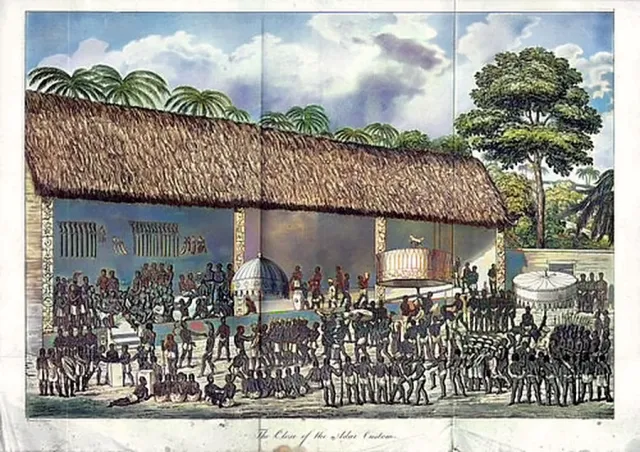
The 'Adai' customs as Bowdich saw them, 1817
AdaeBowdich's is the first description of the Adae by a visitor. He understood that the Asante reckoned their year by it, that the 'great' Adae fell on a Sunday and the 'little' Adae on a…
Note on the sourcesDecember 1870 to June 1873Adae in Kumase, 1870-1873: the missionaries' diary
AdaeRamseyer and Kuhne noted each Adae in their diary because it shaped the captives' lives: it was when they were paid. Their dates give the rhythm of the calendar in the last years before the…
Note on the sourcesrecorded 1929Rooms for the stools and the dead in a chief's palace
akonnua dan / barim dan (stool room); saman dan (room of the spirits); pato; adidi dan (dining room)Rattray drew the plan of a head chief's palace and numbered its rooms. His key shows how much of the building served the dead. One room held the chief's ancestral blackened stools; it was…
witnessed 1920s (published 1929)A rite for Komfo Anotche's stools at Agona Akyempim
mmerane (strong names, titles); abosom; hyire (white clay)Rattray closes his chapter on Komfo Anotche with a ceremony he attended at Agona Akyempim, the town that claims the priest as its own. Libation was first poured at the house of the gods…
Note on the sourcesApril 2019Awukudae today: the private 'worship' and the public sitting
Awukudae som (Wednesday worship); Bampenase; Akyeremade; BogyaweA Graphic report of April 2019 shows the two halves of an Adae as kept now at Manhyia. The occasion was the Awukudae that preceded the Adae Kese of 21 April 2019, the high point of the…
Note on the sourcesOdwira and the great festivals
The Yam Custom of September 1817, day by day
Odwira (Bowdich calls it the Yam Custom)Bowdich saw the great yearly festival of Kumase in September 1817. He explains that yams were planted in December and could not be eaten until the custom was over. Every chief and captain…
Note on the sourcesOctober 1870; December 1871; August-September 1872The yam festival in 1870, 1871 and 1872
Odwira; BosommuruRamseyer and Kuhne were in Kumase for three of the yearly festivals and their diary gives details Bowdich missed. In 1870 it began on Sunday 23 October and lasted about a fortnight. The…
Note on the sourceseighteenth and nineteenth centuries (recorded 1929)Odwira outside Kumasi: trophies, levies and first fruits
Odwira; afrihyiadie (the yearly offering); adwesase (first fruits); tu adwesase (to steal first fruits)Every head chief kept an Odwira of his own and also owed attendance and tribute at the king's. Rattray's stool histories mention it mostly in passing, as a date in the calendar of…
Note on the sourceswitnessed October 1921 (published 1923)Who may not taste the new yam: the Afahye rule
Afahye; samanfo; akrafo (soul-washers)Rattray's account of the Afahye at Ejura in October 1921 is covered in outline elsewhere in this collection. One part of it bears on custom more widely: the rule about who must…
Note on the sourcesFestivals of the states and towns
Papa Nantwi: Kumawu's festival of courage
Papa Nantwi (nantwi: cow); Nkonyafie (stool house)Kumawu's own festival honours the chief its people call Tweneboa Kodua, who by tradition gave his life before the war with Denkyira so that Asante should win. Rattray's Kumawu elders in the…
Note on the sourcesinstituted November 1995Mmoaninko: Offinso remembers a choice of land
Mmoaninko; oheneba (chief's child)Offinso's festival is recent and its founding is on record. According to the Graphic's report of the 2018 celebration, the present Offinsohene, Nana Wiafe Akenten III, and his elders…
Note on the sourcespresent; grove rites recorded 1929Nkyidwo at Essumeja and the Monday of Asantemanso
Nkyidwo; AsantemansoEssumeja (Asumegya) keeps the grove of Asantemanso, where the first ancestors of several Asante clans are said to have come out of the ground. Its festival, Nkyidwo, is held on a Monday:…
Note on the sources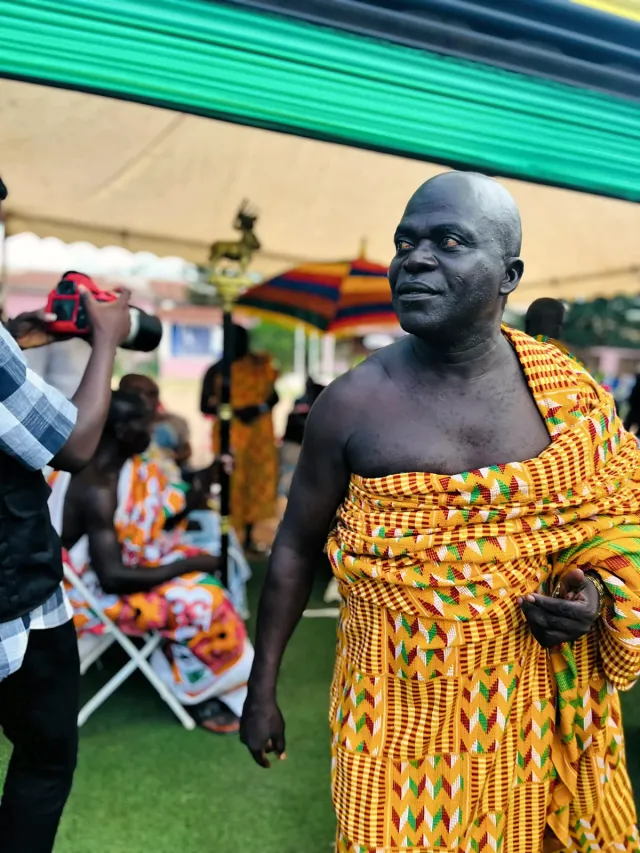 present
The Bonwire Kente Festival
kenteBonwire, the weaving town in the Ejisu area, holds a festival built round its craft. Wikipedia's entry, drawing on tourism pages and Graphic and Modern Ghana reports, describes it as an…
Note on the sourcesfrom 2000; 2006; 2016-2019The Yaa Asantewaa Festival at Ejisu
Ejisu commemorates its queen mother Yaa Asantewaa, who led the war of 1900 and died in exile in the Seychelles in 1921. Wikipedia's entry on the Yaa Asantewaa Festival, which carries the…
Note on the sourcesOaths, law and taboo
Ntam: how naming a calamity brings a case to court
ntam (the 'oath'); ntam kese (great oath); efiesem (household matters); oman akyiwadie (things hateful to the nation)The Asante ntam is called an oath in English but is not a promise. Rattray explains it from the household upwards. A person with a grievance named aloud some past disaster that had befallen…
eighteenth and nineteenth centuries (recorded 1929)The great oaths of the states and what they recall
ntam kese; Kwesida ne Mpete (Sunday and smallpox, Bekwai); Duruman (Nsuta)Rattray asked the elders of each state for its oaths and their origins. The answers are a map of each state's worst memories. Asumegya's great oath is Wednesday, traced to the war against…
Note on the sourceseighteenth century to presentThe Great Oath of Asante
ntam kese / ntamkesie; Memeneda (Saturday); KoromanteAbove every state's oath stood the king's. Bowdich heard it in 1817: oaths by the king's foot or by his father were in common use, but an oath 'by Cormantee and Saturday' was the serious…
Note on the sourcesnineteenth century (recorded 1929)An oath case in a chief's court: venue, fees and appeal
aseda (thank-offering); atitodie (head-money paid in place of death); sawa (the spoon for gold dust); okyeameThe stool histories give the working rules of an oath case as the elders remembered them from before British courts. Venue followed the oath. A case was tried in the territory where the…
Note on the sourcesrecorded 1929, describing the nineteenth centuryOman akyiwadie: the acts the nation abhorred
oman akyiwadie; awudie (murder); musuo (misfortune); sasa (the avenging spirit); atopere (the dance of death)Rattray's chapter on the gravest offences survives in the open scan only as far as its first pages, but they contain the list and the reasoning. Oman akyiwadie means things hateful to the…
Note on the sourcesrecorded 1929, describing the nineteenth centuryPae abusua: cutting a person off from the lineage
pae abusua (split off from the lineage); obi nton obi abusua (no one sells another's kin)The lineage was answerable for its members. It paid their debts, compensated those they wronged and buried them. Rattray describes the remedy a lineage had against a member who made that…
1870-1872Things forbidden in Kumase, 1871
Ramseyer and Kuhne, as prisoners at large in the capital, had to learn its prohibitions and wrote them down. Their list shows the day-to-day taboos of the king's town in the last years…
Note on the sources1817Laws an envoy wrote down in 1817
Bowdich's chapter on law is a list of rules as they were explained to him. Several concern everyday conduct and are worth setting beside later custom. Gold. To pick up gold dropped in the…
Note on the sources1817 to 1929A family's sacred day and the food it will not eat
ntoro; akyiwadee (a thing avoided)Bowdich noticed in 1817 that inland there was no common day of rest as on the coast, where Tuesday stopped the fishing. Each family kept its own day, usually the weekday of the birth of its…
Note on the sourcesFarming, hunting and the land
Before the first cut: the farmer's offering to the earth
Asase Yaa; eto; adwin and summe leaves; Yawoada (Thursday)Rattray's chapter on land in his 1923 book opens with belief, because, he says, land law cannot be understood without it. The earth is Asase Yaa, also called Old Mother Earth, and her day…
Note on the sourcesnineteenth century to 1923Giving, pledging and selling land: the acts that made it binding
tramma (the witnesses' earnest; literally cowries); awowa (pledge); nnanso (the hut built to take possession); ntiani (witness money); pon asase (redeem land)Land in Asante belonged to stools, clans and families, never outright to one person, and behind them to the ancestors. Rattray, writing in 1923, describes how rights in it were passed and…
nineteenth century (recorded 1929)The chief's share of the forest: game, snails, fish and first fruits
sere (hind leg); basa (foreleg); nwafe (snail tribute); asase wura (owner of the land); kotoko (porcupine)What a hunter, gatherer or fisherman owed to the stool was fixed by custom in each state, and Rattray's elders listed the dues among their old sources of revenue. Game. At Asumegya a…
Note on the sourcesnineteenth century (recorded 1929)Gold from the ground: nuggets, diggings and treasure trove
asikadie (gold-mining dues); abuatuo (treasure trove)Gold found in the earth was never simply the finder's. Rattray's stool histories give the rules of several states, and they turn on the difference between dust and nuggets. At Juaben every…
Note on the sourcesnineteenth century to 1945Gyadua: the tree that makes a town
gyadua (the shade tree planted in the street)A new settlement was marked by planting a gyadua, a shade tree, in its street. Rattray records this in a note to his Kokofu history, with the penalty for cutting one down, twenty-five…
Healing, protection and the unseen
The soul's day: washing the kra
kra / kraa (soul); kraa-dwaree (soul-washing); adwera (purslane); hyire (white clay)A person's kra, the soul received from God, is tied to the day of birth, and that day was kept for it. Bowdich saw the outward signs in 1817: on their own weekday people dressed in white…
Note on the sourcesrecorded 1929 and 1945Sasa: the dead who can harm
sasa; sasa bonee (evil sasa); gyabum; gyebirie (charcoal)Asante thought, as the sources record it, distinguishes the ancestor who protects from the spirit of a dead person that pursues and injures. The second is sasa. Rattray meets it in law.…
1817Beads, household gods and the priest's string: protection in 1817
abosom (gods); suman (charm)Bowdich's chapter on what he calls superstitions records some protective customs of 1817 that later writers pass over. Aggrey beads. The old glass beads dug from the ground in the south…
Etiquette, speech and dress
Manners a child was taught
ago (the call on entering); ame (the reply); etam / danta (under-cloth)Rattray's informants listed the rules of behaviour drilled into children, and they amount to a code of everyday Asante manners. Do not smoke or use a chewing-stick in front of elders. Take…
1817 to 1873Behaviour before the king, 1817-1873
Two sets of foreign visitors, half a century apart, noted the same care around the king's person. Bowdich, 1817. When the king sneezed everyone present touched forehead and breast. Boys…
nineteenth century to 1929Bared shoulder, sandals and the round of greeting
hyire (white clay); ntwuma (red clay); mpaboa (sandals)Rattray's descriptions of enstoolments and funerals carry a consistent set of bodily signs of respect. The cloth. A man lowers his cloth from the shoulder before a superior and before the…
Note on the sourcestradition of 1826; presentDansinkran: the queen mothers' haircut
dansinkran / densinkran; 'Gyese Nkran'Dansinkran is the close haircut, blackened round the edges, that marks Asante queen mothers. A Kumasi barber, Obaa Yaa of Asafo, who inherited the trade from her mother, showed a…
Note on the sources1817 to 1929Dress that showed standing, and dress that shamed
koboaka (jerkin); kadana (drawers); toma (waist beads); kwasea-nkome (the 'fool's' shaved eyebrows)Clothing in the old kingdom placed a person at a glance, and the sources give both ends of the scale. At the top, privilege was specific. Gold on the sandals was for the king and four…
recorded 1929 and 1945Sayings that carry the rules
Asante, yeware yere, yento yere; aware gu nkuro; awaree nye aware na, na ne gyae; odehye nsi hene; obi nkyere obi ase; opanyin nni fie mma asedua mfoMuch of Asante custom was carried in fixed sayings that could be quoted as authority. Rattray and Kyei cite them at the points where a rule is stated. On marriage. 'In Asante a wife is…
Rites of war and of peace
Going to war: the captains' oath
afona / afena (sword); nsafohene (captains); akwansrafo (scouts)Before an army marched, each commander swore. Bowdich was told in 1817 that a general received a gold-handled sword from the king and swore to bring it back bloodied. Rattray gives the…
nineteenth century (recorded 1929)Customs of an army in the field
boto (skin bag for food); sumankwafo (charm-men, healers); ntumpane (talking drums); dumpiafo ('pushers')Rattray's chapter on war lists what changed when the army was out. Law was suspended in one respect: no oath cases were heard for the length of the campaign. Chiefs and soldiers stopped…
nineteenth century (recorded 1929)Trying a defeated general, alive or dead
epo (treason); asedaWar was understood in the terms of law, and it ended in a court. Rattray records that a captured enemy general was almost always put to death, but only after trial. If he had fallen in the…
July to September 1871The army comes home, 1871
Ramseyer and Kuhne watched the return of Adu Bofo's army from the eastern campaign and noted the forms in which a victory was presented to the capital. The first parties came in early…
January to May 1873Asking the gods about the war, 1873
akomfo (priests)As the army went down to the coast in 1873 the king turned to the gods, and the missionaries in Kumase recorded what they saw and heard. Early in the year he called the priests together to…
Note on the sourcesnineteenth century (recorded 1923-1929)Making peace and binding allies: drinking the gods
nom abosom (to drink the gods); mpata (pacification)The oath on a stool's forbidden word bound a subject to his own chief. To bind someone who stood outside that tie, Asante used a different act: both sides 'drank the gods'. Rattray's Nsuta…
Custom today
Councils against costly funerals, 2008-2026
asiedee (burial items); adekyere (the parading of items); sode (parents losing a child for the first time)No single rule on funerals for the whole of Asanteman was found in this research. What the record shows is a series of traditional councils acting for their own areas, each against the same…
2003 to 2022Widowhood rites under challenge
kunayeThe rites a widow keeps have been criticised from inside and outside Asante for at least two decades, and one Asante council has abolished them. The National Commission for Civic…
2017 to 2025When the palace mourns or celebrates, other funerals stop
One present-day rule is applied across Asanteman with full force: funerals of ordinary people give way to those of the royal house, and in some states to the state festival. In December…
Note on the sources2014 to 2026Customary marriage today: 'engagement', hired spokesmen and the old core
aware pa (proper marriage); okyeame (spokesperson); tiri nsaThe formalities Kyei recorded in 1945 are still the legal heart of an Asante marriage, but the event built round them has changed, and people who care about custom have begun to say…