History › The army and its wars
Wars and campaigns
Every war and campaign from the founding to 1900, battle by battle: the causes, the commanders, the numbers each side claimed, the outcome and what it changed. Most of the written accounts come from men who fought against Asante, and are read with that in mind.
103 sourced entries · every source listed
The army and how it fought
 c. 1690s - 1900
'Dane guns', powder and the limits of the musket
The Asante soldier's weapon was the long flintlock trade musket, known on the coast as the Long Dane. Fuller's informants thought that at the start of the Denkyira war fewer than three men…
c. 1700 - 1900The order of march and battle: scouts, van, main body, wings and rear
akwansrafo (scouts), twafo (advance guard), adonten (main body), nifa (right wing), benkum (left wing), kyidom (rear guard), gyaase (household / bodyguard), ankobea (those who stay at home: the king's guard)An Asante army marched and fought in a fixed order. Sources that summarise Tordoff, Arhin and Edgerton list six parts: the akwansrafo or scouts, the twafo or advance guard, the adonten or…
Note on the sources18th - 19th centuryNo standing army: how the states mustered
kosa-ankomi (one who dodges the fight)Asante kept no standing army. Manuel Manu-Osafo, writing in the Journal of African History in 2021, describes the army as raised afresh for each war under an unwritten bargain: subjects…
18th - 19th centuryWar medicine, oracles and the charm-covered war coat
batakari kese (great war smock), nsumankwaafo (medicine men / army doctors), mmomomme (women's war chants)Spiritual protection was part of the army's equipment. The best-known sign of it is the batakari, the northern-style smock sewn all over with leather and metal charms, which a commander…
c. 1700 - 1900Who commanded: the Bantama and Asafo stools, Mampon, and the king
Krontihene (commander of the Kumase force; the Bantamahene), Akwamuhene (second war chief; the Asafohene)Command in the field belonged to particular stools. In Reindorf's order of battle for the Denkyira war the two Kumase generals are Amankwatia Panyin, called the Koronti general, and Asafo…
Note on the sources1701 - 1900How big was the army? The numbers and who gave them
Every figure for the size of an Asante army is a guess by someone with a reason to make it large. Reindorf, from tradition, gives 60,000 Asante at Feyiase and makes Anokye prophesy against…
Note on the sources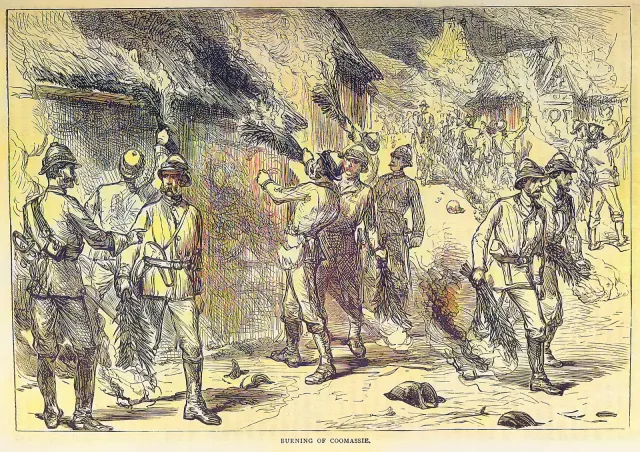 1701 - 1873
Heads, jawbones, captives and tribute: what victory brought
Victory was measured in heads, people and gold. The heads of enemy kings were taken, smoked and brought to Kumase; Fuller lists gold casts made of the skulls of Ntim Gyakari of Denkyira, an…
 1718 - 1874
War oaths: 'do not come back without him'
ntam (oath)A general took the field under oath. Manu-Osafo describes chiefs swearing before the Asantehene that they would not turn back until the object of the war was gained, an oath whose breach…
18th centuryAn army on foot: horses, bowmen and the savanna
Asante fought on foot. Summaries of Robin Law and John Thornton say that horses reached Asante in the eighteenth century and that officers might ride, but that no cavalry arm was formed;…
1742 - 1900Death before capture: commanders who killed themselves
Across the Akan world a beaten commander was expected not to survive his defeat, and the usual way was to sit on a keg of powder and fire it, or to shoot or poison oneself. The cases below…
Note on the sources 18th - 19th century
Discipline: sword-bearers behind the line
afenasoafo (sword-bearers), dompefo (those who push the army on)Discipline in the field was harsh and it was enforced from behind. Fuller lists the punishments of an Asante court-martial as death, loss of rank and fines, and says that cowardice, dodging…
1807 - 1874Supply, roads and the two great killers: hunger and smallpox
An Asante army carried little and lived off the country. Slaves and carriers followed the main body with loads, and summaries after Edgerton mention smiths, carpenters, food sellers and…
1816 - 1873Coming home: the forty days, the swords and the king's foot
Mponponsuo, Ahwihwibaa, Gyapetia, Akumfena (state swords, in Fuller's spelling Mpomponsu, Ahwihwiba, Japetia, Akunfona)An army did not simply walk back into Kumase. Fuller describes the state entry that ended Amankwa's long southern campaign in 1816. All captives, treasure and loot were sent into the town…
Wars of the founding (to 1717)
The Doma wars of Oti Akenten and Obiri Yeboa
The first wars remembered for the Oyoko of Kwaman were fought against the Doma (Dormaa), who then lived close to the site of Kumase. Fuller's version, taken from Asante elders, begins with…
Note on the sourcestradition; 1680s - 1690sOsei Tutu's first campaign: revenge on the Doma
Osei Tutu's first act as ruler, in both Fuller's and Reindorf's tellings, was to avenge his uncle. Fuller names the Doma chief as Odamara Kwesi and says his forces were routed; Reindorf…
Note on the sourcestradition; 1680s - 1690sAmakom, Tafo and Offinso: the neighbours brought in
Before the war with Denkyira, Osei Tutu fought the towns nearest to Kumase one after another. Fuller and Reindorf give the same three, in the same order. First came Akosa of Amakom, who was…
Note on the sources1699 - 1701 (Bosman); tradition undatedThe Denkyira war: what each account says started it
Kwaman and its allies paid tribute to Denkyira, the strongest inland state, and the war that made Asante began as a refusal. The sources give several causes that are not exclusive. Fuller's…
Note on the sources1701The two armies at Feyiase, as tradition lists them
Reindorf preserves a full list of commanders on both sides, the earliest Asante order of battle on record, though written down nearly two hundred years later. For Asante the van was under…
Note on the sources1701Adunku, Aputuogya and Feyiase: the course of the fighting
The Denkyira army came north and the Asante drew it on. Fuller gives three engagements. At Edunkum, between Asumegya and Ejumum, the Denkyira advance guard was lured northward. Near Jachi…
Note on the sources1701The death of Ntim Gyakari and Dwaben's bracelet
Ntim Gyakari did not die fighting. Both Fuller and Reindorf say he was surprised by Adakwa Yiadom, a Dwaben man, and cut down; Fuller says he was eating, Reindorf that he was playing a…
Note on the sources1701 - c. 1702After Feyiase: the Elmina 'Note', the cannon and Mampon's silver stool
The victory was followed up. Reindorf says Denkyira was plundered for fifteen days, thousands were taken prisoner and much gold was carried off. Fuller's elders spoke of a second phase…
Note on the sources1717 (Fynn); tradition says c. 1730-31The Akyem wars and the ambush at the Pra
Koromante, Memeneda (the great oath recalling the king's death)Akyem had helped Denkyira, and Osei Tutu turned on it next. Reindorf dates a first war to 1700: two bloody battles, the capture of the Akyem leader Ofosuhene Apenteng, whose effigy was…
Note on the sources1717 - 1718Ebirim Moro sacks Kumase; Amankwatia hunts him down
While the army was away in Akyem, a western king fell on the undefended capital. Fuller calls him Ebirim Moro, king of the Sefwi; Reindorf calls him Abirimoro of Sefwi and Wassa; Fynn, from…
Note on the sourcesWars of expansion (1717-1800)
The Techiman war and the trick of the buried guns
The conquest of Bono, whose capital by then was Techiman, is told by both Fuller and Reindorf as a war won by a stratagem. The agent was Bafo, the Amakom man who had fled to Techiman a…
Note on the sources1730The fall of Akwamu in 1730: was Asante involved?
Akwamu, the eastern power that had sheltered the young Osei Tutu and sent men to Feyiase, was destroyed in 1730, but not by Asante. J. K. Fynn's account, as given in the Encyclopaedia…
Note on the sources1732 - 1745Opoku Ware in the north: Gonja, Krupi and the eastern savanna
The northern conquests are known from two kinds of source that do not fit neatly together. The Arabic chronicle of Gonja, the Kitab Ghanja, written by Muslims of the region, is the basis of…
Note on the sources1740 (also given as 1732)Abo Kobina of Gyaman and the first rival golden stool
Gyaman, founded by Doma refugees, grew rich at Bonduku on the trade to Kong. Fuller's account of the war is that its ruler Abo Kobina had joined the Muslims of Bonduku, claimed the standing…
Note on the sources1741 - 1742The Akyem war of 1742: the battles on the Benna
Reindorf, whose Ga and Akyem informants knew this war well and who also used the Danish writer Romer, gives the fullest account. Opoku Ware declared war in 1741 after the Akyem king Ba…
Note on the sources1744-45; early 1770sYendi and the 'tribute in slaves': four versions
What happened between Asante and Dagbon is told four ways. Reindorf places it under Opoku Ware: the Ya Na submitted after a short struggle in which Koranten Pete, commander of the Asante…
Note on the sources1740s (tradition)The march along the Volta: Yeji, Atebubu and a general fined
Reindorf closes Opoku Ware's reign with a sweep through the country between the Pru and the Volta, and the details show how such a campaign was parcelled out among chiefs. The ruler of Yeji…
Note on the sources1750 - 1764Kusi Obodom and the southern coalition, 1750-1764
Kusi Obodom's reign began with fighting inside Asante. Fynn says he was put on the stool by the Kumase war chiefs after a disputed succession and that his rival Darko was defeated and…
Note on the sources1764The ambush beyond the Volta, 1764
The heaviest defeat Asante suffered before 1826 happened east of the Volta. According to Fynn, Akyem called in the Yoruba power of Oyo. The Asante army beat down Akyem resistance, pushed…
Note on the sources1765 - c. 1772Osei Kwadwo's southern wars: Akyem 1765, the Fante quarrel and Krobo
Osei Kwadwo, known as Okoawia, 'he who fights at midday', restored the army's standing within a year. Fynn's account is that in 1765 Asante and Fante forces moved together against the…
Note on the sourcesc. 1765 - 1777Wassa and Kotoku: two short punitive wars
Okoawia (he who fights at midday)Two smaller wars of Osei Kwadwo's reign are remembered by a trophy and by a name. Wassa, in the south-west, had been at odds with Asante since 1726, when, Fynn says, an intermittent war…
c. 1770sThe Banda war and the head of Worosa
Worosa-ti (the sword bearing the cast of Worosa's head)Banda lay north-west of Asante on the road to Bonduku and Kong. Fuller and Reindorf agree on the outline of the war. Asante traders were killed in Banda country by order of its king,…
Note on the sourcesc. 1770sMampon against Dwaben: a civil war inside the union
The two greatest states after Kumase fought each other in Osei Kwadwo's time. Reindorf says the Mamponhene Atakora Maniampon met the Dwabenhene Akuamoa Panin near Namonsi, in the north-east…
Note on the sourcesc. 1777 - 1798Osei Kwame's reign: Assin, the south-west and the end of Owusu Sekyere
Osei Kwame came to the stool as a boy and his wars were fought by others. Wilks lists campaigns in the south-western provinces in 1785 and in the north-west in the 1790s, without naming…
Note on the sourcesc. 1798 - 1803The north-western rising for Osei Kwame and the battle of Kaka
Osei Kwame's fall set off the last war of the eighteenth-century empire. Wilks's account is that after the death of the heir in 1797 the king was accused of poisoning him, fled to Dwaben,…
Note on the sourcesWars on the coast (1800-1831)
The Assin crisis: a robbed grave and two runaway chiefs
The first Asante invasion of the coast grew out of a lawsuit. Assin, on the road between Kumase and the sea, was divided between chiefs. In Fuller's account, in 1805 a subject of Kwaku…
1806 - June 1807Appia Dankwa's advance and the destruction of Abora, 1806-07
The campaign had two stages. First the general Appia Dankwa, whom Fuller calls the Nantahene, went ahead. He beat the Fante in two engagements near Abora and captured a Fante leader, Atta,…
Note on the sourcesJune 1807Fort Amsterdam at Kormantin opens its gate
The first European post the Asante army reached in 1807 was Dutch. Fuller says the advance guard, led by the king of Denkyira, a tributary serving in the Asante army, came to Fort Amsterdam…
Note on the sources15 - 16 June 1807The attack on Anomabo fort, 15-16 June 1807
Anomabo fort was held by a handful of the African Company's men. Fuller, following the account of Henry Meredith who was there, counts twenty-nine, including four officers and four free…
Note on the sourcesJune - October 1807Torrane's bargain, Tsibu's death and the smallpox retreat
Colonel George Torrane, governor at Cape Coast, came to Anomabo to treat with Osei Bonsu, and the two were reconciled by 25 June according to a summary after McCaskie. The price was the…
1811 - 18121811: Opoku Frefre in Akyem, Akuapem and at Ada
In 1811 the Fante attacked Elmina and Accra, both friendly to Asante, and two armies were sent to help them. The larger, said by Fuller to number 25,000, was given to the Gyaasewahene Opoku…
Note on the sources18111811: Appia Dankwa's column and the death of Atta
The second army of 1811 was small, about 4,000 men in Fuller and 6,000 in Reindorf, and was led by Appia Dankwa, the general of 1806. Its task was to reach Elmina and relieve the pressure…
Note on the sources1814 - 18161814-16: Amankwa's two-year campaign and the two heads
In 1814 Osei Bonsu set out to finish with Akyem and Akuapem. The command went to a general Fuller calls Amankwa and Reindorf Amankwa Abunyawa, with 20,000 men in Reindorf's figure; Appia…
Note on the sources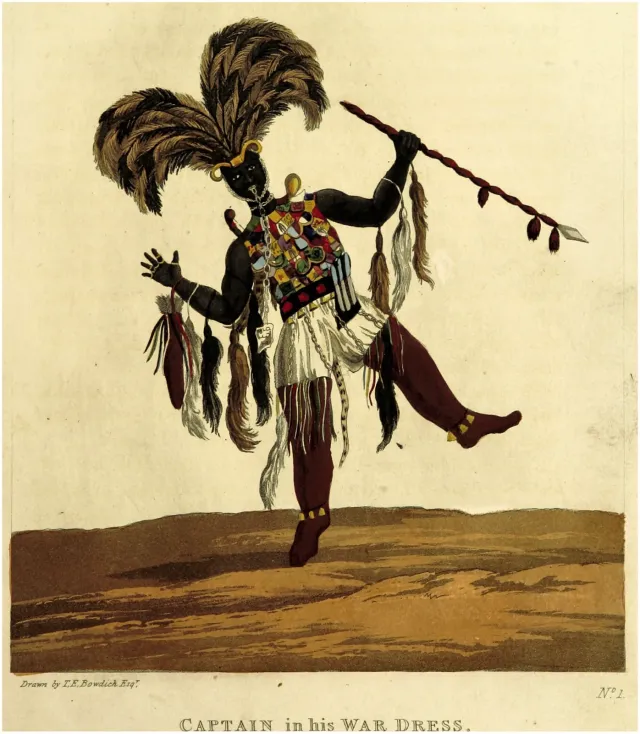 1818 - 1819
The Gyaman war of 1818 and the death of Adinkra
Kwadwo Adinkra of Gyaman repeated the offence of Abo Kobina. Fuller says he had a golden stool made, gave up a first one, then made a second and, when it was demanded, replied that his…
Note on the sourcesMay 1822 - June 1823The sergeant at Anomabo and the ambush near Dunkwa, 1822-23
War with the British began over an insult. In May 1822 a mulatto sergeant of the garrison at Anomabo, whom Reindorf names as Kwadwo Otetefo, abused the Asantehene in a quarrel with an…
Note on the sources1823Kwadwo Tibu of Denkyira breaks away
The man who did most to bring the south-west over to the British was Kwadwo Tibu, king of Denkyira, whom Fuller calls Kudjo Otibu. Reindorf tells his story at length. Tibu was accused in…
 21 January 1824
Nsamankow, 21 January 1824
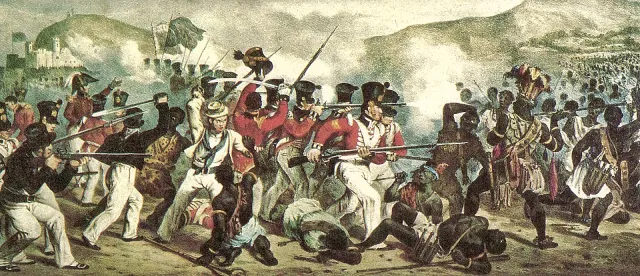
Bonsaraso (Fuller's spelling of the Asante name for the battle)MacCarthy heard that the Asante were coming south in twelve divisions and divided his own force into four. On 21 January 1824 he was alone with the smallest part beside a stream in Wassa…
Note on the sources1824 onwardsMacCarthy's head: what is said and by whom
The fate of Sir Charles MacCarthy's head is one of the best-known stories of the wars, and it should be read as a set of reports and not as an established fact. Fuller, who governed Asante…
Note on the sources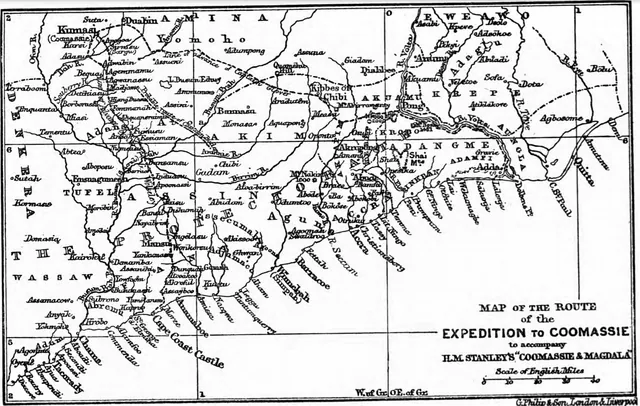 April - August 1824
Dompim, Efutu and the lines before Cape Coast, 1824
The victory at Nsamankow was not followed at once by an advance. A truce was arranged and Williams was released in March. Then Tibu of Denkyira crossed the Pra to attack; on 25 April he and…
Note on the sourcesJuly - 7 August 1826Katamanso: the two armies on the Accra plain
Akantamansu (the Asante name)Osei Yaw Akoto came south again early in 1826 to punish the peoples who had deserted to the British, and above all the Ga of Accra. By late July his army lay on the open plain north of…
Note on the sources7 August 1826Katamanso, 7 August 1826: the fight and the rockets
Fuller has the Asante attack begin about half past nine and run from right to left along the line; a modern summary gives nine hours of fighting, from six to three. The king led the centre…
Note on the sourcesAugust 1826 - early 1827Katamanso: the dead, the lost treasure and the Golden Stool
The loss among the Asante leadership was the worst in the kingdom's history to that date. Fuller says about seventy of the great chiefs were thought to have been killed; Reindorf says about…
Note on the sources1827 - 27 April 1831From Katamanso to the treaty: four years of blocked roads
Peace took nearly five years. The Asante proposed a meeting in Assin in January 1827. At Cape Coast in October 1827 terms were set: 4,000 ounces of gold to be lodged as security and…
Note on the sourcesMid-century wars (1831-1872)
Kumase against Dwaben: Boaten's flight to Akyem
Katamanso left a quarrel between the king and the Dwabenhene Kwasi Boaten, who had recovered the stool and, his enemies said, kept the lost treasure. Reindorf says Osei Yaw was jealous of…
Note on the sources1841 - 1853Kwaku Dua I: a war in Gonja and three wars refused
Kwaku Dua I had fought against Gyaman in 1818-19 and commanded a division at Katamanso, where he was wounded, and as king he was sparing of war. Wilks records one large campaign. In 1841…
March - June 18631863: three columns and Owusu Koko's two canes
The war of 1863 began when Governor Pine refused to give up Kwasi Gyani, a fugitive from the king's justice whose story is told in the first pass of this project. A special envoy failed,…
Note on the sourcesJanuary - mid 18641864: the camp on the Pra and 'the bush is stronger than the cannon'
The British reply to the invasion of 1863 was to prepare a march on Kumase, and it failed without a shot. Fuller's outline is that a camp was formed at Manso in January 1864, a stockade was…
Note on the sources1867 - June 1869Across the Volta, 1868-69: Anum, Ho and the missionaries
East of the Volta Asante had allies in Akwamu and the Anlo, and enemies in the Ewe states the coast called Krepi. Fuller records an army marching against the Krepi early in 1867, and Fynn…
Note on the sourcesJune 1869 - mid 1871Dompre's resistance and a campaign that would not end
What was meant as a short reoccupation became two years of bush fighting, largely because of one man. Dompre was an Akyem war leader who took up the Ewe cause. Fuller says he led the Krepi…
Note on the sourcesJuly - September 1871The cost counted: Adu Bofo's army comes home, 1871
Ramseyer and Kuhne watched the return from inside Kumase, and theirs is the only eyewitness record of an Asante army's homecoming from a long war. The trophies came first. On 3 July 1871…
1868 - December 1872The Elmina question and the council that chose war
Asante's claim to Elmina went back to the Note taken from Denkyira in 1701, and the town was its one sure outlet for guns and powder. When Britain and the Netherlands exchanged forts in…
Note on the sourcesThe war of 1873-74
December 1872 - January 18731873: three columns and the crossing of the Pra
The plan of 1873 was the plan of 1863 on a larger scale. Fuller gives it in detail. Kofi Bentuo, chief of Marawere, with two to three thousand men was to move south-east and hold the Akyem.…
Note on the sourcesFebruary - June 1873Nyankumasi, Dunkwa and Jukwa: the victories of early 1873
For five months the Asante army beat every force put in front of it. Fuller's sequence runs as follows. On 9 February 1873 it attacked a hastily gathered allied camp at Assin Nyankumasi and…
Note on the sourcesJune 1873Elmina, 13 June 1873: the bombardment and the repulse
Elmina was the object of the war for many in Kumase, and its people had not accepted the transfer to Britain. After the rout at Jukwa between fifteen and twenty thousand people from the…
June - October 1873The camp at Mampon: hunger, sickness and a quarrel over orders
From June to October 1873 the army lay in a huge camp at Mampon, inland from Cape Coast and Elmina, and wasted. Fuller, who saw the ground described by those who entered it, says the camp…
Note on the sources2 October - 7 November 1873Essaman and Abakrampa: the tide turns, October - November 1873
Sir Garnet Wolseley landed at Cape Coast on 2 October 1873 with thirty-six staff officers and no army. Fuller says the West India troops on the spot numbered six or seven hundred, about…
Note on the sources7 - 30 November 1873; return 22 DecemberThe retreat to the Pra and Asamoa Nkwanta's rearguard
Srafokra (soul of the army, the name given to Asamoa Nkwanta)The retreat was the best-handled part of the campaign. Fuller calls it clever: Amankwatia fell back through Ainsa and cut his own path through the bush, reaching Nsuta on the main road on…
Note on the sources2 - 29 January 1874January 1874: terms, hostages and a new commander
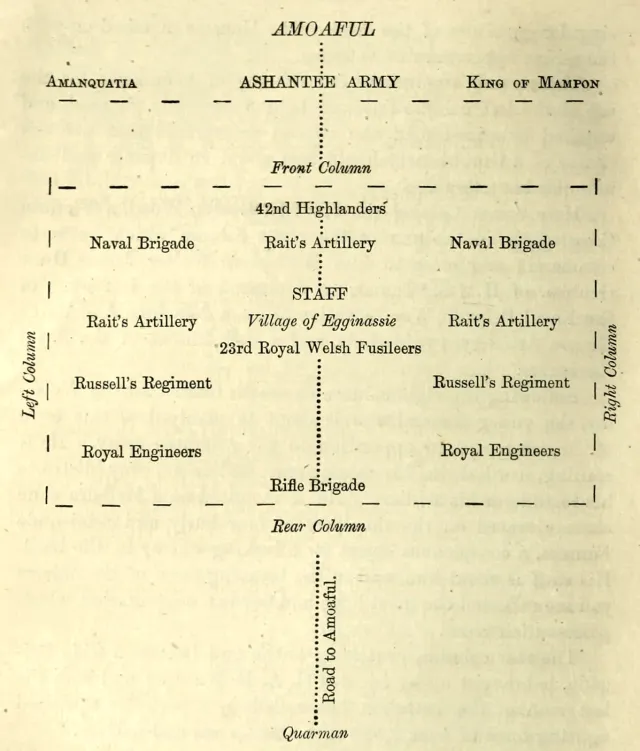
British battalions landed in December: the 23rd Fusiliers, the 42nd Highlanders, a battalion of the Rifle Brigade and engineers, with the 1st West India Regiment from Jamaica. Wolseley was…
Note on the sources29 - 31 January 1874Borborassi and Amoaful, 29 - 31 January 1874
The Asante plan was the old one: fall back, let the enemy into the forest, hold him in front and close the wings. On 29 January Colonel McLeod surprised the Adanse force at Borborassi and…
Note on the sources31 January - 4 February 1874Bekwai, the Oda and Odaso: the last four days
On the afternoon of Amoaful the Naval Brigade destroyed the town of Bekwai. On 2 February the column moved to Agyemamu and on the 3rd to the Oda river, skirmishing all the way. The…
Note on the sources5 - 13 February 1874The burning, Glover's march and the reckoning
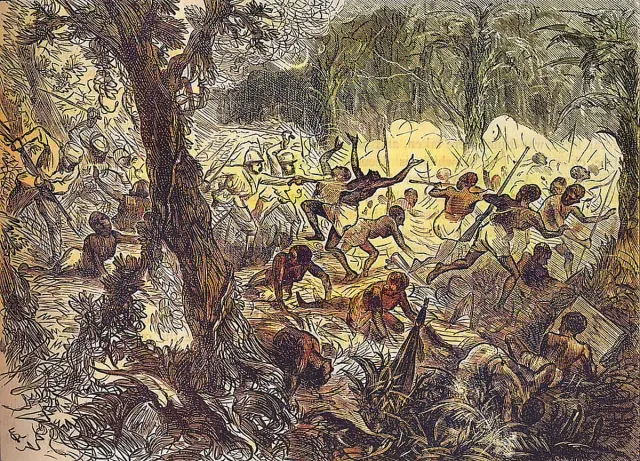
Wolseley could not stay: the rains were beginning and his sick list was growing. He wrote to the king, received no submission, and had the town set on fire and the stone palace blown up…
Note on the sourcesCivil wars (1874-1896)
1874 - 1900Why the army could no longer be raised: one historian's argument
Manuel Manu-Osafo's article of 2021 offers an explanation for the military collapse that does not rest only on British weapons. The Asante army, he argues, had always depended on consent…
October - 3 November 1875The Dwaben war of October - November 1875
Dwaben had stood aside in 1874 and made its own peace with Glover. The Encyclopaedia Africana entry by Adu Boahen says Kumase saw this as betrayal; it explains the abstention chiefly by a…
Note on the sources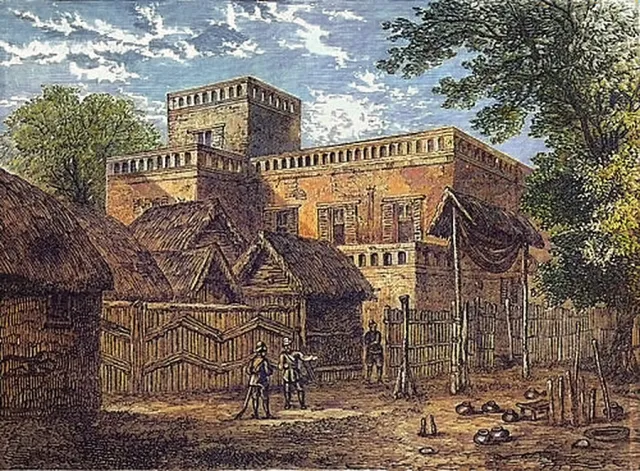 February 1883 - June 1884
1883-84: the overthrow of Mensa Bonsu and Kofi Karikari's last fight
The civil wars began in Kumase itself. Fuller records a first crisis in 1882, when a plot touching the Bantamahene Awua led to executions and Awua's escape. In February 1883 the Kumase…
Note on the sourcesApril - June 1886Adanse and Bekwai, 1886: a whole people crosses the Pra
Adanse, the old southern state through which the great road ran, had been declared independent of Kumase by the treaty of Fomena in 1874. Its neighbour Bekwai remained one of the strongest…
March - mid 18881888: Kokofu's war and the death of the Bantamahene
The choice of a king was finally forced by arms. Two candidates stood: the boy Agyeman Prempe, whose mother was the queen mother Yaa Akyaa, and Yaw Atweneboana. A summary of the scholarship…
Note on the sources1888 - 1889Mampon and Nsuta defeated: the pursuit to Ejura
With Kokofu gone the opposition's strength lay in the north-east, in Mampon and Nsuta. Fuller says the Mamponhene, whom he calls Akwessi Sechere, attacked Ejisu, one of Prempe's supporters.…
Note on the sources1892 - December 1893The Nkoranza war, 1892-93, and the British at Atebubu
Nkoranza, the state founded by Bafo and rewarded after the Techiman war, was the last to defy Prempe. Fuller says its chief refused claims that Mampon made on it, and that an Nkoranza…
Note on the sources1896 and the war of 1900
 December 1895 - 22 January 1896
January 1896: an invasion without a battle
The British expedition of 1895-96 met no resistance at all. Its advance guard was at Praso on 3 January 1896. Sir Francis Scott commanded; Major Baden-Powell led a levy of coast men and…
Note on the sourcesMarch - April 1900The search for the stool and the first shots, 31 March - 2 April 1900
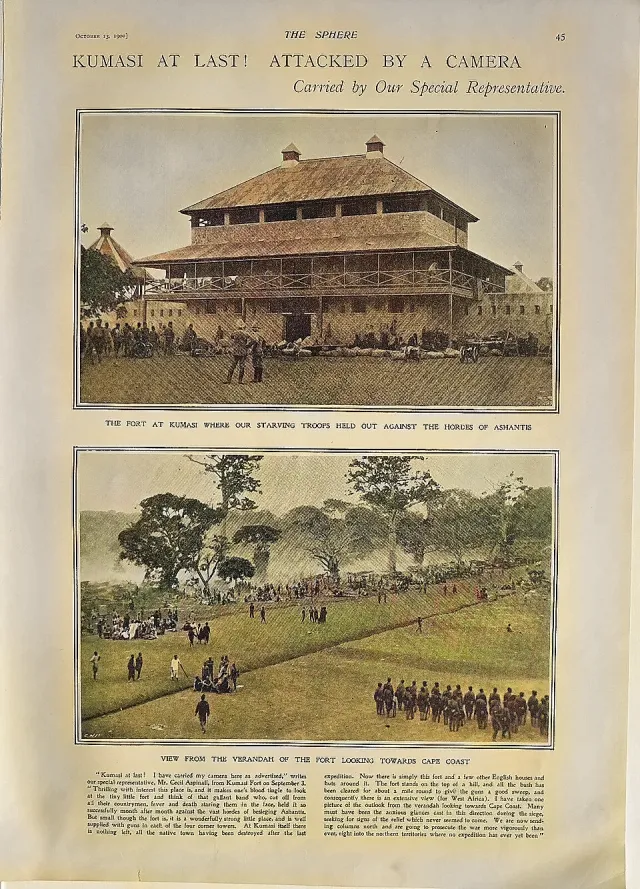
The war of 1900 began with a search party. A fort had been built in Kumase and there had been small outbreaks at Berekum and Agona in 1898-99. Between December 1899 and February 1900…
Note on the sources23 April - 15 May 1900Kumase shut in: Fumesua, Asago and the armistice
The fort was not attacked so much as fenced off. On 23 April a detachment under Captain Marshall, with Captains Middlemist and Bishop and Dr Hay, went out and was caught at Fumesua. Three…
Note on the sources23 June - July 1900The governor's escape, 23 June 1900
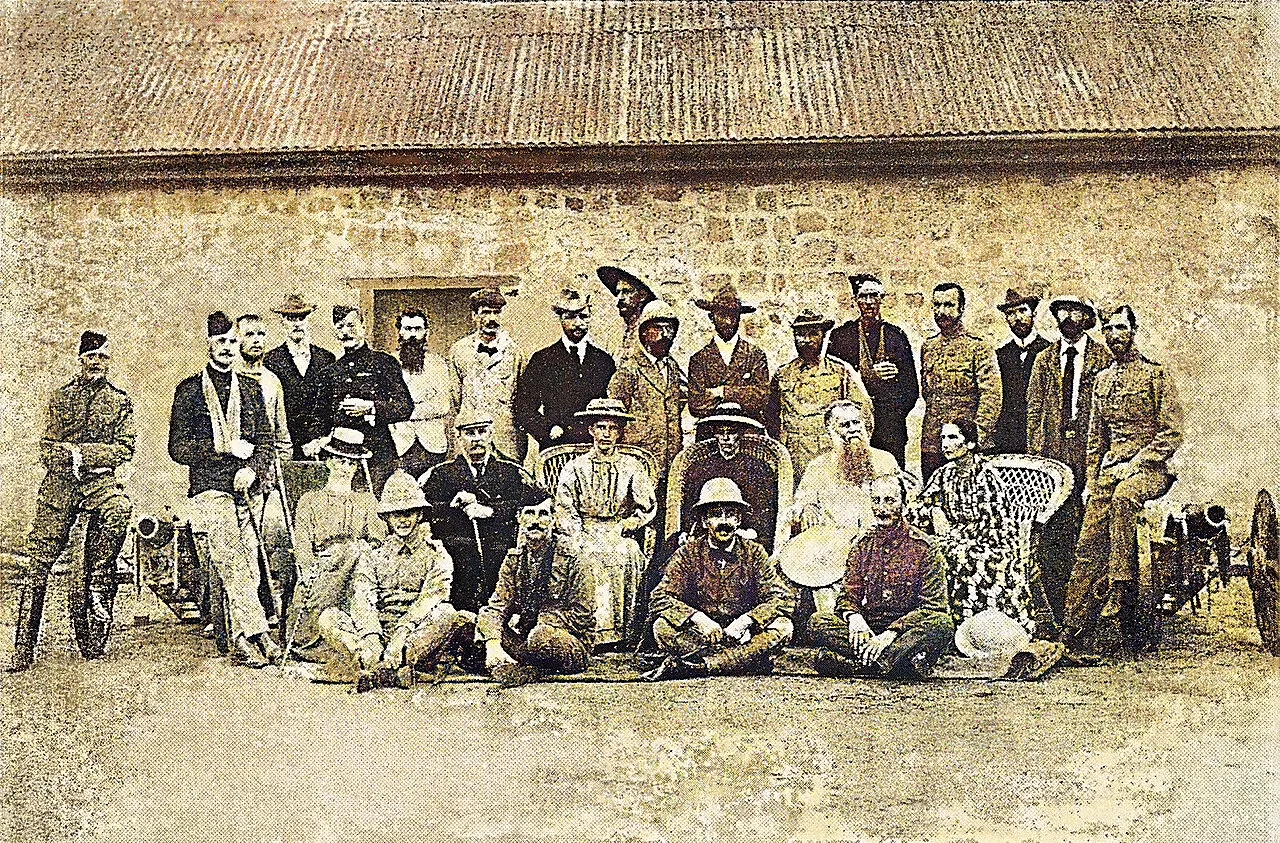
By mid-June food was nearly gone. The governor decided to break out with everyone who could march and leave a small party to hold on. On 23 June Hodgson, Lady Hodgson and the main body left…
Note on the sourcesMay - July 1900Dompoase, Kwisa and the repulse at Kokofu
The relief force had to fight its way up the main road through Adanse and past Kokofu, both of which had joined the rising. Colonel James Willcocks landed on 26 May with orders for 1,400…
13 - 15 July 1900The relief of the fort, 13 - 15 July 1900
Willcocks left Bekwai on 13 July with 60 Europeans, 1,000 soldiers, two 75-millimetre guns, four seven-pounders and six Maxims, and took the village of Treda on the way. On 15 July the…
Note on the sources22 July - September 1900Kokofu, Adanse and Ejisu fall; a column fails at Boankra
After the relief the war became a series of attacks on war camps. On 22 July Lieutenant-Colonel Morland went against Kokofu with 800 men; Major Melliss rushed the stockade and the town was…
Note on the sources21 September - 25 November 1900Aboaso, 30 September 1900, and the last pursuit
On 21 September Major Montanaro had a sharp fight at Odanasi, which ended with a bayonet charge and the surrender of Offinso chiefs. The remaining Asante force, about 5,000 by Fuller's…
Note on the sources1900 - 19011900: who led, what it cost and who was punished
The leadership of 1900 was a council of chiefs, not a single command. Yaa Asantewaa, queen mother of Ejisu, is named in British despatches as the influence that kept men in the field; Adu…
Note on the sourcesCommanders
Amankwatia Panin, first war chief of Kumase
Bantamahene, KrontiheneThe stool of Bantama, whose holder is the Krontihene or commander of the Kumase army, traces itself to Amankwatia Panin, 'the elder'. He appears twice in the traditions read for this…
Note on the sources1701 - 1888The Mamponhenes: commanders of the right and makers of kings
Mamponhene; holder of the silver stoolThe chief of Mampon was, in Fuller's words, one of the two men to whom the supreme command went in a great war, and his stool, the silver stool, ranked next to the Golden Stool. Fuller's…
Note on the sourcesc. 1744 - 1830sKoranten Pete and the generals of the van
Adontenhene (commander of the main body)The Adonten stool of Kumase supplied the commander of the centre, and in the eighteenth century its holders made the northern province of Dagbon their particular charge. Reindorf names…
Note on the sourcesc. 1760 - 1826Opoku Frefre: treasurer, general and founder of a military family
Gyaasewahene (head of the palace household and treasury); frefre (nimble)Opoku Frefre rose from nothing. A biography drawing on Wilks, McCaskie and the Dictionary of African Biography says he was born about 1760 at Anyatiase near Lake Bosomtwe and served as a…
Note on the sources1701 - 1885The Dwabenhenes at war: Akuamoa, Boaten and Asafo Agyei
DwabenheneDwaben supplied the union with soldiers second only to Kumase's, and its rulers' quarrels with Kumase were fought out in arms three times. The claim began with Adakwa Yiadom, the Dwaben man…
Note on the sources18th - 19th centuryCommanders named in tradition but not traced here
Several men who belong in any list of Asante commanders could not be given a biography from the sources opened for this record, and it is better to say so than to fill the gap from memory.…
fl. 1806 - c. 1815Appia Dankwa, general of the coast road
Appia Dankwa is the first Asante general the coast knew by name. Fuller gives his office as Nantahene, which is probably the Ananta stool, one of those from which he says lesser commands…
Note on the sourcesfl. 1814 - 1816Amankwa Abunyawa, the general of 1814-16
The commander who finished the Akyem and Akuapem war under Osei Bonsu is called simply Amankwa by Fuller and Amankwa Abunyawa by Reindorf; in a later chapter Reindorf's text also has the…
Note on the sourcesfl. 1863 - 1874Owusu Koko and the campaign of 1863
Owusu Koko commanded the main body of the army that entered the Protectorate in 1863, the only large operation of Kwaku Dua I's later years. Fuller's narrative shows a careful general under…
Note on the sourcesfl. 1867 - 1874Asamoa Nkwanta, 'Srafokra', the soul of the army
Anantahene; Srafokra (soul of the soldiers)Asamoa Nkwanta held the Ananta stool and was the most respected soldier of his generation; Fynn calls him the veteran war lord who trained Amankwatia. He first appears in Fuller at the…
Note on the sourcesd. 1883Adu Bofo, keeper of the keys and leader of the war party
GyaasewaheneAdu Bofo was a son of Opoku Frefre and held his father's office of Gyaasewahene; a European in Kumase in the 1870s described him as keeper of the keys, treasurer and likely commander of the…
Note on the sourcesc. 1833 - 31 January 1874Amankwatia of 1873: the general who swore not to return
Bantamahene, KrontiheneJ. K. Fynn's biography says he was born about 1833 at Akrofuom in Adanse, of no great family; a contemporary called him a creature of the king whose ancestry nobody troubled about. He…
Note on the sourcesfl. 1875 - 1888Awua of Bantama: victor of 1875, victim of 1888
BantamaheneKobina Awua, whom Fuller writes Ewua, was Bantamahene by 1875, and his career spans the whole of the civil wars. On 3 November 1875 he commanded the Kumase army that defeated Dwaben, the…
Note on the sources