History
The story of Asanteman
From the forest states before the union, through the founding at Kumase, the empire, the wars with Britain, exile and restoration, to independence. Where sources disagree on a date or a name, the disagreement is shown, not smoothed over.
134 sourced entries · every source listed
Go deeper
Origins and the great movements
The origin stories as each clan and each state tells them, set beside what archaeology, language and the written record…
91 entriesThe army and its warsWars and campaigns
Every war and campaign from the founding to 1900, battle by battle: the causes, the commanders, the numbers each side…
103 entriesGreater AsanteConquests, provinces and the great roads
The peoples and states brought under the Golden Stool, how each was ruled and what it paid, the roads, trade and…
102 entriesInside the kingdomMovements and lives
The struggles inside Asante society across two centuries: court and commoners, slavery and freedom, women and power,…
103 entriesBefore Asante
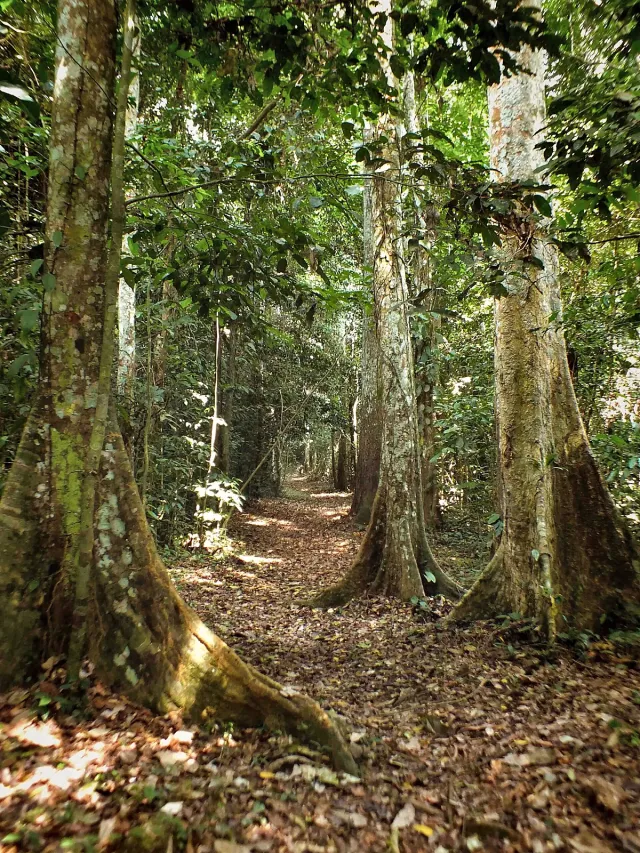 tradition; archaeology from c. 9th century CE
Asantemanso: the place of origin
AsantemansoAsante royal tradition places the beginning of the people at Asantemanso, near Asumegya in the Amansie district south of Kumasi. The earliest written version is the history set down by…
Note on the sourcesc. 9th century - 1659Adanse, remembered as the first Akan state
Adanse (linked by tradition to 'builders')Adanse, in the south of today's Ashanti Region, holds a special place in Akan memory as the country where the Akan first built lasting towns and shrines. Reindorf, collecting traditions in…
Note on the sourcesc. 11th century - 18th centuryBegho, the market that linked the forest to the Niger
Nsoko (another name for Begho)Begho, just south of the modern village of Hani in the Bono country, was the great meeting place of forest and savanna traders before Asante existed. University of Ghana excavations in the…
Note on the sourcesc. 13th century - 1723Bono and its capital Bono Manso
Bono MansoNorth of the forest, in the savanna-forest borderland around present-day Techiman, lay Bono, one of the oldest Akan states and an early centre of the gold trade. Techiman tradition traces…
Note on the sourcesbefore 1600 - 18th centuryTwifo and the road to the sea
TwifoTwifo, with its centre at Hemang near the Pra, was one of the earliest Akan states and sat on the main route between the gold-producing interior and the forts at Cape Coast and Elmina.…
17th centuryThe forest Akan before Asante: 'estates' and big men
obirempon (pl. abirempon) - big man; osawura - lord of warHistorians now warn against picturing the seventeenth-century forest Akan world as a map of tidy kingdoms. T. C. McCaskie, following Ivor Wilks, describes it instead as a landscape of…
Note on the sourcestradition; c. 1600 - c. 1660The Oyoko move from Asantemanso to Kokofu and Kwaman
Kwaman; Oyoko (clan)The dynasty that founded Asante belonged to the Oyoko clan, and its traditions describe a slow move north. McCaskie summarises it plainly: Osei Tutu's ancestors left Asantemanso for Kokofu,…
Note on the sourcesc. 1620s - 1730Akwamu, the eastern power and school of war
AkwamuAkwamu grew up inland around the Atewa hills, with its capital at Nyanoase, and first appears on a Dutch map of 1629. Under Ansa Sasraku it became the strongest state of the eastern Gold…
Note on the sourcesc. 1650s - 1690sMuskets change Akan warfare
nifa - right wing; benkum - left wingThe rise of Asante cannot be separated from a military revolution that swept the Gold Coast interior in the second half of the seventeenth century. Ray Kea showed that between the 1650s and…
Note on the sourcesc. 1659 - 1701Denkyira and its capital Abankeseso
Abankeseso (from abankese, a large strong building); also NtibansoBetween the 1660s and the 1690s Denkyira was the dominant power among the forest Akan of the Ofin-Pra basin, and Kwaman, the future Kumasi, was one of its tributaries. Its people are said…
Note on the sourcesc. 1659 - 1701Kwaman as a tributary of Denkyira
For roughly forty years before 1701 the people of Kwaman and their neighbours lived under Denkyira's demands. Akrokyere tradition suggests that Kwaman had first been tributary to Adanse and…
17th - 19th centuriesThe gold of the Ofin valley
nsuyiri sika - 'the flood of gold'; sika dan - gold houseDenkyira's power rested on gold that was unusually easy to reach. Along the Ofin river and between the Ofin and the Oda, seasonal floods threw up gold-bearing gravels, so that washing and…
c. 1660 - c. 1680Obiri Yeboa and the war with Domaa
Obiri Yeboa, who ruled Kwaman before Osei Tutu, is remembered for strengthening the Oyoko settlement and for dying in war with the Domaa (Dormaa), an Aduana group settled close by around…
Note on the sourcesFounding of the union
Osei Tutu: birth and family
Osei Tutu OpemsooOsei Tutu, the first Asantehene, was by matrilineal descent the heir to the Kwaman stool. His mother, Manu (Maanu Kotosii), was a sister of the Kwaman rulers Oti Akenten and Obiri Yeboa.…
Note on the sources1660s - 1670sOsei Tutu's years at the Denkyira court
okyemfo (pl. akyemfo) - shield-bearerOne of the most widely told Akan traditions is that the young Osei Tutu lived for years at Abankeseso, the Denkyira capital. McCaskie dates the stay to the 1660s and 1670s and explains it…
Note on the sources1670s - 1680sRefuge in Akwamu and the return home
Adum (Kumasi ward said to descend from the Akwamu escort)From Denkyira Osei Tutu fled to Akwamu, where Ansa Sasraku received him. There he saw at first hand the most advanced army of the forest zone, built around musketeers. When Obiri Yeboa was…
Note on the sources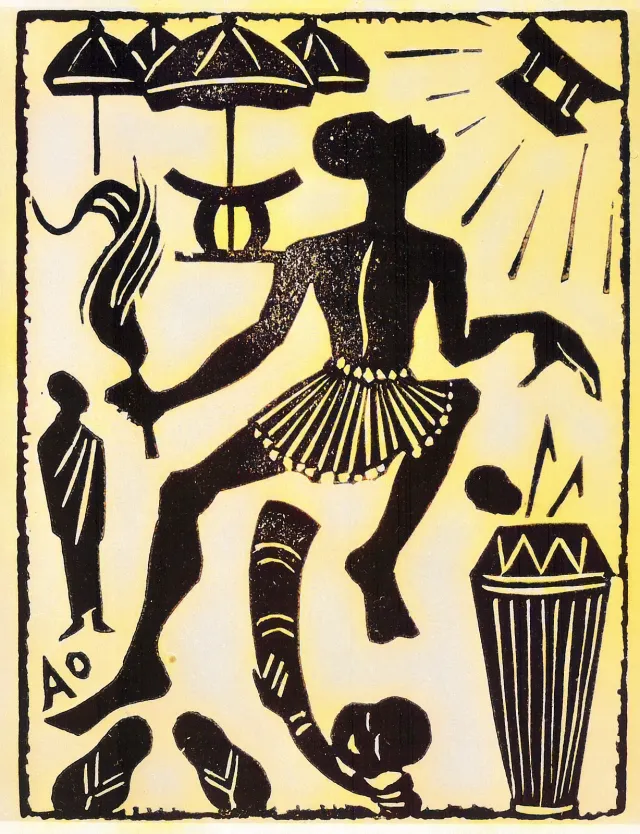 late 17th - early 18th century
Okomfo Anokye: who he was and where he came from
okomfo - priest; Okomfo AnokyeOkomfo Anokye is the priest and lawgiver whom tradition places beside Osei Tutu at every step of Asante's founding. No European document of the time mentions him, so everything known comes…
Note on the sources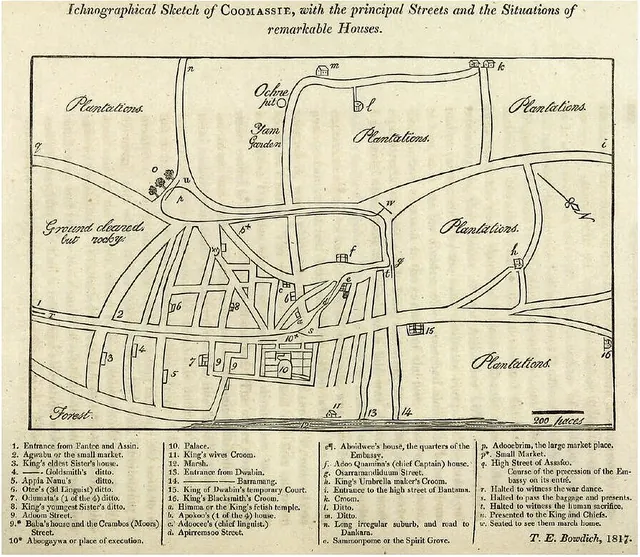 tradition: 1680s - 1701
How Kumasi got its name
Kum-ase - under the kum treeKumasi grew out of the older settlement of Kwaman, and its name is explained as 'under the kum tree'. The best-known story says Okomfo Anokye planted two kum seedlings, one at Kwaman and…
Note on the sources1680s - 1690sKwaman defeats its neighbours
Before he could challenge Denkyira, Osei Tutu made Kwaman the first among its neighbours. McCaskie notes that from the 1680s until the Denkyira war and beyond, Kwaman fought a string of…
c. 1694 - 1720sNkawie and the Denkyira prince who joined Asante
abankamdwa - the Denkyira royal stoolThe most damaging defection from Denkyira was that of Asensu Kufuor of Nkawie. Nkawie, a gold-mining centre about twenty miles north of Abankeseso, was arguably Denkyira's second town, and…
Note on the sources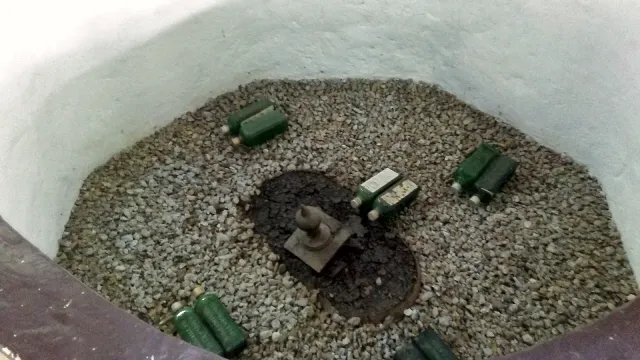 c. 1690s - 1701
Anokye's work: medicine, oaths and the laws
Komfo Anokye mmara (laws of Komfo Anokye)In the traditions Anokye is Osei Tutu's partner in building the state. Prempeh's history, where he is called Annochi, shows him supplying prophecy, war medicine and oaths before the…
Note on the sourcesc. 1695 - 1701The states that formed the union
amanto (the founding states); Asanteman - the Asante nationAsante began as a military coalition of neighbouring towns that wanted to be rid of Denkyira's demands. McCaskie calls it the Kwaman coalition and says Osei Tutu created it in the mid 1690s…
Note on the sourcesc. 1698 - 1700Ntim Gyakari's demands and the pan of stones
kyekyerekona - bead necklace worn by a king's wives as a sign of submissionNtim Gyakari succeeded Boamponsem as Denkyirahene about 1694. Both Denkyira tradition and European observers describe him as a young man of poor judgement. Asante royal tradition,…
Note on the sourcesc. 1694 - 1701The people who changed sides: the Bontwumafo and Atwema
Bontwumafo - 'Boa's red clay people'; Atwema; akradwareni - soul-washerA large part of Asante's victory was won before the battle, by people walking away from Denkyira. McCaskie traces the story in detail. After defeating Adanse, Boamponsem enslaved the people…
Note on the sources1700 - 1804Why the old dates for the kings are wrong
Readers will meet two quite different sets of dates for the eighteenth-century Asante kings. The older set comes from the first British visitors. Bowdich (1819) gave Opoku Ware's accession…
Note on the sourcestradition: c. 1695-1701The Golden Stool, Sika Dwa Kofi
Sika Dwa Kofi - the Golden Stool born on a Friday; sunsum - spirit, soulThe Golden Stool is the sacred seat that holds the sunsum, the spirit, of the whole Asante nation: the living, the dead and those not yet born. Tradition says that at a great gathering of…
Note on the sources1701The battle of Feyiase
FeyiaseThe war that made Asante was fought in 1701. Denkyira and Asante traditions tell nearly the same story. Ntim Gyakari's army advanced north-east from Abankeseso and in hard fighting drove…
Note on the sources1701 - 1707After Feyiase: the sack of Abankeseso and the remaking of Denkyira
With Ntim Gyakari dead, the remnants of his army fled south across the Ofin and Osei Tutu turned on the undefended capital. The Dutch reported that the victors spent fifteen days sacking…
Note on the sourcesOctober 1701 - October 1702The first European envoy to Kumasi
The Dutch West India Company had been Denkyira's trading partner, and the result at Feyiase forced it to change sides quickly. McCaskie notes that the Dutch immediately sent an emissary to…
Note on the sources1702 - 1716Osei Tutu's wars after 1701
Victory over Denkyira did not bring peace. The outline below comes mainly from J. K. Fynn's work on European records, as summarised in reference articles. In 1702 a combined Akyem and…
Note on the sources1712 / 1717 (disputed)The death of Osei Tutu: 1712, 1717 or 1731?
Koromante - the great oath recalling the king's death; Memeneda - SaturdayHow and when the first Asantehene died is the best-known dating problem in early Asante history. Tradition says he fell in a war against Akyem: Dupuis was told he was wounded and then shot…
Note on the sourcesExpansion
Ebiri Moro of Aowin sacks Kumasi
The death of Osei Tutu was followed at once by the worst blow the young capital ever suffered. While Opoku Ware and the army were still in the field against Akyem, news came that Kumasi had…
Note on the sources1719 - 1751Opoku Ware's wars in the west and north
Opoku Ware fought on every frontier. In the south-west his armies defeated Aowin between 1719 and 1722 and absorbed Ahafo; Dutch reports describe Aowin prisoners sold at Elmina, Cape Coast…
Note on the sourcesc. 1717 - 1721Opoku Ware I comes to power
Opoku Ware KatakyieOpoku Ware, remembered by the praise-name Katakyie, was the second Asantehene and the true builder of the empire. Tradition presents him as the successor Osei Tutu had chosen, a young…
Note on the sources1722 - 1723The conquest of Bono (Techiman)
In 1722-23 Opoku Ware's army destroyed the independence of Bono, the old gold-trading state to the north-west. The date is unusually well anchored: the Gonja chronicle known as the Kitab…
Note on the sources1742The defeat of Akyem and the road to Accra
Akyem, east of the Pra, had killed Osei Tutu and in 1730 had destroyed Akwamu, making itself master of the country behind Accra. In 1742 Opoku Ware settled the account. Reindorf's…
Note on the sources1744 - c. 1772Dagbon: conquest or arrangement?
Ya Na - title of the king of Dagbon; Yane - Asante name for YendiDagbon, the Dagomba kingdom with its capital at Yendi, lay beyond Gonja on the road to Hausaland. Wilks dates an Asante invasion to 1744-45, at the end of Opoku Ware's reign, and Bowdich…
Note on the sourcesc. 1740s - 1750Opoku Ware's reforms and the chiefs' revolt
Gyaasewa; NsumankwaaOpoku Ware was a reformer as well as a conqueror. Work by George Hagan, summarised in reference articles, credits him with reorganising the royal household (the Gyaase) and creating within…
Note on the sources1750 - 1764Kusi Obodom: a contested succession and a cautious reign
atitodee - payment to buy off a death sentence; akwanmofo - road clearersOpoku Ware is said to have wanted a kinsman named Dako (Darko) to follow him, but the kingmakers chose Kusi Obodom. Danish reports of May 1750 describe a civil war; by 1751 letters from…
Note on the sources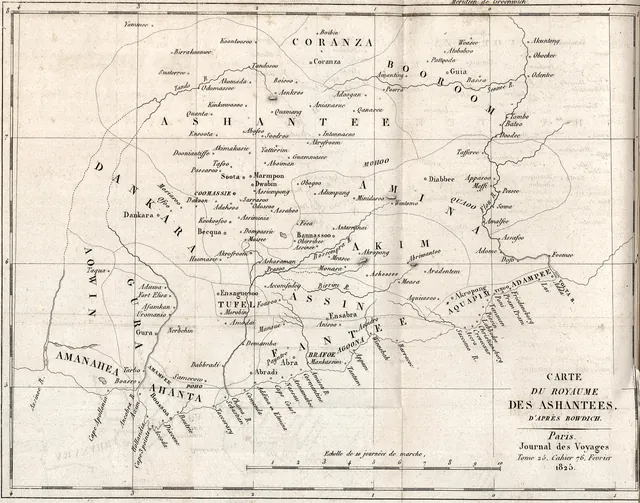 c. 1750 - 1820
How large was the empire?
By the death of Opoku Ware in 1750 Asante's authority reached from the Gonja and Dagomba savanna to the coast at Accra, and from Gyaman in the west towards the Volta in the east. Figures…
Note on the sources1764Defeat beyond the Volta: Asante meets Dahomey and Oyo
The one great military reverse of eighteenth-century Asante came in 1764 east of the Volta. Akyem, restless under Asante rule, had been in touch with Dahomey and, it was reported, had…
Note on the sources1764 - 1777Osei Kwadwo restores Asante power
Osei Kwadwo OkoawiaOsei Kwadwo, described by the Dutch governor at Elmina in October 1764 as a courageous young man, spent his reign repairing the damage of his predecessor's last years. In 1765 he marched…
Note on the sources1777 - c. 1803Osei Kwame: a boy king and his deposition
Osei Kwame PaninOsei Kwame came to the Golden Stool in 1777 as a child; Reindorf says he was about twelve. He was the son of the Asante royal Akyaama and of Safo Katanka, the Mamponghene, and it was the…
Note on the sourcesDecember 1803 - March 1804Opoku Fofie's reign of weeks
saman - ghostOpoku Fofie, a son of the queen mother Konadu Yaadom, was the shortest-reigning Asantehene of the period. Before taking the stool he led the war against the Muslim-backed forces from Gyaman…
Note on the sources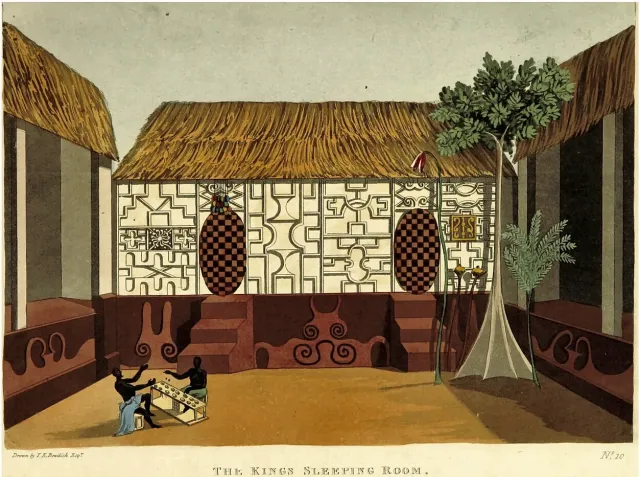 c. 1800/1804 - 1807
The first years of Osei Bonsu
Osei Tutu Kwame; Bonsu - whaleOsei Tutu Kwame, later called Osei Bonsu, was about seventeen when he succeeded his brother. His first task was to finish the war in the north-west. Dupuis says his first campaign was…
Note on the sourcesGovernment and administration
 c. 1690s - 1800
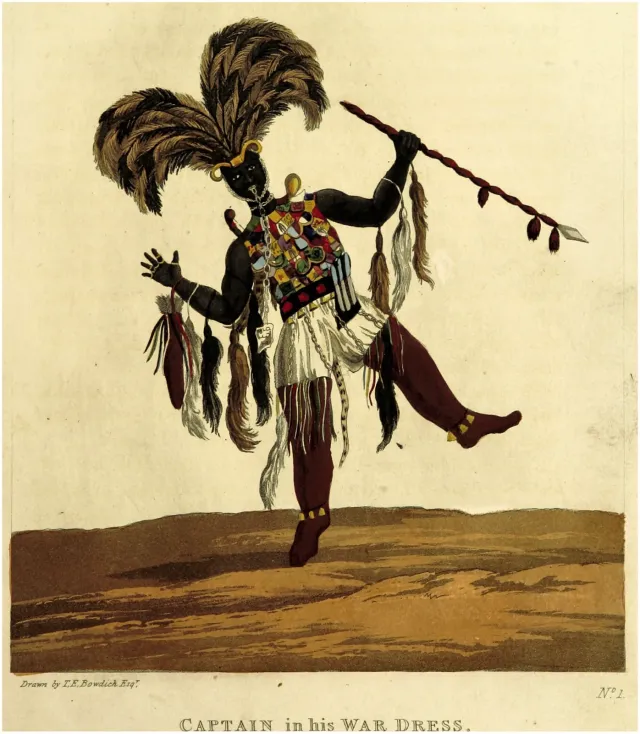
How the army was organised
adonten - main body; twafo - advance guard; kyidom - rear guard; nifa - right wing; benkum - left wing; gyaase - household guard; akwansrafo - scouts; Kontihene - senior general; asafo - companyAsante's army was a citizen force organised on a fixed plan that doubled as the political map of the state. Tradition says Osei Tutu reorganised the Kwaman forces just before the Denkyira…
c. 1700 - 1820Muslims at court and the Nsumankwaa
Nsumankwaa - the 'department of medicines'; Nsumankwahene - its head; asuman - charm, amuletA small community of Muslims lived at the Asante court from the time of the state's founding around 1700. They were Dyula, Mande-speaking Muslims of the kind long settled in trading towns…
Note on the sources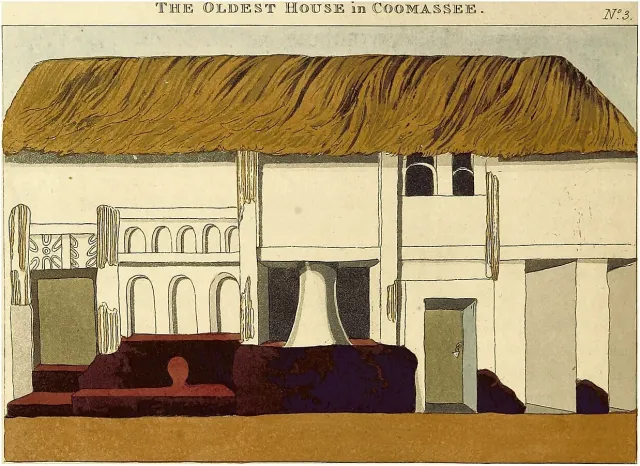 1701 - 1817
Kumasi before 1800: what can and cannot be known
KumaseNo eyewitness description of Kumasi survives from the eighteenth century. The Dutch envoy van Nyendael, who lived there in 1701-02, died without writing his report, and for more than a…
Note on the sources18th - 19th centuryThe Gyaasewa and the state treasury
Gyaasewahene; Sanaahene; Fotosanfohene; Adaka Kesie - the Great ChestAsante's finances were run from within the royal household. The Gyaasewahene headed the treasury, presided over an exchequer court and controlled the state budget. Under him the Sanaahene…
Note on the sources18th - early 19th centuryServants of the stool: the court officials
nhenkwaa - royal servants; akyeame (sing. okyeame) - spokesmen; nseniefo - heralds; afenasoafo - sword-bearers; ankobia; abrafo - executionersThe Asantehene governed through bodies of household officials whose titles are still in use. The nhenkwaa were royal servants employed as messengers, mostly on errands within Asante. The…
18th - early 19th centuryKing, council and the power to destool
Asantemanhyiamu - assembly of the Asante nation; Asantehene; omanhene (pl. amanhene)The Asantehene was powerful but never absolute. Bowdich in 1817 described three estates: the king, an inner 'aristocracy' reduced by then to four great men who had to be consulted on…
Note on the sources18th - early 19th centuryThe great roads from Kumasi
nkwantempon - great roads; akwanmofo - road clearers; nkwansrafo - road wardensAsante was held together by roads. Wilks identified eight great roads, the nkwantempon, radiating from Kumasi, four to the north and four to the south, and numbered them. Route I ran…
Note on the sources1764 - 1824The 'Kwadwoan revolution' in government
In 1966 Ivor Wilks proposed that Asante government was transformed in the later eighteenth century. In his account, reforms begun by Osei Kwadwo and carried on by Osei Kwame and Osei Bonsu…
Note on the sourcesc. 1750 - 1809Konadu Yaadom and the power of the queen mother
Asantehemaa - queen mother of AsanteThe Asantehemaa, the senior woman of the royal lineage, had her own stool beside the king's and a decisive voice in choosing him. The most powerful holder of the office in this period was…
Note on the sources1817Asante law as an outsider recorded it in 1817
peredwan - a weight of gold dustThe earliest written description of Asante law comes from Bowdich's chapter on the constitution and laws. It is a colonial-era account by a visitor of a few months, but it preserves rules…
Note on the sourcesTrade and economy
Gold: mines, washings and the king's share
sika - gold; sika boba - gold nugget; nkoron - mine shaftsGold was the foundation of Asante's wealth and the reason the forest states mattered to both the Saharan and the Atlantic trade. It was won in two ways: by washing river gravels, especially…
Note on the sourcesc. 1400 - 1900Gold dust money and the brass weights
mrammou (abrammuo) - goldweights; peredwan, benda, ackie, tokoo (units as written by Bowdich)Asante used no coins. Money was gold dust, weighed out at every purchase with a small balance against cast brass weights. Bowdich set down the scale as he learned it in 1817: sixteen ackies…
Note on the sources1690s - 1800Guns, powder and the politics of supply
Firearms were the import that mattered most to Asante rulers, and controlling the paths by which they arrived was a constant aim of policy. Before 1701 Denkyira was the richest buyer of…
1701 - 1807Asante and the Atlantic slave trade
Asante's rise coincided with the peak of the Atlantic slave trade on the Gold Coast, and its wars fed that trade. The Dutch Director-General de la Palma wrote soon after 1701 that the…
Note on the sources1701 - 1872The 'notes': Asante as landlord of the forts
European forts on the Gold Coast stood on African land and paid for it. The payment was recorded in a document the traders called a note, and whoever held the note received the rent.…
Note on the sources18th - early 19th centuryKola and the northern markets
bese - kola nut (Bowdich's 'boossee'); Batahene - head of the state tradersKola nuts, which grow in the Asante forest and are chewed across the savanna, were the staple of the trade northward. They went to markets on the edge of the grasslands, where the goods of…
Note on the sourcesNeighbours and rivals
Akyem, the most persistent enemy
Okyenhene - king of Akyem AbuakwaThe Akyem states east of the Pra, chiefly Abuakwa and Kotoku, resisted Asante longer than any other Akan people. Akyem troops are said to have fought beside Denkyira in 1699-1701 and…
Note on the sources1700 - 1807The Fante: partners, middlemen and obstacle
The Fante states of the central coast were never conquered by Asante in the eighteenth century, and their relationship with Kumasi swung between partnership and hostility. Around 1700 the…
1701 - 1816The Dutch at Elmina
Of all the Europeans on the coast the Dutch had the longest and steadiest relationship with Asante. Before 1701 the Dutch West India Company at Elmina was Denkyira's chief customer for gold…
Note on the sources1701 - 1807The British and the Danes
The English at Cape Coast Castle, trading as the Royal African Company and then its successor company, knew Asante for a century mainly as a distant power whose wars opened or closed the…
1706 - 1776Wassa and the southern league
South-west of Asante, between the forest and the forts at Elmina, Axim and Cape Coast, lay Wassa, Twifo, Aowin and the remnant of Denkyira. Asante wanted free passage through them; they…
Note on the sources1732 - 1804Gonja and the opening of the savanna
Nta - Asante name for GonjaGonja, the Muslim-influenced kingdom of the Volta basin north of Asante, was a loose federation of divisional chiefdoms such as Kpembe, Buipe, Bole and Daboya under a paramount, the…
Note on the sourcesc. 1690 - 1819Gyaman, the reluctant tributary in the north-west
GyamanGyaman, with its centre near Bonduku in what is now north-eastern Ivory Coast, was founded by Akan migrants of the Aduana clan connected with Domaa. One tradition recorded by Reindorf makes…
Note on the sourcesNineteenth-century kingdom
c. 1800/1801 - January 1824Osei Bonsu (Osei Tutu Kwame), Asantehene at the height of the empire
Bonsu - whale, the greatest creature of the seaOsei Tutu Kwame, remembered as Osei Bonsu, came to the Golden Stool at the opening of the nineteenth century after the short reign of Opoku Fofie, and ruled until his death in Kumasi in…
Note on the sources1806-1807The Fante campaign of 1806-07 and the attack on Anomabu fort
The first Asante army to reach the sea in force came down in 1806-07. The trouble began in Assin, where relatives of a chief (Edgerton calls him Aputai) were accused of robbing a grave;…
Note on the sources1811; 1814-1816The coastal campaigns of 1811 and 1814-16
Asante authority on the coast had to be reasserted twice more in Osei Bonsu's reign. In 1811 an army went down in support of Asante's Ga allies at Accra in a war against the Fante states,…
Note on the sources1817The Bowdich mission and the treaty of 7 September 1817
In 1817 the African Company of Merchants sent its first embassy from Cape Coast Castle to Kumasi. Frederick James is named first among its members, with the young writer Thomas Edward…
Note on the sources1817-1820Kumasi as Bowdich and Dupuis saw it (colonial-era accounts)
sankuo - lute-harpThe books of Bowdich (1819) and Dupuis (1824) are the earliest detailed European descriptions of the Asante capital, and should be read as outsiders' accounts written to impress a British…
1817-1819The Gyaman war of 1818-19
Gyaman, the large tributary state to the north-west with its capital at Bonduku, had been restive since about 1811 under its ruler Adinkra. In November 1817 the Kumasi council and then the…
Note on the sources1819-1820Consul Dupuis and the repudiated treaty of 23 March 1820
Joseph Dupuis, previously vice-consul at Mogador, was appointed by the Crown as the first British consul to Asante. He landed at Cape Coast in January 1819 but was kept waiting about a year…
Note on the sources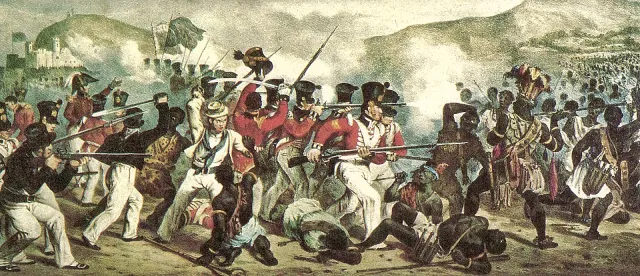 1824-1834
Osei Yaw Akoto and the loss of the southern provinces
Osei Yaw Akoto succeeded Osei Bonsu in 1824, in the middle of the first war with Britain. The victory at Nsamankow was not followed up: the army that threatened Cape Coast that year was hit…
Note on the sources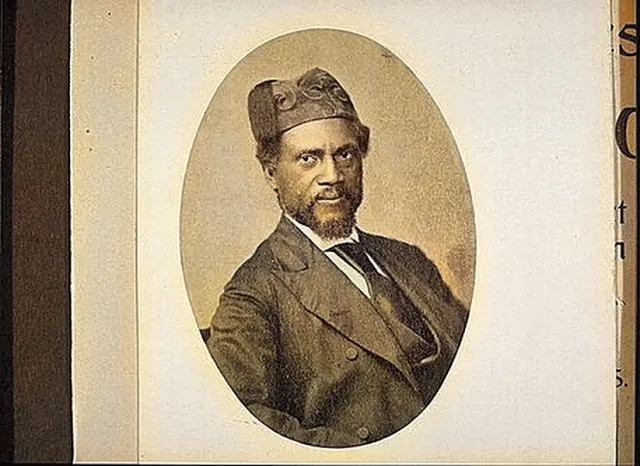 1831-1896
The Owusu-Ansa princes: hostages, mission agents and go-betweens
John Owusu-Ansa (1822-1884), a son of Osei Bonsu, was one of the two royal boys handed to George Maclean in 1831 as security for the peace; the other was his cousin Owusu Nkwantabisa. They…
Note on the sources1834-1867Kwaku Dua I: three decades of peace and accumulation
Manwere fekuo - an administrative grouping of Kumasi officesKwaku Dua I (born Fredua Agyeman, about 1797) had fought in Gyaman and commanded at Katamanso before he was enstooled in August 1834. His thirty-three-year reign was the longest of the…
Note on the sources1837-1842Asante recruits for the Dutch East Indies and the two princes sent to Holland
Asante's oldest European partners were the Dutch at Elmina, and under Kwaku Dua I the connection took an unusual form. A Dutch mission under General Verveer arrived in Kumasi at the start…
Note on the sources1839-1843Thomas Birch Freeman and the Wesleyan mission to Kumasi
The first sustained Christian contact with the Asante court was the work of Thomas Birch Freeman (1809-1890), a Wesleyan Methodist missionary born in Hampshire to an African father and an…
Note on the sources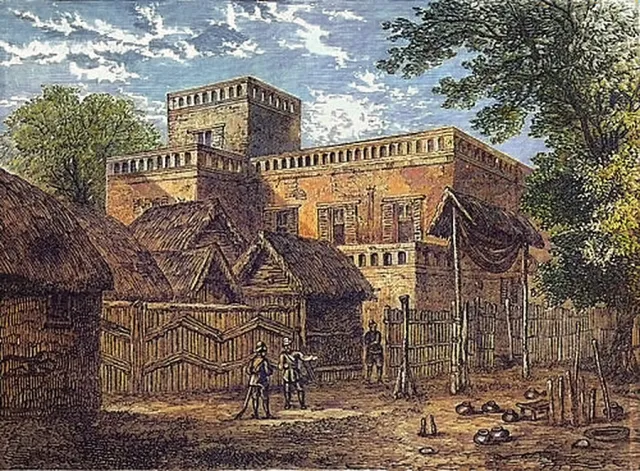 1867-1874
Kofi Karikari's accession and the turn to war
The sudden death of Kwaku Dua I in April 1867 opened a disputed succession. A rival was removed - Edgerton says the general Owusu Koko was seized and exiled - and Kofi Karikari (Kakari), a…
Note on the sources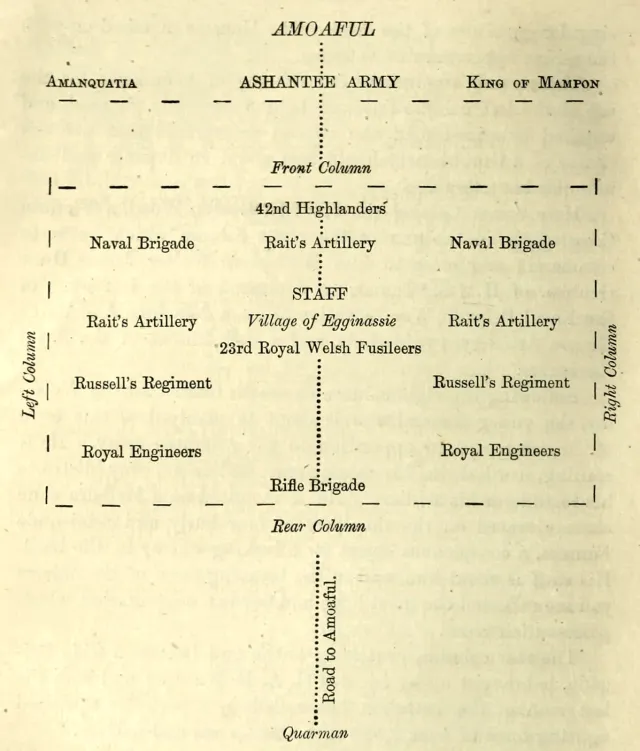 June 1869 - January 1874
The captivity of Ramseyer, Kuhne and Bonnat, 1869-74
In June 1869 an Asante army under Adu Bofo, campaigning among the Ewe east of the Volta, overran the Basel Mission station at Anum. It carried off the Swiss missionary Friedrich (Fritz)…
Note on the sources1869-1872The Dutch cession of Elmina, 1872
Elmina, the Dutch headquarters on the Gold Coast, was Asante's oldest outlet to the sea and the one coastal town that Kumasi regarded as its own; Kwaku Dua I had even named a village and…
Note on the sources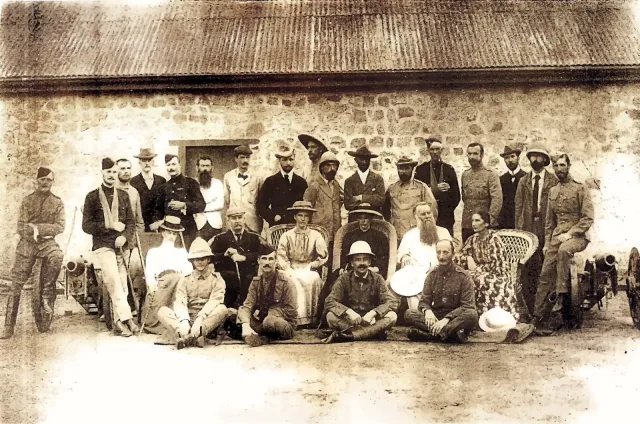 1875-1908
The Basel Mission and Asante: Abetifi to Kumasi
The Basel Mission, already at work on the south-eastern Gold Coast, reached Asante by way of its former captive. After his release Fritz Ramseyer toured churches in Britain and Switzerland…
Anglo-Asante wars
1823 - January 1824The war of 1823-24 and the death of Sir Charles MacCarthy at Nsamankow
In 1821 Parliament dissolved the African Company and placed its forts under Sir Charles MacCarthy, governor of Sierra Leone. He reached Cape Coast in 1822, sided with the Fante and prepared…
Note on the sources7 August 1826Katamanso (Dodowa), 7 August 1826
Akantamansu / KatamansoThe battle the British called Dodowa and the Asante Akantamansu was fought on open ground on the Accra plains, roughly twenty miles north of Accra, on 7 August 1826. Asantehene Osei Yaw…
Note on the sources1831The Maclean treaty of 27 April 1831
After Katamanso the British government lost interest in the Gold Coast and in 1829 handed the forts back to a committee of merchants. Their president from February 1830, Captain George…
Note on the sources1862-1864The war of 1863-64: the Kwasi Gyani affair
The so-called second Anglo-Asante war was a confrontation without a battle between the two armies. In 1862 a wealthy Asante, Kwasi Gyani, was accused of keeping a gold nugget that by law…
Note on the sources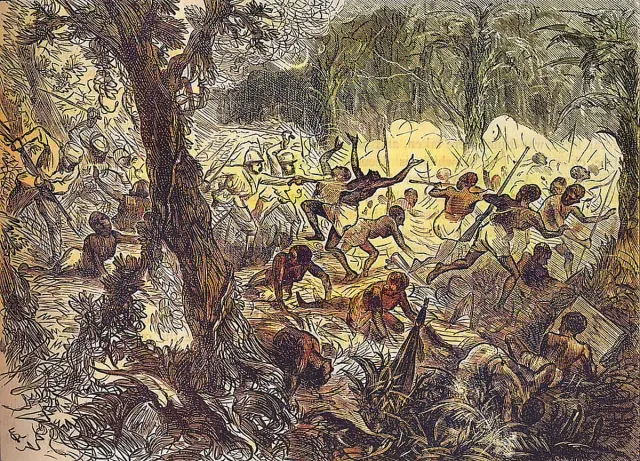 December 1872 - December 1873
The Asante invasion of the Protectorate, 1873
The war of 1873-74 began as an Asante offensive. The army left Kumasi in December 1872 - Edgerton says it took eleven hours to file out of the city - and crossed the Pra in January 1873…
Note on the sources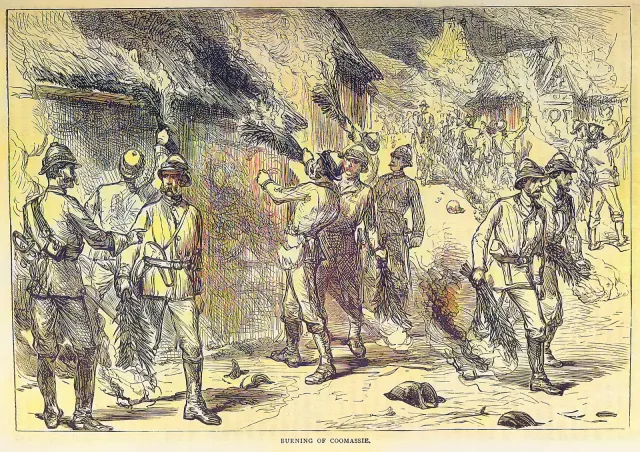 October 1873 - February 1874
Wolseley's expedition: the 'Sagrenti' war
Sagrenti - the Asante rendering of 'Sir Garnet'Asante remembers the war of 1873-74 by the name of the British commander: Sagrenti, from Sir Garnet (Wolseley). Appointed in August 1873 as both general and civil administrator, Wolseley…
Note on the sources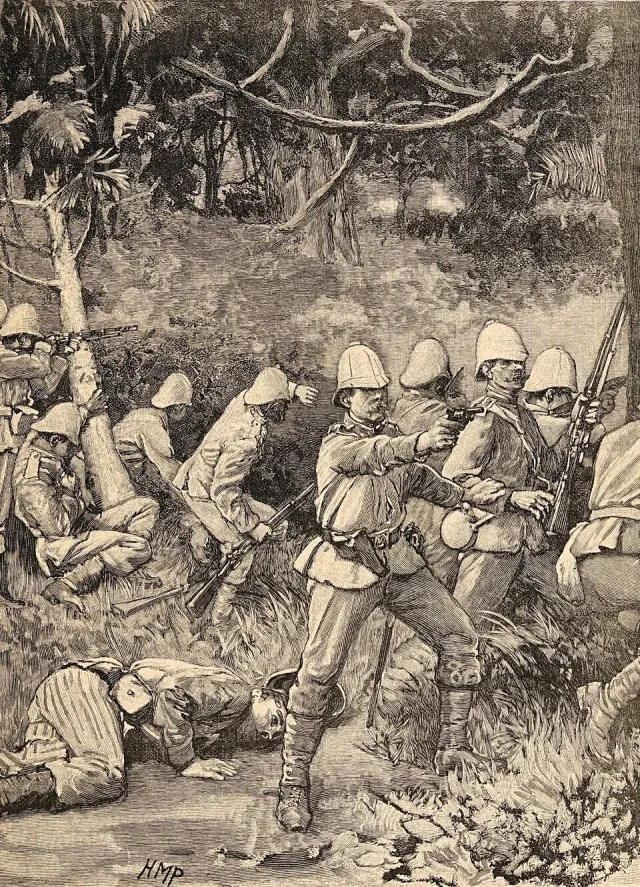 31 January - 4 February 1874
Amoaful and Odaso, 31 January - 4 February 1874
The Asante command, led by the veteran Asamoa Nkwanta with Amankwatia, chose not to defend the Adansi hills and instead prepared a position in thick forest around the village of Amoaful…
Note on the sources4-6 February 1874The occupation, looting and burning of Kumasi, February 1874
Wolseley held Kumasi for less than two days. The king had withdrawn and no one came to negotiate; rain was falling, the rivers behind were rising and the general had sick and wounded to…
Note on the sources13 February 1874The Treaty of Fomena and the indemnity
On 9 February 1874 messengers from Kofi Karikari overtook Wolseley on his way back to the coast and accepted his terms. Envoys came into the British camp at Fomena in Adansi on the 12th…
Note on the sources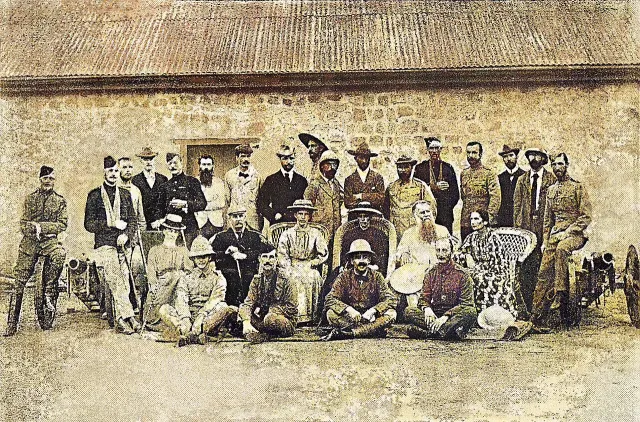 25-28 March 1900
Governor Hodgson's demand for the Golden Stool, 28 March 1900
Sika Dwa - the Golden StoolAfter 1896 Asante was ruled by a British Resident from a stone fort in Kumasi, with a small council of administration that included the Kumasi chief Opoku Mensa. The Golden Stool, which…
Note on the sourcesc. 1840 - 17 October 1921Yaa Asantewaa, queen mother of Ejisu
Edwesohemaa - queen mother of Edweso (Ejisu)Yaa Asantewaa was born about 1840 at Besease and became queen mother of Edweso (Ejisu) under her brother, the Edwesohene Afrane Panin. After his death she secured the stool for her grandson…
Note on the sources25 April - 15 July 1900The siege of the Kumasi fort, April - July 1900
Fighting began at the end of March 1900 when a detachment searching for the Golden Stool was attacked. The Asante then did something new: they ringed Kumasi with log stockades, twenty-one…
Note on the sourcesJuly 1900 - March 1901The end of the 1900 war and the deportation of its leaders
The relief of the fort did not end the war. Through August and September 1900 Willcocks's columns, by now including Sikhs and Nigerian troops, attacked the stockaded war-camps one by one:…
Note on the sourcesCivil war and decline
August - October 1874The destoolment of Kofi Karikari, 1874
Defeat discredited Kofi Karikari. To meet the first calls of the indemnity and the costs of his court he is said to have taken gold ornaments that had been buried with former kings and…
Note on the sources1874-1883Mensa Bonsu: reform, repression and overthrow
Mensa Bonsu, a younger son of Afua Kobi born about 1840, took over a kingdom that had lost its southern and many northern dependencies and whose capital lay in ashes. His early years were…
Note on the sources1874-1880The secession of Juaben and the founding of New Juaben (Koforidua)
Juaben (Dwaben), east of Kumasi, was the second state of the union; Bowdich had been told its ruler's power was equal to the king's, and visitors in 1869 thought its capital finer than…
Note on the sources1883-1888The civil wars of 1883-88
The removal of Mensa Bonsu opened five years of dynastic war. Three parties contended in 1883: supporters of a restoration of Kofi Karikari, those of the young Kwaku Dua, and local…
Note on the sourcesc. 1884-1917Yaa Akyaa, Asantehemaa and kingmaker
Asantehemaa - queen mother of AsanteYaa Akyaa, daughter of the Asantehemaa Afua Kobi and sister of the kings Kofi Karikari and Mensa Bonsu, was the dominant figure of the civil war years. Married to Kwasi Gyambibi, a Kumasi…
Note on the sources26 March 1888 - 11 June 1894The election of Agyeman Prempeh (Kwaku Dua III), 1888-94
Agyeman Prempeh was placed on the stool at midnight on 26 March 1888 in the presence of a British officer, Barnett, whom the Gold Coast government had sent to see a king chosen and the…
Note on the sources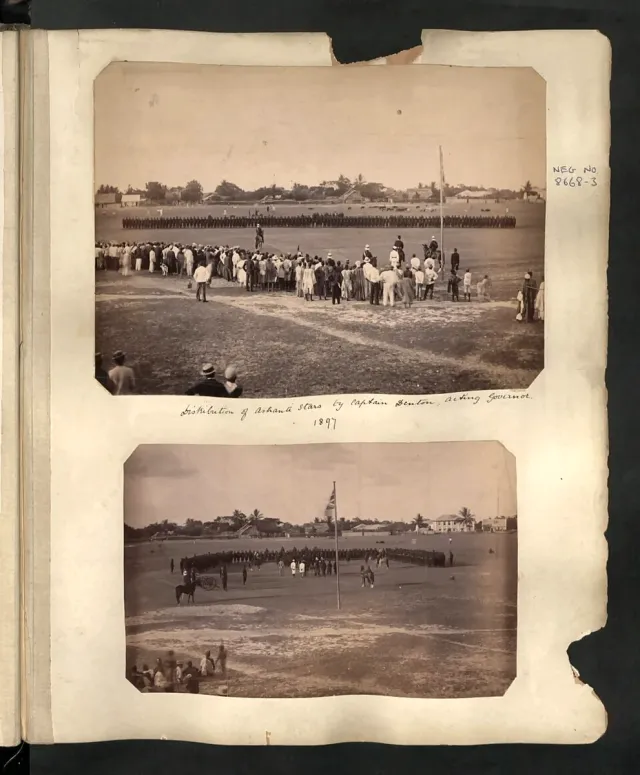 December 1894 - December 1895
The Asante embassy to London, 1895
Faced with renewed British demands that he accept a Resident, Prempeh and his council decided to appeal over the governor's head to the Queen. A delegation of about six - the brothers John…
Note on the sourcesExile and colonial rule
 December 1895 - January 1896
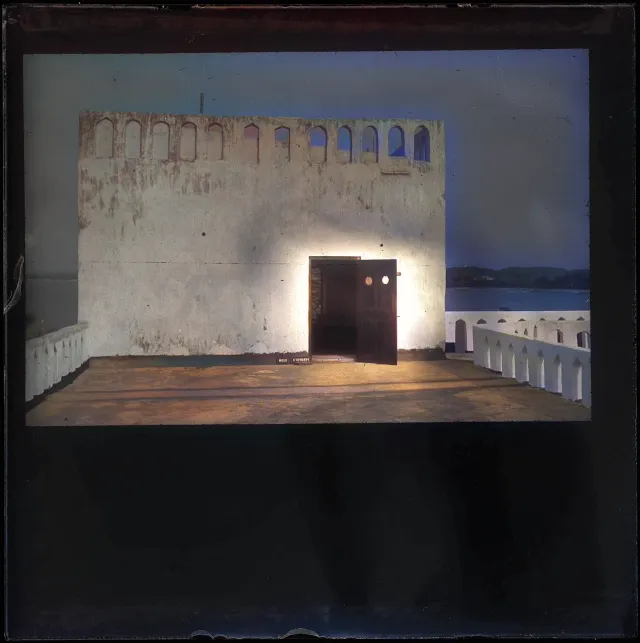
The 1896 expedition and the arrest of Prempeh I
The expedition of 1895-96 was designed to forestall the French and Germans and to end Asante independence without a battle. Colonel Sir Francis Scott commanded a force of West Yorkshire…
Note on the sources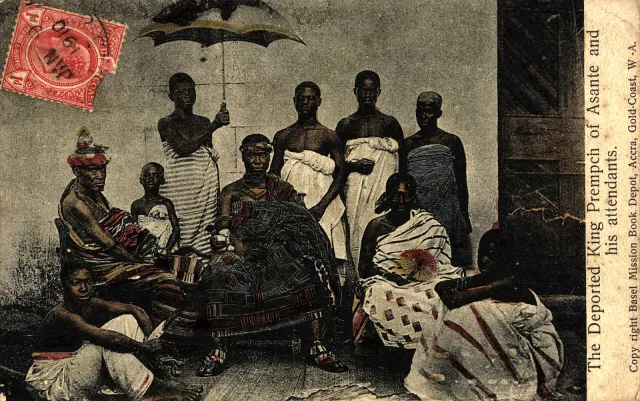 1896-1924
Exile: Elmina, Sierra Leone and the Seychelles
Prempeh I and those arrested with him were brought to Cape Coast Castle on 1 February 1896 and then confined in Elmina Castle. A published list of the party has fifty-five entries: the…
Note on the sources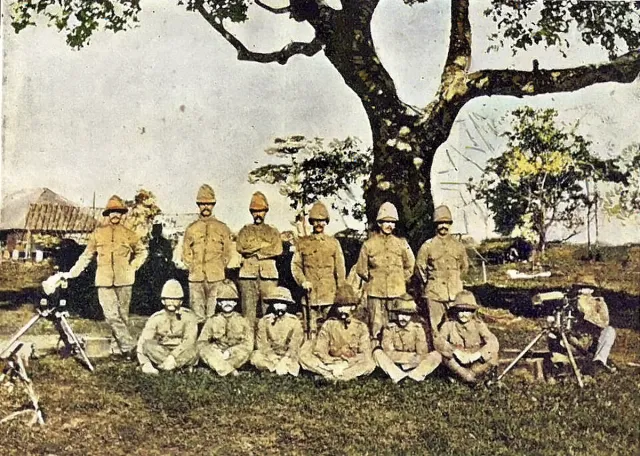 26 September 1901 - 1 January 1902
Annexation: the Ashanti Crown Colony, 1 January 1902
Between 1896 and 1900 Britain had described Asante as a protectorate. After the rising it was annexed outright. The Ashanti Order in Council, made on 26 September 1901, took effect on 1…
Note on the sources1898-1923Railways and cocoa reach Asante
Colonial rule tied Asante to the world economy with two railways. The western line was begun from the port of Sekondi to serve the gold mines: it reached Tarkwa in 1901, the Ashanti…
Note on the sources1902-1920Chief Commissioners and the Kumasi Council of Chiefs
The first Chief Commissioner was Captain (later Sir) Donald Stewart, Resident since 1896, with Armitage and Davidson-Houston among his district officers. His successor Francis Fuller, who…
Note on the sources1921The desecration of the Golden Stool and Rattray's advice, 1921
Sika Dwa - the Golden StoolSince 1896 the Golden Stool had been kept in hiding by a small group of custodians. In 1921 a government road was laid out across the spot where it was buried. As Edgerton tells it, the…
Note on the sourcesSeptember - November 1924The return of Prempeh I, November 1924
After the Golden Stool affair the Gold Coast government decided that the ex-king, now in his fifties and a practising Anglican, could safely be repatriated. Prempeh and the surviving exiles…
Note on the sources1926 - 12 May 1931Kumasihene, 1926-31: Prempeh I's last years
Kumasihene - ruler of the Kumasi stateFor two years after his return Prempeh had no official position. In 1926 the government recognised him as Kumasihene, head of the Kumasi division only, on the same footing as the other…
Note on the sourcesRestoration of the Confederacy
 1931-1970
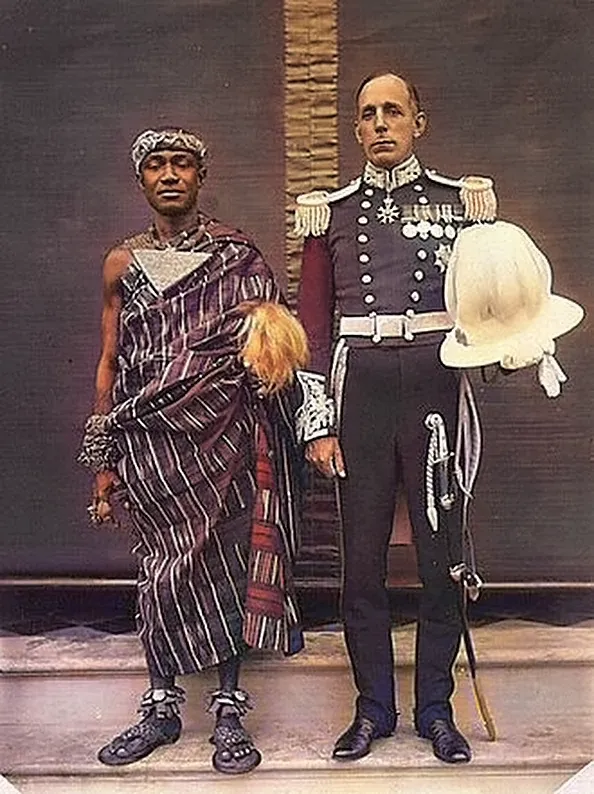
Osei Agyeman Prempeh II
Osei Agyeman Prempeh II was born in Kumasi about 1892, a son of Prempeh I's eldest sister and so a grandson of Yaa Akyaa. He was elected to succeed Prempeh I and installed as Kumasihene on…
 31 January 1935
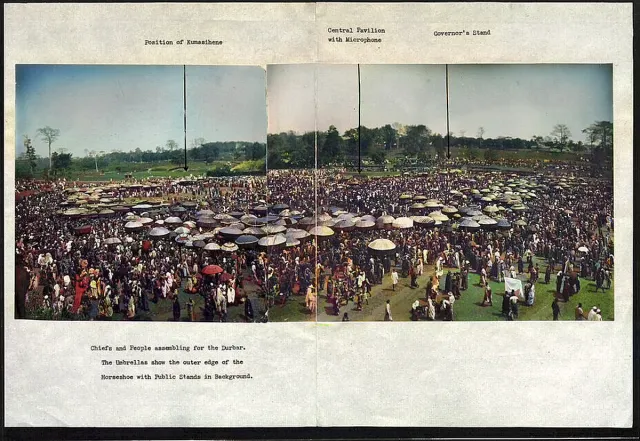
The restoration of the Asante Confederacy, 31 January 1935
Asanteman - the Asante nationBy the early 1930s the administration had come round to the view that Ashanti could not be governed indefinitely as a scatter of separate 'native states'; the Chief Commissioner of the day,…
Note on the sources1935-1957The Confederacy Council and the Asanteman Council
Asanteman - the Asante nationThe governing body of the restored union was the Ashanti Confederacy Council: the Asantehene as president, the paramount chiefs of the member divisions, and senior Kumasi chiefs, sitting as…
Note on the sourcesRoad to independence
The Brong-Kyempem movement and the creation of Brong-Ahafo, 1959
Bono Kyempem - the Brong federationThe Bono (Brong) states of the north-west - Takyiman, Dormaa, Berekum, Wenchi, Nkoranza and others - had been conquered by Asante in the eighteenth century and several had welcomed its…
Note on the sources19 September 1954 - 1957The National Liberation Movement, 1954
nkwankwaa - 'youngmen', commoners without officeMany in Asante had supported Kwame Nkrumah's Convention People's Party. The break came after the 1954 election when the CPP government, having campaigned on a promise of a better deal for…
Note on the sources1955 - 17 July 1956Federalism and the election of 17 July 1956
The NLM's campaign forced a delay in the Gold Coast's independence timetable. The movement insisted on a federation of the Colony, Ashanti, the Northern Territories and Trans-Volta…
Note on the sources6 March 1957Asante at independence, 6 March 1957
When the Gold Coast became Ghana on 6 March 1957 the Crown Colony of Ashanti ceased to exist as a separate legal entity and became a region of the new state. Asante entered independence…
Looted regalia and restitution
1874What was taken in 1874 and where it went
akrafokonmu - soul-washer's badgeThe regalia removed from the palace on 4-5 February 1874 reached Britain by two routes. Most was 'prize', gathered by Wolseley's three prize agents and sold for the benefit of the troops;…
Note on the sources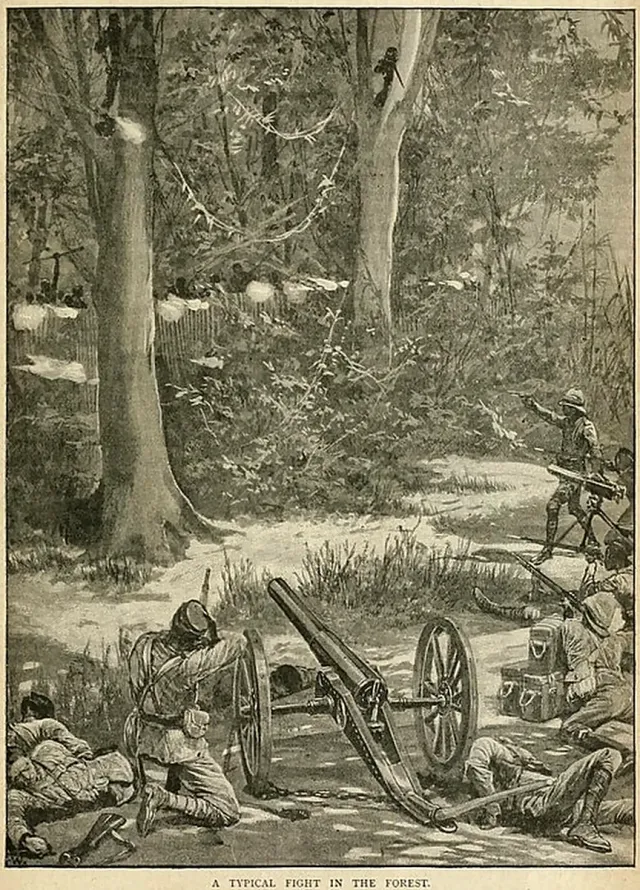 1896-1901
What was taken in 1896 and 1900
fontomfrom - state drum ensembleThe bloodless occupation of 1896 was followed by a second stripping of the capital. After Prempeh's arrest troops under Baden-Powell searched the palace and the royal mausoleum at Bantama;…
Note on the sources1974-2023The 1974 request and fifty years of negotiation
The first formal claim was made in 1974, the centenary of the sack of Kumasi, when Asantehene Opoku Ware II, with the backing of the Ghana government, approached the British Foreign and…
Note on the sources5-8 February 2024The Fowler Museum's permanent return, February 2024
sika mena - gold elephant-tail whisk; asipim - chief's chairThe first objects to come back to Kumasi outright, with no strings, came from the United States. The Fowler Museum at the University of California, Los Angeles, held seven pieces of Asante…
Note on the sourcesJanuary - May 2024The British Museum and V&A loans: 'Homecoming', May 2024
Mponponsuo - a sword of state; denkyemkye - ceremonial capOn 25 January 2024 the British Museum and the V&A announced a three-way agreement with the Manhyia Palace Museum to lend thirty-two objects to Kumasi. The V&A sent seventeen: all thirteen…
Note on the sourcesNovember 2024AngloGold Ashanti's return of 28 objects, November 2024
A third return in 2024 came from a company rather than a museum. AngloGold Ashanti, the South African-based mining group that works the Obuasi mine, handed twenty-eight Asante gold objects…
Note on the sources9-10 November 2025The November 2025 returns: AngloGold Ashanti and Hermione Waterfield
A year later a much larger group arrived. On 9 November 2025 (the report is dated the 10th and says the ceremony was on the Sunday) the Asantehene received about 130 gold and bronze works…
Note on the sources2025-2026Where things stand in November 2026: loans extended, more returns sought
In November 2026, following a visit to Kumasi by the British Museum's director Nicholas Cullinan at the Asantehene's invitation, the British Museum and the V&A confirmed that the thirty-two…
Note on the sourcesSince independence
 1954-1959
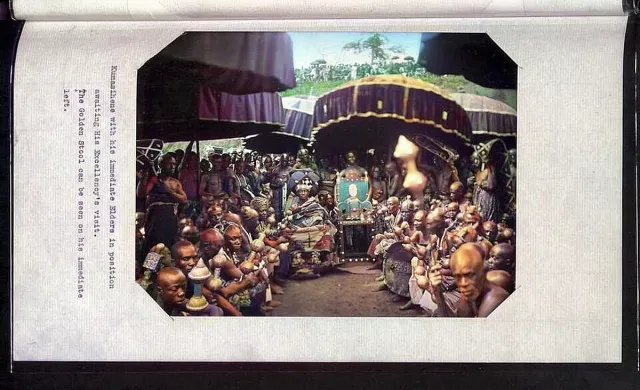
Prempeh II under Nkrumah's government, 1957-1959
When Ghana became independent on 6 March 1957 the Asantehene was Otumfuo Sir Osei Agyeman Prempeh II, on the Golden Stool since 1931. In 1954 he had lent his support to the National…
April 1959Brong-Ahafo is separated from Ashanti, 1959
The most lasting territorial change of the independence era was the creation of the Brong-Ahafo Region out of the north-western part of what had been Ashanti. Bono (Brong) chiefs organised…
Note on the sources1958-1970Prempeh II's last decade and death, 1960-1970
After the confrontations of the late 1950s Prempeh II largely stayed out of national politics. His standing nevertheless grew after the 1966 coup that removed Nkrumah. The Encyclopaedia…
 1919-1970
Opoku Ware II: surveyor, barrister, commissioner and king
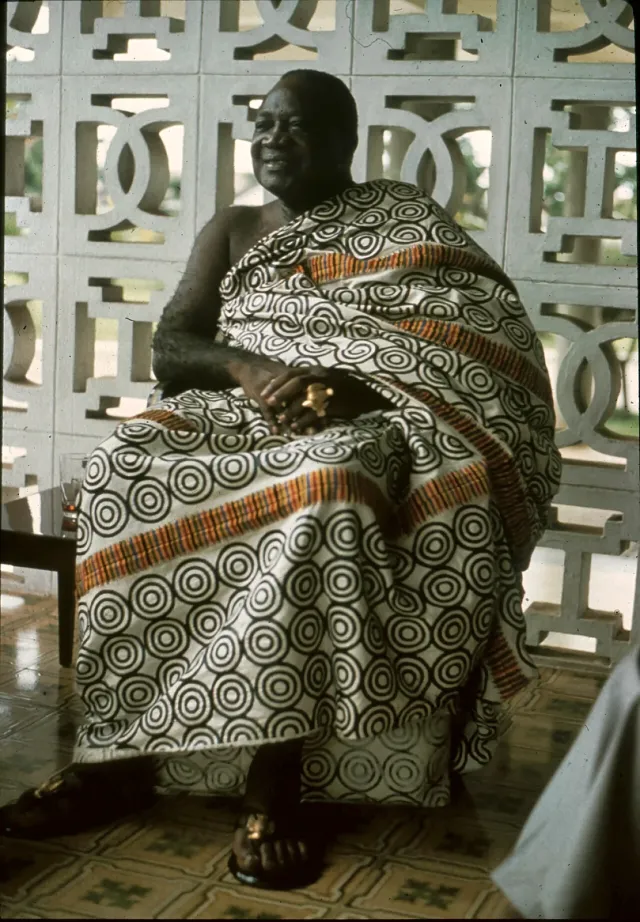
Opoku Ware II was born Jacob Matthew Poku in Kumasi on 30 November 1919. He was educated at an Anglican school and at Adisadel College in Cape Coast, worked as a building inspector and in…
Note on the sources16 October 1984 - 17 March 1985'Asante: Kingdom of Gold' in New York, 1984-85
In October 1984 the American Museum of Natural History in New York opened Asante: Kingdom of Gold, an exhibition of about 800 Asante objects drawn from the collections of the British…
Note on the sources1985 onwardThe Nkosuohene: a new stool for development
Nkosuohene (chief of progress or development); nkosuo (progress)One of the best-known customary innovations of the modern kingdom is the Nkosuohene, usually translated as development chief. Opoku Ware II created the Nkosuo stool in 1985 as a way of…
1995-1999Silver jubilee of 1995 and the death of Opoku Ware II, 1999
Opoku Ware II marked twenty-five years on the Golden Stool in August 1995 with a large jubilee celebration in Kumasi. He died in Kumasi on 26 February 1999 at the age of 79, after a reign…
Note on the sources