tradition: 1680s - 1701
How Kumasi got its name
Kum-ase - under the kum tree
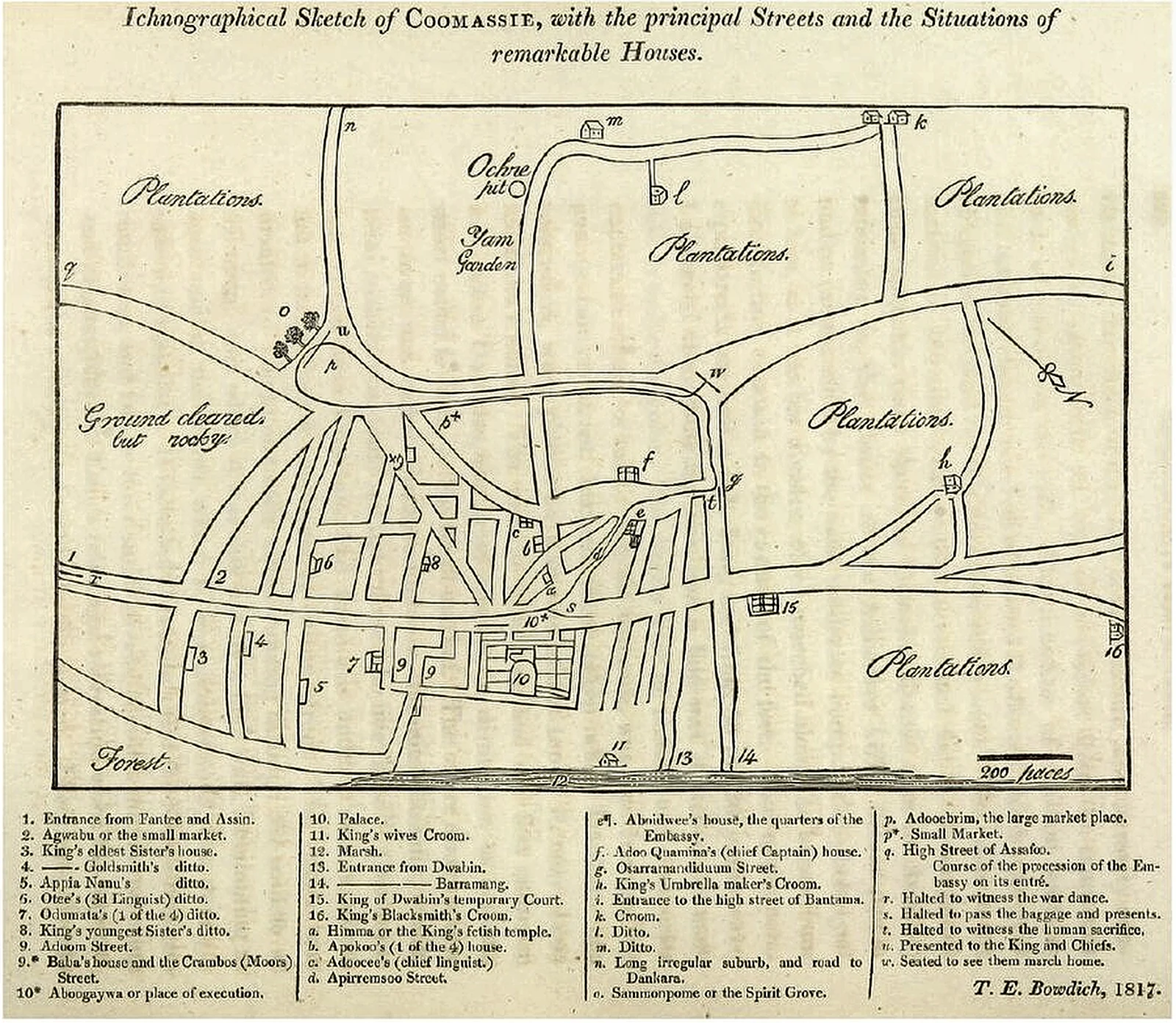
Kumasi grew out of the older settlement of Kwaman, and its name is explained as 'under the kum tree'. The best-known story says Okomfo Anokye planted two kum seedlings, one at Kwaman and one at Kumawu, and declared that the place where the tree flourished would be the capital; the tree at Kwaman lived. Other traditions give the credit to earlier rulers: that Oti Akenten bargained with the chief of Tafo for a plot under a kum tree, or that Obiri Yeboa founded his capital under such a tree, which is Reindorf's version. The first European visitors disagreed in the same way. Bowdich was told that Osei Tutu founded 'Coomassie'; Dupuis insisted that he did not found it but enlarged an existing town into a seat of government. Ivor Wilks described the site as the eastern slope of a ridge rising from the marshes of the Nsuben stream. Whatever the truth about the tree, Kumasi became the capital of the union only with the victory over Denkyira, when Osei Tutu was recognised as Asantehene.
Founder is Osei Tutu with Anokye (most oral sources, Bowdich), Oti Akenten (some traditions) or Obiri Yeboa (Reindorf). Dupuis says Osei Tutu enlarged rather than founded the town. Reference works give founding dates of 1680 and 1695.
Key facts
- Kumasi means 'under the kum tree'.
- Tradition says Anokye planted kum trees at Kwaman and Kumawu to choose the capital.
- The city stands on a ridge above the Nsuben marshes.