Lands › State by state, town by town
The history of every area
Each state, town and conquered land told as its own story: who founded it, how and when it came under the Golden Stool, what it owed, when it rose or broke away, and where it stands today. Where a land tells the story differently from Asante, both tellings are kept.
100 sourced entries · every source listed
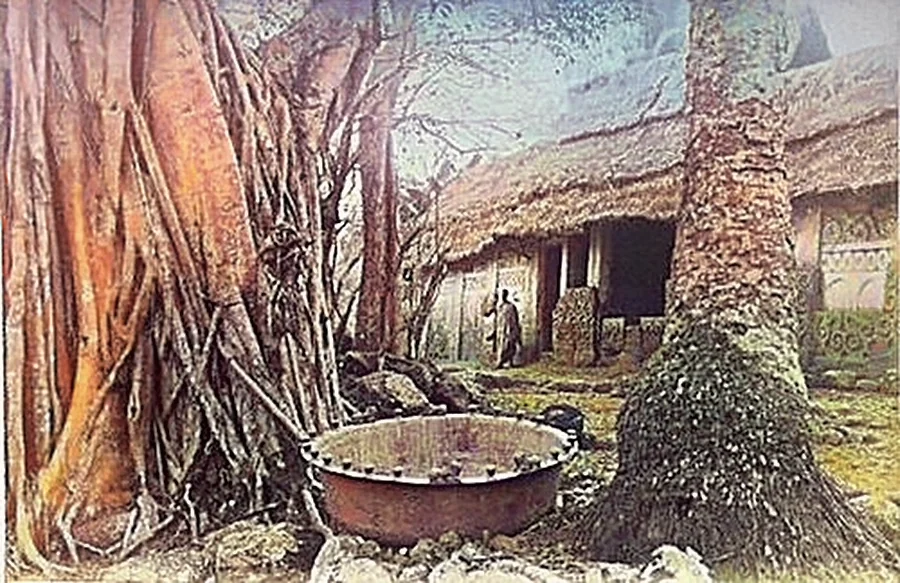
Kumase and its wards
Kumase: bought, begged or conquered ground that became the capital
Kumase (earlier Kwaman)Kumase began as the Oyoko settlement at Kwaman. The Manhyia Archives account says the Oyoko immigrants bought the land for 30 peredwans from Adwoa Krawiri of Kwaman, and that their first…
Note on the sourcesc. 1690s - presentAdum: the ward of the men from Anum
AdumReindorf's Gold Coast traditions (1895) give Adum an origin outside Asante. When Osei Tutu left the Akwamu court to take the Kumase stool, the Akwamu king sent him home with 700 men of…
Note on the sourcesc. 1700 - presentBantama: the war chief's ward and the kings' burial place
BantamaBantama is the seat of the Kumase Krontihene, the commander next to the king. Rattray's Agona informants (1929) said the Kronti title went to Amankwatia after Okomfo Anokye set a test…
Note on the sourcesc. 1700 - presentAsafo: the Akwamu division and its gold villages
Asafo; AkwamuThe chief of the Asafo quarter of Kumase is the Akwamuhene, second to the Krontihene in the command of the army. Rattray (1929) links the title to Osei Tutu's years at the Akwamu court,…
before c. 1680 - presentTafo: the old lords of the Kumase country
TafoBefore there was a Kumase, Tafo was the leading town of the district. The Manhyia Archives account places it in the first batch of settlements, founded by Ekuona, Aduana, Asenie and Agona…
Note on the sourcesbefore c. 1680 - presentAmakom: the neighbour whose chief was replaced by a brother-in-law
AmakomAmakom, east of the old town, was one of the first-batch settlements named in the Manhyia Archives account and, with Tafo, a holder of the land round Kwaman in the tradition Rattray took…
Note on the sourcesbefore c. 1650 - c. 1700Kaase, Ohwim and the other first towns swallowed by Kumase
The Manhyia Archives history of the union lists a first batch of settlements in what is now the city: Tafo, Otikrom, Amakom, Anyinase, Domaa, Kaase, Ohwim, Obookrom and Kwaman, founded by…
Note on the sources19th century - presentSuame: the village of the king's hammock bearers
SuameSuame, north of the old town, enters the written record as a service village of the palace. The editors of Agyeman Prempeh's writings note that the young prince's circle of friends in the…
18th century - presentAsokwa: horn-blowers, traders and a Tano shrine
Asokwa; asokwafo (horn-blowers)The name Asokwa is explained in Ghanaian oral history, as reported in a news feature, from the asokwafo, the horn-blowers of the Kumase court, whose village it was. Rattray shows what the…
c. 1680 - presentBreman: Oyoko village, royal refuge and Kakari's last stand
BremanBreman lies just north of the old town. The Manhyia Archives account names Oyoko-Breman among the villages that gave their allegiance to the first Oyoko rulers of Kwaman, and says Osei Tutu…
Note on the sourcesc. 1690s - presentAsokore Mampong: Anokye's temple and a defeated chief's place of exile
Asokore MamponAsokore Mampong, about ten kilometres from the centre of Kumasi, is tied in tradition to the Domaa wars and to Okomfo Anokye. Rattray's account of Anokye, taken at Agona in the 1920s, says…
Note on the sourcesTowns and villages of note
Bonwire: the weavers' town and the chief who chose to die
BonwireBonwire, about eighteen kilometres from Kumasi on the Mampong road, is the town most Asante name as the home of kente. The tradition summarised in its Wikipedia entry says that two hunters,…
Note on the sourcesearly 17th century - presentAntoa: an old town and the river that judges
Antoa; Antoa NyamaaAntoa, about seven miles from Kumasi, is listed in the Manhyia Archives history among the second batch of settlements of the future Asante country, founded by Bretuo, Aduana and Asona…
18th century - presentEjura: Mampong's Adonten town on the northern road
EdwiraEjura stands where the forest gives way to the savanna, on the road from Mampong to Atebubu, Yeji and Salaga. In Rattray's account of the Mampong state it is the capital of the Adontenhene,…
early 17th century - 1874Amoafo: an old town, a Bekwai birempon and the battlefield of 1874
AmoafoAmoafo, on the old main road south of Kumasi, is in the Manhyia Archives list of early seventeenth-century settlements, older than Bekwai, to which it later belonged. Asumegya's history…
1897 - presentObuasi: the gold town on Adanse and Bekwai land
ObuasiObuasi is a colonial town on old ground. The area had been mined for centuries before the town existed, in a country where the Adanse chief held rights over nuggets found on his land.…
17th century - presentKwabre and Mamponten: the crowded villages north-east of the capital
KwabreKwabre is the name of the thickly settled country north and north-east of Kumasi. The Manhyia Archives account names Amansie, Kwabre and Sekyere as the three areas in which the leading…
The founding states
Mampong: Bretuo of Adanse, commanders of the army, twice driven north
MamponThe Mampong stool belongs to the Bretuo clan with the Tana, who in the tradition Rattray recorded there (1929) came out of the ground, or down from the sky, at Adanse. Their leader…
Note on the sources17th century - presentDwaben (Juaben): the Oyoko rival that twice went into exile
DwabenDwaben's Oyoko rulers trace themselves to Asantemanso. In the stool history Rattray recorded, Ampobin Afra first settled at Juaben Mma (Little Dwaben) and Awere Tumfo founded the present…
Note on the sources17th century - presentBekwai: thirty guns on the Denkyira border, winner of the civil wars
BekwaeBekwai's Oyoko stool tells of an ancestor, Otutu Akate, who left the Dwaben family after a dispute over the stool and a child hidden in a palm-oil pot, and who beat the Asona people of…
Note on the sources17th century - presentKokofu: the elder house of the Oyoko
KokofuKokofu is where the royal Oyoko lived before Kumase. In the history Rattray recorded there, the ancestress Ankyewa Nyame came out of the ground at Asantemanso; her daughter Pinaman Panin…
Note on the sources17th century - presentNsuta: the Dako cousins at the twin rivers
NsutaNsuta's ruling line is Dako, the clan the Oyoko call inseparable from themselves. Its stool history, as Rattray took it down, shares an ancestress with Kumase and Kokofu at Asantemanso.…
Note on the sources17th century - presentKumawu: Aduana of the east and the price of Tweneboa Kodua's death
KumawuKumawu's Aduana stool claims the oldest emergence at Asantemanso: a dog carrying fire, a frog, then the ancestress Seni Fontom and her brother Adoforowa. Asumegya's history calls Kumawu a…
Note on the sourcestradition - presentAsumegya (Essumeja): keeper of the hole and commander of the left
AsumegyaAsumegya stands beside Asantemanso, the grove from which several clans say they emerged. Its Aduana stool, in the history Rattray recorded, was founded by Kusi Aduaku, and nephews of his…
Note on the sources17th century - presentOffinso: conquered by Osei Tutu, counted among the great states
OfinsoOffinso sits oddly in the traditions: it is both a conquered town and one of the great divisions. The Manhyia Archives account places 'Ofin So' in the second batch of settlements, founded…
Note on the sourcesOther states of metropolitan Asante
 17th century - present
Ejisu (Edweso): from a volunteer at Feyiase to Yaa Asantewaa's war
EdwesoEjisu is an Asona stool. The Manhyia Archives account lists Edweso among the towns founded in the early seventeenth century; Reindorf says Adanse chiefs named Aboagye Agyei and Burum Ankama…
Note on the sources c. 1701 - present
Agona: the stool Okomfo Anokye made from the spoils of Denkyira
Agona; Agona AkyempimAsante Agona is the priest's state. Rattray, who collected its history in the 1920s, was told that Okomfo Anokye was an Asenie man of Adanse Akrokyere and that Agona Akyempim had been…
Note on the sourcesbefore 1600 - presentAdanse: the old homeland that left in 1874 and came back in 1935
AdanseAdanse, between the Pra and the hills south of Lake Bosomtwe, is the country many Akan states name as their first home; its name is usually glossed 'builders'. It was a loose league of…
Note on the sourcesbefore 1600 - presentThe towns of Adanse: Akrokerri, Dompoase, Ayaase, Edubiase and Fomena
Adanse was never one town. The proverb quoted of it likens its chiefs to crabs, each lord of his own hole, and each town had its own clan and its own office in the state. Akrokerri, perhaps…
early 17th century - presentDenyase: the 'pusher' of the Kumase war chiefs
DenyaseDenyase, south of Kumasi, is one of the towns the Manhyia Archives account lists as founded in the early seventeenth century by Bretuo, Aduana or Asona groups, before Kokofu, Dwaben or…
18th century - presentDadease: the town Kokofu bought and could not keep quiet
DadeaseDadease lies near Kokofu, and its history is the history of that tie. Reindorf says that during the eighteenth-century war between Mampong and Dwaben, Dadease, then under the Dwabenhene…
Note on the sources 18th century - present
Manso Nkwanta: the gold villages that began the revolt against Mensa Bonsu
Manso NkwantaManso Nkwanta, in the gold country south-west of Kumasi, was not an old state but a cluster of mining villages belonging to a Kumase office. Rattray's Bekwai informants called them villages…
Note on the sourcesearly 17th century - presentAsokore: the Ekuona town that sold itself and was handed back
AsokoreAsokore, in the Sekyere country north-east of Kumasi, appears in the Manhyia Archives account among the towns founded in the early seventeenth century, in the same batch as Mampong, Kumawu…
Note on the sourcesearly 17th century - presentBeposo: the hill town that sold Nsuta its land
BeposoBeposo, between Mampong and Nsuta, is another of the early Sekyere towns in the Manhyia Archives list. Rattray's histories of its two neighbours both mention it. Nsuta's stool history says…
17th century - presentEffiduase and Jamasi: the right and left hands of Mampong
Effiduase; GyamaseEffiduase and Jamasi are the two wing towns of the Mampong state. In Rattray's account of the Mampong constitution (1929), the Effiduase chief is Nifahene, commander of the Mamponhene's…
Note on the sourcesc. 1600 (tradition) - presentKwaman (Kwamang): the third stool of the Afram war
KwamanKwamang, an Aduana town in the Sekyere hills, has no history of its own in the sources read here, but it stands in three other towns' stories. The tradition told at Agogo says that about…
Note on the sourcesc. 1600 (tradition) - presentAgogo: Aduana of Asante Akyem between Kumawu, Kumase and Bompata
AgogoAgogo, about eighty kilometres east of Kumasi, is an Aduana stool. Its tradition, as summarised in the reference entry on the town, says the Aduana dispersed from Asantemanso about 1500,…
Note on the sourcesc. 1700 - presentAsante Akyem: Bompata, Juaso, Dwease and the towns on the Akyem border
Asante AkyemAsante Akyem is the border country between Kumase and the Akyem states. Reindorf calls Ofosuhene Apenten, taken by Osei Tutu about 1700, 'king of Asante-Akem', and says Kotoku people were…
c. 1690s - presentAtwima and Nkawie: the western home district of Kumase
AtwomaAtwima is the country immediately west and south-west of Kumasi. It was never a state: its villages belonged to Kumase stools. Reindorf says that when Osei Tutu beat the Offinso chief, the…
19th century - presentTepa, Mankranso and Ahafo Ano: the edge of the hunters' forest
Ahafo AnoAhafo Ano, 'the mouth of Ahafo', is the north-western corner of the Ashanti Region, where the Kumase home district meets the old royal hunting forest. Its towns are young by Asante…
c. 1700 - presentKuntanase and the Bosomtwe country
KuntanaseKuntanase, on the road from Kumasi to Lake Bosomtwe, is one of the smaller Oyoko-ruled towns of the heartland. Rattray groups it with Dwaben, Kokofu and Nsuta when he explains the saying…
before 1701 - presentAbodom and Pekyi: Kumase villages that became Bekwai's great chiefs
Abodom; PekyiAbodom and Pekyi are two small stools of the Amansie country south of Kumasi whose history shows how the civil wars of the 1880s rearranged the map. Abodom is old: Asumegya's stool history,…
Note on the sources19th century - 1920sAsekyiri, Asaman and Aboso: three Kumase stools that went over to Kokofu
Rattray's account of the Kokofu state in the 1920s lists three birempon, great subordinate chiefs, directly under the Kokofuhene: Asekyiri, Asaman and Aboso. None had begun as a Kokofu…
Note on the sourcesLands to the east and the Volta
The Afram Plains: Ataara Finam's country and four claims to its conquest
AframEast of Kumawu the land drops to the Afram river and the Volta. Before the Asante states held it, tradition says it belonged to a ruler called Ataara Finam, whose people the Akan called…
Note on the sources1740s - presentKrakye: the oracle town Dwaben was given and could not hold
KrakyeKrakye, on the Volta, was the home of the Dente oracle. Its people are Guan; Reindorf says emigrants from Larteh in Akuapem carried their god to Nkonya and Krakye and named it Odente there.…
Note on the sourcesc. 1650 - presentKwahu: kin on the scarp who were never fought and left in 1874
KwawuThe Kwahu live on the high scarp east of Asante Akyem. Their own traditions bring them out of Adanse when Denkyira broke it, about 1650: one party under Osei Twum settled at Bukuruwa, and…
Note on the sourcesc. 1600 - presentAkwamu: the teacher of Osei Tutu, reduced to an eastern client
AkwamuAkwamu was a great power before Asante existed. Its Abrade rulers came from the Twifo country, built a capital at Nyanoase near the Atewa hills, destroyed the Ga kingdom of Accra in the…
Note on the sourcesc. 1740s - 1886Krepi and Peki: Ewe hill states ruled through Akwamu, invaded in 1869
KrepeKrepi was the European and Akan name for the inland Ewe states east of the Volta, of which Peki was the leading one. Peki's people say they are partly autochthonous and partly migrants from…
Note on the sourcesc. 1690s - presentAnum: the Guan town that gave Kumase a ward and lost its people in 1869
AnumAnum is a Guan town on the east bank of the Volta, with its neighbour Boso. Reindorf lists the Anum among the hill peoples, with the Larteh, Kyerepong and Nkonya, who crossed the river to…
Note on the sources19th century - presentBuem: mountain villages on the edge of the Asante wars
BuemBuem is the hill country north of the Ewe and Nkonya, between the Volta and the Togo border, whose people are called Balemi. A summary of ethnographic notes says they were first led by…
Note on the sourcesc. 1730 - presentNkonya and Wusuta: Guan and refugee towns that Nsuta claimed beyond the Volta
Nkonya; WusutaThe Nkonya are a Guan people living in a group of towns east of the Volta. Their own history, as set out by the Guan writer Kwame Ampene, brings their ancestors from near Kpembe in the…
Note on the sources1811 - 1869Ada and Anlo: the Volta mouth, a Danish fort and Asante's coastal ally
Ada; Anlo (Awuna)Two peoples held the mouth of the Volta. The Ada, on the west bank under the Danish fort Kongensteen, were drawn in by the rebellion of 1811. The Akuapem king Kwaw Safrotwe escaped through…
Note on the sourcesLands to the south
Denkyira: the old overlord, a province for 120 years, then a people in exile
DenkyiraDenkyira was the power the Asante union was made to break. Its Agona-clan rulers rose on Adanse's western edge, built the capital Abankeseso near the Oda and Offin, crushed Adanse about…
Note on the sources1698 - presentAssin: two chiefdoms on the great road, emptied by the wars
AsenAssin lay astride the road from Kumase to Cape Coast, south of the Pra. It was two states, not one: Apemanim in the east, and Atandansu (Reindorf's Tanoso) in the west. Denkyira had…
Note on the sourcesbefore 1500 - presentTwifo: the old gold market between Denkyira, Asante and the coast
TwifoTwifo, on the lower Pra and Offin with its market town at Hemang, was one of the oldest inland trading states, known to Europeans for gold by the early sixteenth century. Akwamu tradition…
Note on the sourcesc. 1700 - presentThe Fante states: a coalition that blocked the road, then twenty years under Asante
MfantseThe Fante were never one kingdom. Their traditions bring them from the Bono country to Mankessim under three leaders, Oburumankoma, Odapagyan and Oson, and from there the states of Abora,…
Note on the sources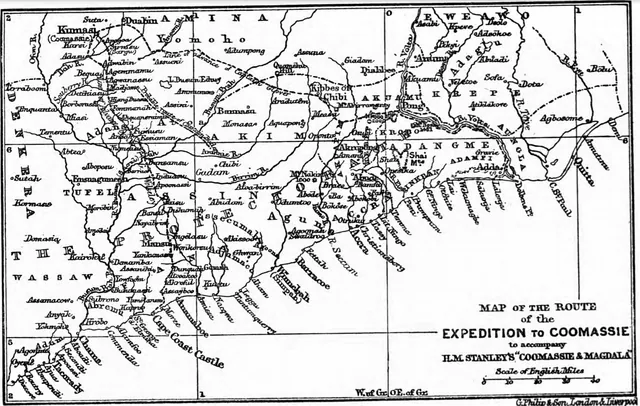 1807 - 1831
Cape Coast, Anomabo and Komenda: towns under the forts that paid for their words
Oguaa; Anomabo; KomendaThe three British fort towns of the central coast were never garrisoned by Asante, but between 1807 and 1823 each learned that it stood inside the king's reach. Anomabo was attacked on 15…
Note on the sources1701 - 1872Elmina: the friend on the coast whose loss brought on the war of 1873
EdinaElmina was different from every other coastal town: it was never conquered and it wanted the Asante connection. The tie began with the fall of Denkyira, when, as Fuller and Reindorf both…
Note on the sourcesc. 1742 - 1826Accra: the 'brother' town that turned and won at Katamanso
NkranThe Ga towns of Accra had been broken by Akwamu in the seventeenth century and lived under Akwamu governors for some fifty years. Reindorf, himself a Ga pastor writing from Accra…
Note on the sources1730s - presentAkuapem: hill towns freed from Akwamu, taxed by Asante, lost in 1826
AkuapemThe Akuapem ridge north of Accra was settled by Guan and Kyerepong communities, among them Larteh, Mamfe, Abiriw, Dawu, Awukugua and Adukrom. Reindorf says the Akwamu king Ansa Sasraku gave…
Note on the sourcesc. 1700 - presentAkyem Abuakwa: Asona from Adanse who killed one Asantehene and outlasted five
Akyem AbuakwaAkyem Abuakwa's Asona rulers say they left Adanse in the troubles of the seventeenth century; Reindorf names the leaders who refused Osei Tutu's call to return. The Akyem had backed…
Note on the sourcesc. 1700 - presentAkyem Kotoku: the state that kept moving
Akyem KotokuKotoku's history is a series of removals, most of them forced by Asante. Its Agona-clan stool is traced to the Denkyira side: the reference history says Ofosu Apenten brought a Denkyira…
Note on the sources17th century - presentAkyem Bosome: the smallest Akyem state and its villages left behind in Asante
Akyem BosomeAkyem Bosome is the third and smallest of the Akyem states, with its capital at Akyem Swedru. Its name points back to Lake Bosomtwe. The tradition given in the reference entry says its…
Note on the sourcesc. 1700 - presentWassa: one gold state, raided for a boast, later split into Amenfi and Fiase
WassaWassa, the gold country west of the lower Pra, paid tribute to Denkyira before 1701; Reindorf says its ruler refused to fight for Ntim Gyakari after a quarrel over a wife. A Ghanaian press…
Note on the sources18th century - presentNzema (Apollonia): the far south-west, beyond effective reach
Nzema; AmanahiaThe Nzema coast, called Apollonia by Europeans and Amanahia in older Twi usage, lies beyond Wassa and Aowin at the far south-western corner of modern Ghana. Reindorf lists Amanahia among…
Note on the sources1811 - 1826Krobo: the mountain that could not be taken
KroboThe Krobo, an Adangme people living on and around an isolated hill north of the Accra plain, enter Asante history as a place of refuge. Reindorf, whose informants were neighbours of the…
Note on the sources1806 - 1863Asikuma: the inland Fante town where fugitives ran and armies followed
AsikumaAsikuma, an inland town on the northern edge of the Fante country, appears again and again in the wars because it was the first place of safety south of Assin and Akyem. In 1806 the Assin…
1807 - 1826Winneba, Obutu and Agona on the coast: the south-eastern edge of the conquest of 1807
Simpa; ObutuEast of the Fante states the people of Winneba, the Obutu (Awutu) and the state of Agona lay between Asante's armies and Accra, and were struck from both sides. Reindorf, writing from…
Note on the sourcesLands to the north
Nkoranza: founded by an Amakom refugee, ally for 170 years, rebel in 1892
NkoransaNkoranza begins with a loser of the wars round Kwaman. When Osei Tutu killed the Amakom chief Akosa, Akosa's brother Bafo fled north to Amo Yaw, king of the Bono at Takyiman, who settled…
Note on the sources1723 - presentTechiman: heir of Bono Manso, destroyed twice, out of the Confederacy in 1952
TakyimanTechiman is what was left of Bono, the oldest Akan kingdom, after Opoku Ware's army took its capital Bono Manso in 1722-23. Asante tradition, in Reindorf and Fuller, makes the cause the…
Note on the sourcesfirst millennium CE - presentWenchi: an ancient Bono town in the Asafo chief's following
WankyiWenchi is among the oldest inhabited places in the Akan world. Its people say their ancestors came out of a hole in the ground at Bonoso, dug out by a burrowing animal called wankyie from…
Note on the sourcesc. 1770s - presentBanda: three years of war for the head of Worosa
Banda (Banna)Banda lies on the Black Volta where the forest roads met the route to Kong. It was drawn into Gyaman's orbit before Asante reached it. The war that made it an Asante province was fought…
Note on the sourcesc. 1690 - presentGyaman: the Abron kingdom of the Domaa who would not come back
GyamanGyaman is the other half of the Domaa story. Its Aduana rulers left Akwamu, lived for a time near Suntreso and Asantemanso, lost the wars with the Oyoko of Kwaman, and moved north-west to…
Note on the sourcesbefore 1701 - presentAtebubu: gatekeeper of the kola road and refuge of Asante's exiles
AtebubuAtebubu, the chief town of the eastern Bron, commanded the road from Mampong to the Volta crossing at Yeji and on to Salaga. Asante tradition claims it early: Asumegya's history lists…
Note on the sources1740s - presentYeji and Prang: the Volta crossing and its Guan chiefs
Yegyi; PranYeji is the crossing of the Volta on the road from Kumase to Salaga, and Prang lies just south of it. Their people are Guan-speakers; one account of Guan origins counts Yeji among the…
Note on the sourcesc. 1745 - presentSalaga and Kpembe: Asante's northern market and the Gonja chief who owned it
Salaga; KpembeSalaga was a market, not a state. It stood on the land of Kpembe, the eastern division of Gonja, whose chief was its owner. Asante attacked Kpembe in 1745 and again in 1751, and from then…
Note on the sources1730s - presentGonja: the kingdom of Jakpa's sons, tributary division by division
NtaGonja was founded by a Mande expedition from the north-west, traditionally under Ndewura Jakpa, whose descendants, the Ngbanya, rule its divisions in rotation under the Yagbonwura. It lay…
Note on the sources1744-45 - presentDagbon: tribute in people, and an argument over whether it was ever conquered
Yane (Reindorf's spelling of Yendi)Dagbon, the kingdom of the Dagbamba with its capital at Yendi, traces its kings to Naa Gbewaa and his descendants Sitobu and Nyagse; the capital was moved east to Yendi under Naa Luro after…
Note on the sources1730s - c. 1780Krupi, Namonsi and the Bron marches: how the north was shared out, and lost by Mampong
Reindorf preserves a list, found nowhere else in the sources read, of how Opoku Ware's northern conquests were handed to the great chiefs. Three lands lay between the Bron country and…
Note on the sources17th century - presentWa: a Muslim kingdom beyond the tribute line
Wa, the capital of the Wala kingdom in the far north-west, is sometimes drawn inside maps of 'Greater Asante'. Nothing found in this session supports that. The standard study, Ivor Wilks's…
Note on the sourcesc. 13th century (tradition) - presentMamprugu: the senior kingdom of the north, outside Asante's reach
Mamprugu is the eldest of the kingdoms that trace their kings to Naa Gbewaa. Its tradition says the dynasty descends from a warrior called Tohazie, whose grandson Gbewaa settled at Pusiga…
Note on the sourcestradition - presentNanun: the Nanumba of Bimbilla, in Dagbon's shadow
Nanun, the country of the Nanumba, lies south-east of Dagbon with its capital at Bimbilla. Its tradition makes the founder, Gmantambo, a son of Naa Gbewaa, so that the Nanumba, Dagbamba and…
c. 1875 - presentKintampo: the market Kumase raised when Salaga was lost
KintampoKintampo owes its place in history to the collapse of 1874. When Salaga and eastern Gonja threw off Asante control, the Kumase government and its traders needed a northern market that they…
c. 1740 - 1819Kong and Bouna: the Muslim states beyond the north-west frontier
Beyond Gyaman and Banda lay two states Asante fought but never held. Kong, a Muslim trading town three months' march from Kumase in Reindorf's reckoning, appears in the traditions as the…
Note on the sourcesLands to the west
Dormaa: the Aduana who held Kwaman first, fought three wars and went west
DomaaThe Dormaa are the people the Oyoko had to beat before there could be a Kumase. They are Aduana who, by their own and Akwamu tradition, left Akwamu after a dispute between brothers; the…
Note on the sources18th century - presentBerekum: Kumase's sentry on the Gyaman road
BerekumBerekum, between Sunyani and the Gyaman border, was made by the Asante wars in the north-west. Reindorf and Fuller both list it among the towns built by Domaa people who stayed behind when…
Note on the sourcesc. 1700 - presentSunyani, Odumase and Abesim: Domaa villages that became a regional capital
SunyaniThe country round Sunyani was Domaa land. When Osei Tutu broke the Domaa, Reindorf and Fuller say, those who did not go on to found Gyaman built Abesim, Berekum and Odumase and became…
Note on the sourcesc. 1700 - presentSefwi: the raid on Kumase, the loss of Ahafo, and a long quiet tribute
SehwiSefwi, in the forest beyond the Tano, grew from groups of refugees out of Bono, Adanse, Denkyira and Asante who settled on former Aowin land; one explanation of its name is 'the war is…
Note on the sourcesc. 1677 - presentAowin: the gold land whose royals went west and founded new kingdoms
AowinAowin lay between the Tano and Bia rivers, astride gold workings and the roads from the savanna markets to the western forts. Its people are said to descend from Bono migrants, perhaps from…
Note on the sourcesLands lost and regained
New Juaben (Koforidua): the Dwaben who never went home
Dwaben FoforoNew Juaben is an Asante state on Akyem land. It was founded by the Dwaben who lost the war of 1875. After Kumase was burned in 1874 the Dwabenhene Asafo Agyei had his independence…
Note on the sources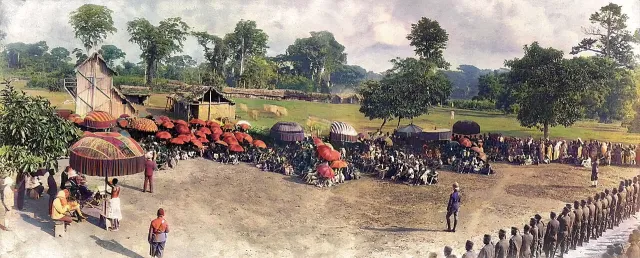 c. 1718 - present
Ahafo: the hunters' forest taken from Sefwi, given back to Kumase chiefs, and made a region
AhafoAhafo is the forest country stretching west to the Bia. Fuller says it was taken from Sefwi after the death of Ebirim Moro about 1718 and became the 'new forest', the game preserve of the…
Note on the sources1935 - 2019The Bono states, 1935-1959: put back under Kumase, then taken out for good
BonoThe north-western states that Asante had conquered in the eighteenth century, Techiman, Dormaa, Gyaman, Berekum, Wenchi, Nkoranza and their neighbours, had mostly broken away between 1874…
Note on the sources1900 - 1901What each state was asked to pay in 1900, and which stools stood empty in 1901
In March 1900 Governor Hodgson came to Kumase and demanded, with the Golden Stool, a yearly indemnity payment of 2,000 peredwans. Fuller, who became Chief Commissioner, prints how that sum…
Note on the sources1902 - 1913Four provinces, 1902-1913: how the British redrew the areas of Asante
After the rising the British stopped treating Asante as one kingdom and governed it as a set of districts. Fuller, who was Chief Commissioner, describes it. An ordinance in force from 1…
Note on the sourcesDistricts today
Greater Kumasi today: one metropolis and six municipalities
The old capital and its wards are now seven separate local governments. The Kumasi Metropolitan area proper, in which Adum and Bantama lie, had 443,981 people at the census of 27 June 2021.…
Note on the sources2021Amansie today: Bekwai, the Manso districts and the lake
AmansieAmansie is the country south of Kumasi from which the Oyoko, Aduana and other clans say they first spread; the Manhyia Archives history names it with Kwabre and Sekyere as the three areas…
2021Sekyere today: Mampong, Nsuta, Kumawu and the road north
SekyereSekyere is the hill country north-east of Kumasi, the third of the areas the Manhyia Archives history names as home to the leading states of the 1680s. Mampong, Nsuta, Kumawu and Agona all…
2021Adanse today: four districts and the two halves of Obuasi
AdanseThe old Adanse country north of the Pra is divided among six local governments. Adansi North, whose capital is Fomena, the seat of the Adansehene and the place where the treaty of 1874 was…
2021The eastern districts today: Ejisu, Juaben and Asante Akyem
East of Kumasi the Accra road runs through five districts whose histories pull in different directions. Ejisu Municipal, the town of Kwasi Afrane and Yaa Asantewaa, destroyed by a British…
2021The north and west today: Kwabre, Offinso, Atwima and Ahafo Ano
The districts north and west of Kumasi hold nearly a third of the Ashanti Region's people: 1,754,521 at the 2021 census, in twelve local governments. They fall into four old areas. Kwabre,…
Note on the sources