History › Greater Asante
Conquests, provinces and the great roads
The peoples and states brought under the Golden Stool, how each was ruled and what it paid, the roads, trade and diplomacy that held the whole together, and how it came apart.
102 sourced entries · every source listed
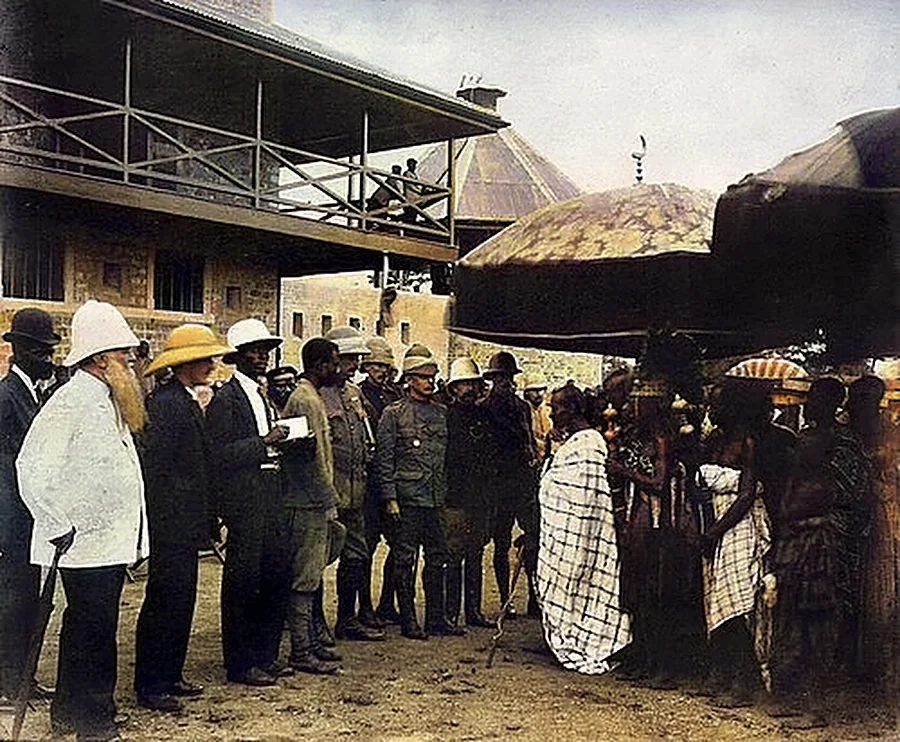
Shape of the empire
Four degrees by four: Dupuis measures the empire in 1820
Joseph Dupuis, the British consul who spent February and March 1820 in Kumase, gave the first reasoned outline of how far Asante power ran. Working from what Kumase Muslims and court…
Note on the sources1817-1820'Twenty-one nations pay tribute': counting the subject states in 1817
How many peoples lay under the Golden Stool? The best contemporary count comes from the Gyaasewahene Opoku Frefre, whom Thomas Bowdich called Apokoo, keeper of the king's treasury. In 1817…
Note on the sources1817Bowdich's table of fighting men and the argument over numbers
Bowdich tried to work out the population of Asante from the number of soldiers each district could send to war. For the heartland he allowed 60,000 people to the Kumase district, 35,000 to…
Note on the sources1700-1896 (scholarship of 1967-2021)Provinces, protectorates, tributaries: three scholars' maps of Greater Asante
Historians do not agree on how to describe the parts of the empire. Kwame Arhin, in 'The Structure of Greater Ashanti' (1967), argued that the old picture of Asante wars as slave raids or…
Note on the sources18th-19th centuryAn empire one month wide: the forty-two-day circle
Asante had no drawn maps of its own territory. Ivor Wilks argued in 1992 that people at the centre nonetheless carried a clear picture of it in their heads. Greater Asante was imagined as a…
1817-1874The inner circle: what set Dwaben, Mampon, Nsuta, Bekwai and Kokofu apart
amantoBetween the capital and the conquered provinces stood the old allied states of the union. Bowdich recorded in 1817 what marked them off from mere tributaries. Four of them, which he spelled…
Note on the sourcesc. 1700-1820How Kumase remembered the building of the empire in 1820
Dupuis's 'Historical Memoirs of Ashantee' set down, reign by reign, what court and Muslim informants in Kumase said each king had added. The dates are his and are often wrong, but the order…
Note on the sourcesc. 1730s-1750 (tradition recorded 1895)Sharing out the north: Reindorf on Opoku Ware's settlement
Carl Christian Reindorf, the Ga pastor-historian who collected traditions in the 1860s to 1890s, preserved an account of what Opoku Ware did with his northern and north-eastern conquests.…
Note on the sources1800-1921A British verdict: 'conquered but never governed'
Sir Francis Fuller, Chief Commissioner of Ashanti from 1905 to 1920, drew on Kumase informants for his history A Vanished Dynasty (1921). His summary of the empire at Osei Bonsu's accession…
Note on the sourcesSouthern provinces
Denkyira as a province: from Feyiase to the flight of Kwadwo Tibo
After its defeat in 1701 Denkyira did not disappear; it became the first great province of Asante. A rising in 1706-07, when the Denkyira reoccupied their ruined capital, was crushed. In…
Note on the sources1806-1853Assin: the province on the road
Assin mattered because the main road from Kumase to the sea ran through it. In Osei Bonsu's time it was divided into two principalities, both subject to Asante: Fuller describes a western…
Note on the sources1807-1823Fante under Asante, 1807-1823: notes, residents and resentment
The Fante campaigns of 1807, 1811 and 1814-16 left Asante claiming the whole coast between the Pra and Accra. The claim took a practical form in the 'notes', the monthly pay-documents that…
Note on the sources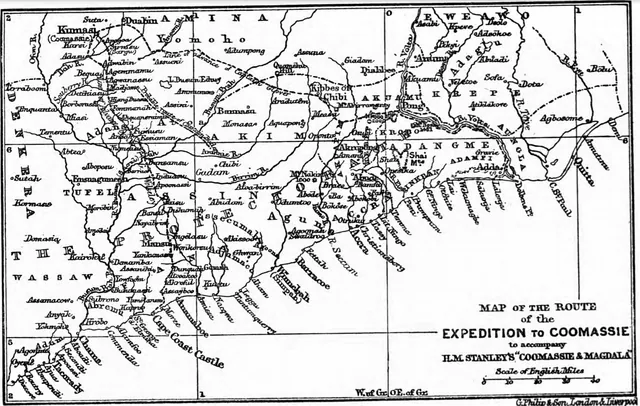 1817-1820
Cape Coast and Komenda: fealty priced in gold
Two episodes show what submission cost a coast town. In 1817 Komenda, which had seized and sold ninety-eight Elmina people, was called to account while Bowdich was in Kumase. The king first…
1701-1872Elmina: an ally with a pay-note, not a province
Elmina was never governed from Kumase, but it was Asante's oldest friend on the coast and its chief source of powder and guns. The tie was expressed in a payment. Larry Yarak's study of the…
Note on the sources1742-1826Accra and Osu: tribute by note, 1742-1826
Asante reached the Ga coast after defeating Akyem in 1742, and from then the three European forts at Accra paid their ground-rent notes to Kumase. Danish records cited by modern historians…
1742-1831Akyem Abuakwa: the province that would not stay conquered
Akyem was defeated in 1742, and Asante installed captured heirs as rulers under its authority. From then until 1831 Abuakwa swung between tribute and revolt. In 1764 Akyem joined a…
Note on the sourcesc. 1750-1865Akyem Kotoku, Bosome and the rebel Kwadwo Kuma
Kotoku, the second Akyem kingdom, followed a different path from Abuakwa. According to work by Kiyaga-Mulindwa cited in current reference summaries, Kotoku moved into the Asante-Akyem area…
Note on the sources1742-1826Akuapem: the hill state on the Accra road
The Akuapem ridge commands the last stage of the road from Kumase to Accra, and Asante treated it as part of the same south-eastern province as Akyem. Bowdich was told its contingent, with…
c. 1730-1831Wassa and Twifo: the unruly south-west road
Wassa and Twifo lay across the south-western road from Kumase, through Denkyira, to Elmina and the Ahanta coast. Dupuis's informants credited Opoku Ware with first gaining a foothold toward…
Note on the sources18th century-1888Kwahu: the quiet province on the scarp
Kwahu, on the high scarp east of Kumase, is described by Dupuis as a fruitful country with a valuable fishery on the Volta, and by his informants as among the earliest lands taken by Osei…
Note on the sourcesEastern and Volta lands
Akwamu: old teacher, eastern ally
Akwamu had sheltered the young Osei Tutu, and after its own empire was broken by Akyem and its allies in 1730-33 the remnant state across the Volta at Akwamufie became Asante's partner in…
Note on the sources1730s-1869Krepi (Ewedome): ruled through Akwamu
The inland Ewe states that Akan-speakers called Krepi (Peki, Ho, Anum's neighbours and many small towns) came into the Asante sphere at second hand. Reindorf explains that after 1733 the…
Note on the sources1869-1871The eastern army of 1869: a bid to recover the Volta
In 1869 Kumase tried to restore by force what the Akwamu alliance could no longer hold. An Asante army under Adu Bofo, which Fuller puts at about 30,000 men, crossed the Volta in concert…
Note on the sources1764-1880Across the Volta: Asante and Dahomey
The Volta was the empire's eastern edge, and beyond it stood Dahomey, a kingdom Asante treated as an equal. The relationship began badly. Dupuis was told that under Kusi Obodom the chiefs…
Note on the sourcesbefore 1874-1876The Volta as a road: salt, Bonnat and Gouldsbury
The Volta was a highway as well as a frontier. Before 1874, Akyeampong writes, salt made at Ada in the river's estuary was paddled upstream, unloaded at the rapids near Krakye and carried…
Note on the sourcesNorthern provinces
Takyiman after the fall of Bono: a province under a Kumase stool
The first pass told how Bono was conquered in 1722-23. What followed is less often described. Fuller's Kumase informants said the Bonohene Amo Yaw and the queen mother were carried to…
Note on the sources1722/23-1893Nkoranza: the ally excused from tribute
Nkoranza owed its rise to Asante. Tradition recorded by Reindorf and Fuller says that Bafo, a refugee from Asante living in Bono, betrayed his host Amo Yaw to Opoku Ware and was rewarded…
Note on the sources1773/74-1906Banda: conquered ally on the Gyaman frontier
Banda, a small Nafana-ruled state on the Black Volta bend north-west of Kumase, was forced under Asante rule in 1773-74 according to the archaeologist Ann Stahl, whose excavations at Makala…
Note on the sourcesc. 1740-1875What Gyaman paid: gold by the peredwan and the kponta
Gyaman, the Abron kingdom around Bonduku, was valued for its gold. Asante destroyed its capital in 1740-41 and took tribute from then until 1875. Three sets of figures survive and they do…
Note on the sources1819-1875Gyaman after Adinkra: occupied province, 1819-1875
The Gyaman war of 1818-19 is told elsewhere; here the question is what became of the kingdom. Dupuis, in Kumase a year later, heard the settlement from both sides. The king said Adinkra had…
Note on the sourcesc. 1732-1874Western and central Gonja: Daboya, Buipe and the house of the king's imam
Gonja was not one province but several divisions under a distant paramount, and Asante dealt with them separately. For the western and central divisions the evidence is thin but pointed.…
Note on the sourcesc. 1745-1874Kpembe and the Lepowura: how eastern Gonja paid
Eastern Gonja, the division of Kpembe, held the land on which Salaga stood. Asante fought Kpembe in 1745 and again in 1751, and thereafter treated it as a tributary. How the tribute worked…
Note on the sourcesc. 1750-1892Salaga: the stranger town Asante made its northern port
Salaga was a zongo, a strangers' quarter. The Kpembewura's account is that a Hausa trader was given land a few miles from Kpembe and that the settlement grew into a market where Hausa was…
Note on the sourcesc. 1745-1874Dagbon's tribute: three sets of figures and a consul's doubt
No part of the empire is more argued over than Dagbon. Bowdich's statement of 1817 is the earliest: 'Inta' and 'Dagwumba' never paid in gold, having cowries for money, and the capital and…
Note on the sources18th century-1874Naa Garba's debt and the Kambonsi: Dagbon's own telling
Kambonsi (Dagbani, 'Asante-style gunmen')Dagbamba drum historians do not speak of conquest. As the drummer whose teaching John Chernoff recorded in A Drummer's Testament tells it, relations with Asante began in the time of Naa…
Note on the sources1817Kumase and Yendi compared: a price list of 1817
Bowdich's Muslim acquaintances in Kumase had travelled the northern roads, and from them he compiled a small table comparing the cost of living in Kumase with 'Yahndi', the Dagomba capital.…
Note on the sources18th century-1894The Bron country and Atebubu, east of Mampon
North-east of Kumase, between Mampon and the Volta, lay a belt of small states that the sources call Bron, Brong or 'Booroom': Atebubu, Krakye, the Nchumuru and others. Reindorf says Opoku…
Note on the sources18th century-1894Krakye and the Dente oracle: a vassal whose god the kings consulted
Dente bosomfo (priest of Dente)Krakye, on the Volta below Salaga, was a small community of farmers and hunters that owned something Asante valued: the shrine of the god Dente. Emmanuel Akyeampong, following Donna Maier's…
Note on the sourcesc. 1740-1897Bouna and Kong: neighbours beyond the tribute line
North-west of Gyaman lay two states that Asante never ruled but could not ignore. Kong, the Dyula trading kingdom, was the great rival for Gyaman's allegiance. Bowdich heard that Kong had…
Note on the sources18th-19th centuryBeyond the tributaries: where the slaves came from
Asante's northern tributaries paid largely in people, but those people were seldom their own. Both the Dagbamba and the Gonja accounts recorded in recent decades describe a further zone…
Western lands
Aowin: beaten, scattered, and still bargaining in 1817
Aowin was the gold-trading power of the south-western forest before Asante. In 1715 an Asante army under Amankwatia, helped by the rising state of Sefwi Wiawso, invaded and defeated it; the…
Note on the sources1715-1887Sefwi: ally against Aowin, payer of 200 peredwans
Sefwi grew up in the seventeenth century on land once held by Aowin, peopled by migrants from Bono, Adanse, Denkyira and Asante; its name is explained as 'Esa awie', 'the war is over'. It…
Note on the sourcesc. 1720-1902Ahafo: the king's game forest
West of Kumase, between the Tano and the Bia, lay thinly peopled high forest that came to Asante with the defeat of Aowin and Sefwi. Fuller wrote that after the pursuit of Ebiri Moro the…
Note on the sourcesc. 1720-1874Apollonia and Amanahia: the far south-west
The Nzema coast, which Europeans called Apollonia after the British fort there and Akan-speakers called Amanahia, was the farthest reach of Asante influence on the sea. It was approached by…
The great roads
Eight roads, not nine: Dupuis's list of 1820
akwantempon / nkwantempon (great roads)The earliest full list of the great roads leaving Kumase comes from Joseph Dupuis, who corrected Bowdich's count of nine to eight and described each. Four led to the sea; he called them the…
Note on the sources18th-19th centuryRoutes I to VIII: the numbering historians use
Ivor Wilks gave the eight great roads Roman numerals, running clockwise from the north-west, and the numbering has become standard. As summarised from his Asante in the Nineteenth Century:…
Note on the sourcesc. 1750-1890sPath-clearers and road wardens: the akwanmofo and nkwansrafo
akwanmofo (road inspectors/clearers); nkwansrafo (road wardens)Two bodies of officials kept the great roads working. The akwanmofo were responsible for clearing and inspection. Tradition credits Kusi Obodom (1750-64) with first appointing inspectors…
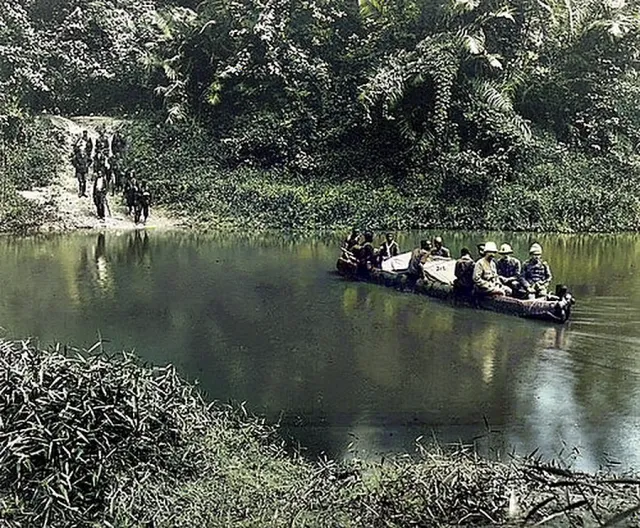
Note on the sources22 April - 19 May 1817Cape Coast to Kumase in 1817: Bowdich's stages
Bowdich's journal is the first day-by-day record of the coast road, later called Route VI. The mission left Cape Coast Castle on 22 April 1817 and went by Mouri to Anomabo. On 24 April it…
Note on the sources9 - 28 February 1820The same road three years later: Dupuis's journey of 1820
Dupuis travelled the coast road in the dry season and in nineteen or twenty days against Bowdich's twenty-seven. He left Cape Coast on 9 February 1820, gave up his palanquin almost at once…
Note on the sources1816-1841Straightening, widening and bridging, 1816-1841
The great roads were not made once and left. In 1816, after the last Fante campaign, Osei Bonsu ordered the two main coast roads rebuilt: straightened, cleared of roots and cut to a…
Note on the sources1817-1841How fast news travelled
afenasoafo (sword-bearers); nseniefo (heralds)Orders and news moved along the roads with the king's messengers. Before the nineteenth century a courier memorised his message word for word; by the 1810s couriers commonly carried…
Note on the sourcesrecorded 1895Messages without writing: bullets, corn and red cloth
Reindorf's chapter on the constitution of the Akan states preserves the code of objects by which rulers sent messages along the roads to people who could not read. The death of a chief was…
1820Distances in 'journeys': the north as Kumase Muslims measured it
The Muslim traders whom Dupuis questioned in Kumase measured the empire in day's journeys, and he converted them to miles at roughly sixteen to the day. Their figures show how the capital's…
Note on the sourcesTribute, trade and money
The tribute list of 1817
Bowdich set out, province by province, what he was told each dependency paid. It remains the fullest statement of Asante tribute. Payments followed what each land produced. The gold…
1817-1870sWho gathered the tribute, and what stuck to their hands
Tribute did not collect itself. Bowdich learned that the men sent from Kumase to bring it in were allowed a commission of two peredwans in every ten, a fifth of the whole. Reindorf…
1817-1867The exchequer court and the Great Chest
Adaka Kesee (Great Chest); Apim Adaka (chest of a thousand)Bowdich watched the Asante treasury at work in 1817. Opoku Frefre, the Gyaasewahene, kept the royal treasure, held the only key and presided over a daily exchequer court. Before the bag of…
Note on the sources1817Where the king's gold came from: Bowdich's eight heads of revenue
awunnyadee (death duties)Besides provincial tribute, Bowdich listed the home sources of the royal revenue as they were explained to him. First came the estates of the dead and the disgraced: the king was heir to…
Note on the sources1817-1874From pesewa to peredwan: the scale of gold-dust money
pesewa, dama, taku, soa, benna, peredwanEvery tribute figure in the sources is stated in gold-dust weights, so their values matter. Three nineteenth-century witnesses give equivalents. Bowdich's glossary of 1817, in coast…
Note on the sources1817-1889Two money zones: gold in the forest, cowries beyond
The empire straddled two currency areas, and the line between them was also the line between gold tribute and tribute in kind. Dupuis set it out in 1820. Cowries, he wrote, were the current…
Note on the sourcesc. 1800-1892Kola and the rule that kept savanna traders out of the forest
Kola was the forest's great export to the Muslim savanna, and Asante policy was to sell it at the edge of the forest and not let the buyers in. Bowdich in 1817 already notes the…
Note on the sources1874-1906Kintampo: the market Asante built to replace Salaga
When the Kpembe people killed the Asante in Salaga after the defeat of 1874, Kumase lost its northern port. Its answer, in Akyeampong's account, was to set up a new market town of its own…
Note on the sources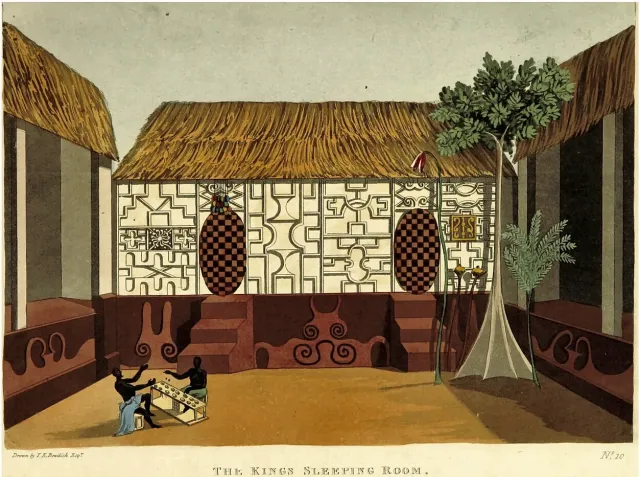 March 1820
'I cannot make war to catch slaves': Osei Bonsu argues with Dupuis
The British ban on the Atlantic slave trade in 1807 removed the main market for Asante's war captives, and in 1820 Osei Bonsu put his objections to the British consul. Dupuis recorded the…
Note on the sourcesc. 1770-1880sTrading for the king: the batafo and the royal loan
batafo / bata fekuo (state traders)Asante government did not live on tribute alone; it traded. A company of state traders, the bata fekuo, is said to have been organised under Osei Kwadwo in the later eighteenth century and…
Note on the sources1817-1878Powder and guns: the trade that tied Kumase to the forts
Everything Asante bought at the coast mattered less than firearms and powder. Dupuis called the four southern roads the 'maritime causeways' for that reason, and the notes paid by the forts…
1880s-1900sRubber: the last export of independent Asante
In the last years before the British occupation a new forest product reshaped Asante's southern trade. Wild rubber had been exported from the Gold Coast since about 1860. By the later…
Diplomacy with Europeans
Nine envoys in four years: Kumase opens to Europe, 1816-1820
For more than a century after David van Nyendael's visit of 1701-02 almost no European reached Kumase. Then, between May 1816 and March 1820, Osei Bonsu received no fewer than nine…
7 September 1817 - 1820What the treaty of 1817 actually said, and the quarrel over its text
The first pass recorded the signing of Bowdich's treaty. Its provisions, and the dispute about them, belong to the story of the provinces. As Bowdich and Dupuis between them report the…
Note on the sourcesSeptember 1817 - 1818William Hutchison, first British resident in Kumase
The treaty of 1817 allowed a British officer to live at the Asante capital, and when Bowdich left in September he installed William Hutchison, an officer of the African Company, as…
Note on the sourcesMarch - April 1820The king's embassy that never sailed, 1820
Dupuis's treaty of 23 March 1820 is remembered for being rejected at Cape Coast. Less noticed is what Osei Bonsu attached to it. Having had the new treaty read over at length and declared…
Note on the sources1817-1848Dinner as diplomacy: Bowdich in 1817, Freeman in 1841
Brandi Simpson Miller's study of Asante 'foodways' compares the state dinners given to European visitors and reads them as political messages. On 25 August 1817 Osei Bonsu entertained…
Note on the sources1831-1872A thousand recruits for guns: the agreement of March 1837
The first pass noted the Dutch recruitment of Asante soldiers for Java. The terms deserve closer attention. Heavy losses in the Java War led the Dutch to enlist Africans at Elmina from…
Note on the sources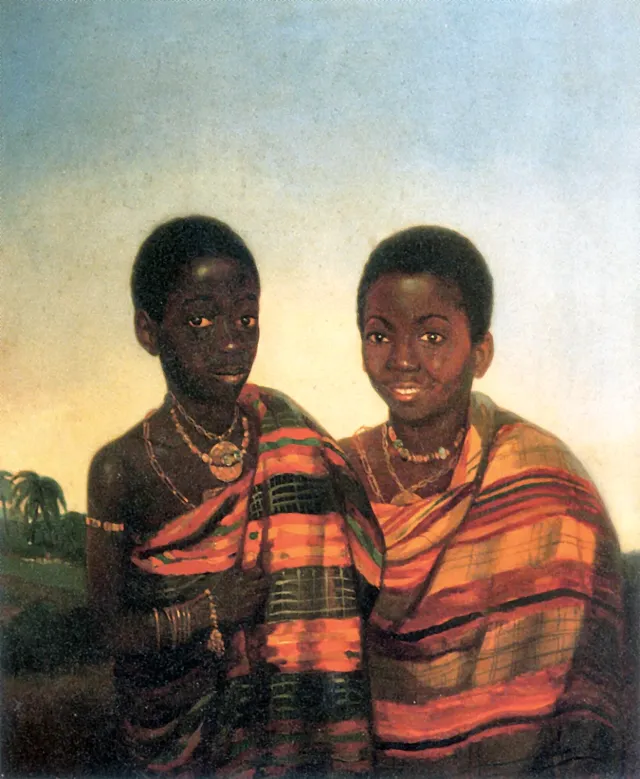 1837-1904
Kwasi Boakye and Kwame Poku: two boys sent to Holland
As part of the 1837 agreement Kwaku Dua I sent two boys of the royal house to the Netherlands with General Verveer, to be educated and returned. They were Kwasi Boakye (the Dutch wrote…
Note on the sources1836-1857The Dutch embassy of 1857 and Kwaku Dua's 'Dutch fort'
Dutch relations with Kumase under Kwaku Dua I were closer than British ones, though they are less known because the records are in Dutch. Larry Yarak published in translation extracts from…
c. 1800-1896Ambassadors, couriers and heralds: the Asante diplomatic service
nhenkwaa (royal servants); afenasoafo (sword-bearers); nseniefo (heralds)Joseph Adjaye's Diplomacy and Diplomats in Nineteenth-Century Asante, the only book on the subject, shows that Kumase had a recognisable foreign service. Envoys were usually chosen from the…
Note on the sources1817-1896Letters and literates: the Kumase chancery and the Ansa family
Asante government was oral, but from early in the nineteenth century it used writing for foreign business. Bowdich noticed in 1817 that a Muslim secretary, who had lived in Oyo, kept a…
Note on the sources 1867-1873
'Elmina Castle is mine': Akyeampon Yaw and the Dutch departure
The Anglo-Dutch exchange of forts in 1867-68 set off the crisis that ended Asante's oldest alliance. Places west of Elmina passed to the Dutch and those east of it to the British; the…
Note on the sources1895Prempeh and Samori, 1895: alliance or trade talk?
In 1895, as Britain prepared its ultimatum, Kumase looked north-west for help. Samori Ture, driven east by the French, had taken Kong in the spring and his forces occupied Bonduku, the old…
Note on the sourcesRuling the provinces
A friend at court: the adamfo system
adamfo (friend, patron)The basic device of Asante provincial government was to attach each dependency to a great man in Kumase. Bowdich stated the rule in 1817: every subject state was placed under the immediate…
Note on the sources1788-1874Residents on the spot: viceroys, captains and toll-takers
Alongside the patron in Kumase, Asante placed officers in provinces that were strategic or restless. The clearest case is Assin in 1820, where Dupuis found a hierarchy: Amon Koitea as…
18th century-1889Hostages, stools and skulls: holding a province by its symbols
Asante bound defeated states with people and objects as well as payments. Hostages were taken from the ruling families: Dupuis records that Akyem, when first fined, had to surrender two of…
1817-1895Oaths and appeals: Asante law beyond Asante
ntam (oath); aseda (thanks-money)Asante law followed Asante power, mainly through the oath. To swear the king's great oath in a dispute carried the case to his court, and to swear it falsely or break it was punished by a…
Note on the sources1817Summoned to the Yam Custom: the yearly muster of the empire
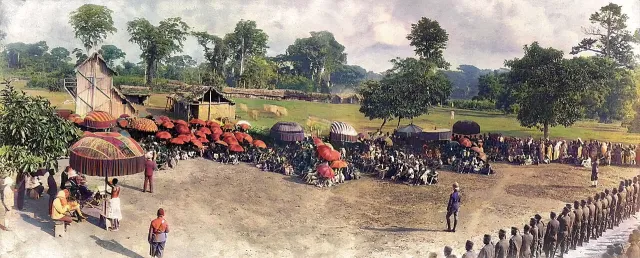
OdwiraOnce a year the empire was made visible in Kumase. Bowdich, who watched the Yam Custom (Odwira) of 1817, wrote that all the caboceers and captains and most of the tributaries were obliged…
18th century-1870sMoving people: captive villages and transplanted communities
Conquest moved populations, and the sources name a number of places made from the people of the provinces. Reindorf says Opoku Ware built Adubron, a quarter of Dwaben, from prisoners of his…
c. 1807-1839Baba and the Kumase Muslims: advisers on the north
Asante Nkramo (Asante Muslims)The Muslim community of Kumase was part of the machinery by which the capital dealt with its northern provinces. Its head in Osei Bonsu's time was Muhammad al-Ghamba, called Baba, said to…
Note on the sourcesc. 1770s-presentThe Asantehene's Kramo: a Gonja cleric's family at court
Otumfuo Kramo; batakari kesee (great war smock)Asante kings have long kept a personal Muslim cleric, although the monarchy has never been Muslim. Emmanuel Akyeampong traces the custom to Osei Kwame (1777-c. 1803), son of the Mamponhene…
Note on the sources1817-2004How the provinces saw it: five testimonies
Most accounts of the empire are written from Kumase or from the forts. A few voices from the provinces survive. From the Ga coast, Reindorf wrote down what his elders had told him: between…
Break-up of the empire
The southern provinces change sides, 1822-1826
The loss of the south was not a single battle but a series of defections, and Reindorf, whose own people took part, describes how they happened. Sir Charles MacCarthy landed at Cape Coast…
1827 - 27 April 1831The peace of 1831: what Asante signed away
Peace took five years to arrange after Katamanso. Reindorf relates that Asante envoys, among them a princess he calls Akyiawa, came to Cape Coast in 1827, and that talks stalled when the…
Note on the sources13 February - March 1874Fomena, 1874: the second list of renunciations
The first pass covered the Treaty of Fomena and its indemnity. Its territorial clauses completed what 1831 had begun. As Fuller summarises them, Kofi Karikari renounced all claim to…
1874-1886Adanse between two powers, 1874-1886
Adanse, the old Akan homeland on the Kumase-Cape Coast road, became independent of Asante by the Treaty of Fomena but was left outside the British protectorate and its courts. Claridge…
1874-1877Dwaben's league of 1875: who joined and what the British did
The first pass told of Dwaben's secession and the founding of New Juaben. Claridge adds detail on its scale. Dwaben did not leave alone: Nsuta, Effiduase and Asokore joined its declaration…
Note on the sources1874-1876The north walks away, 1874-1876
No treaty mentioned the northern provinces; they simply stopped obeying. Claridge lists Salaga, Atebubu, Krakye, Kwahu and 'other distant provinces' as breaking away after the war. At…
1875 - mid-1890sThe Bron Confederation, 1875-1894: a league led by a priest
Out of the secessions of 1874-75 came a new political body in the north-east. Donna Maier's research describes the Bron Confederation as a group of small provinces that seceded from Asante…
Note on the sources 1875-1882
Mensa Bonsu's attempts to win back the provinces, 1875-1882
Mensa Bonsu did not accept the losses of 1874, and for a few years it seemed he might reverse them. Claridge heads his chapter on 1875-80 'the revival of the power of Ashanti'. Dwaben was…
Note on the sourcesJanuary - July 1881The Golden Axe and the Gyaman prince, 1881
The scare of 1881 shows how the lost provinces poisoned relations with the coast. On 18 January 1881 Owusu Taseamandi, a prince of Gyaman on his mother's side, arrived at Elmina seeking…
Note on the sources1888-1897Gyaman courted, raided and divided, 1888-1897
Independent of Asante since 1875, Gyaman spent its last years as a prize. In 1888 its king Agyeman accepted flags and a treaty from French officers; the British surveyor R. Austin Freeman,…
Note on the sources1886-1890A kingdom leaking people: the refugees of 1886-1889
By the time Agyeman Prempeh was placed on the stool in 1888, Asante was losing subjects as well as provinces. The civil wars drove whole communities across the Pra, where the British…
Note on the sourcesNovember 1890 - May 1891Atebubu's treaty and the offer Kumase refused, 1890-1891
In 1888-91 the Gold Coast government adopted what Claridge calls a new policy toward Asante: to ring it with protected states and then offer protection to Kumase itself. Sefwi had been…
1890-1897George Ekem Ferguson's treaties in the old outer provinces, 1892-1894
The man who carried the British flag into Asante's former northern sphere was a Fante. George Ekem Ferguson was born at Anomabo on 14 July 1864, schooled at Cape Coast and Freetown, joined…
Note on the sources1887-1899Drawing lines through the old empire: the Neutral Zone and the frontiers
While Asante still stood, the European powers were already dividing its former dependencies. In the east the Gold Coast's frontier with German Togoland was first marked in 1886-87, and the…
Note on the sources1896-1907Ashanti redrawn: separate treaties, four provinces and the Black Volta line
After Prempeh's removal in January 1896 the British dismantled what remained of the union and then reassembled a territory called Ashanti on their own lines. Fuller, who later governed it,…
Note on the sourcespresentWhere the old empire lies on today's map
The lands once tied to the Golden Stool are now spread over a dozen Ghanaian regions and two neighbouring countries. Metropolitan Asante is the Ashanti Region. Of the northern and western…
Note on the sources