Living culture
Culture and tradition
Kente and adinkra, gold and carving, drums and dance, the forty-two day calendar, and the customs that carry a person from naming to funeral.
59 sourced entries · every source listed
Go deeper
Kente: every cloth and what it says
Each named cloth and motif: what its name means, the saying, person or event it is named for, what the pattern looks…
156 entriesCustom, step by stepRites and customs
Naming, coming of age, marriage, funerals, widowhood, enstoolment, the Adae and the great festivals, oaths and taboos:…
127 entriesA catalogueSymbols and their meanings
Adinkra signs, the emblems of kingship, stool designs, sword ornaments, linguist staffs, goldweights, kente patterns…
236 entriesCloth and adornment
Kente: cloth woven in narrow strips
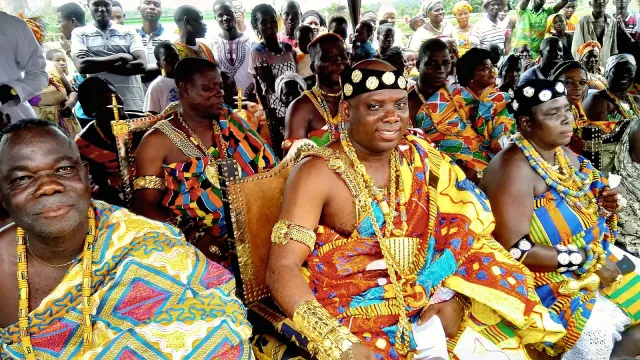
kente; nwentoma (woven cloth)Kente is the best-known Asante textile: long narrow strips woven on a horizontal treadle loom and then sewn edge to edge into a large rectangular cloth. UNESCO describes the strips as woven…
Note on the sourcesmid-17th century to 1721 (oral tradition)The Bonwire origin tradition: two hunters and a spider
Asante oral tradition places the birth of kente at Bonwire, a town about 18 km from Kumasi on the Mampong road. In the version most often told, two men of the town, named as Kuragu (also…
Note on the sources1697 (town tradition)Adanwomase's claim as the royal weaving village
Adanwomase, about 2 km from Bonwire in Kwabre East District, tells a different story. Its tradition says that in 1697 the Asante king had a sub-chief send people from Adanwomase, Asotwe,…
Note on the sources18th century to presentNamed kente cloths and what they say
Every kente has a name, and the name usually belongs to the warp-stripe layout rather than to the picture the cloth makes. Names come from proverbs, events, chiefs, queen mothers and…
Note on the sources18th century to presentWho could wear kente, and when
Kente began as court dress. The Fashion Institute of Technology essay, following Doran Ross, traces it to the regalia of Asante and other Akan rulers. Under the kingdom, important people…
December 2024Kente on UNESCO's Representative List (2024)
In December 2024 UNESCO's Intergovernmental Committee for the Safeguarding of the Intangible Cultural Heritage, at its 19th session, inscribed 'Craftsmanship of traditional woven textile…
Note on the sourcesAugust to September 2025Kente becomes Ghana's first Geographical Indication (2025)
In 2025 kente became the first Ghanaian product protected as a Geographical Indication (GI), a form of intellectual property that ties a name to a place of origin. The launch ceremony was…
Note on the sourcesbefore 1817Where adinkra came from: three traditions
adinkraAdinkra is cloth hand-stamped with symbols, and its origin is told in more than one way. The story heard most often says the Asante learnt it after defeating Gyaman, whose king Kwadwo…
Note on the sources1817The oldest adinkra: Bowdich's cloth of 1817
The oldest adinkra cloth known to survive is in the British Museum (Af1818,1114.23). Thomas Edward Bowdich acquired it in Kumasi in 1817 while serving on the African Company's mission to…
Note on the sources19th century to presentMaking adinkra at Ntonso: badie dye and calabash stamps
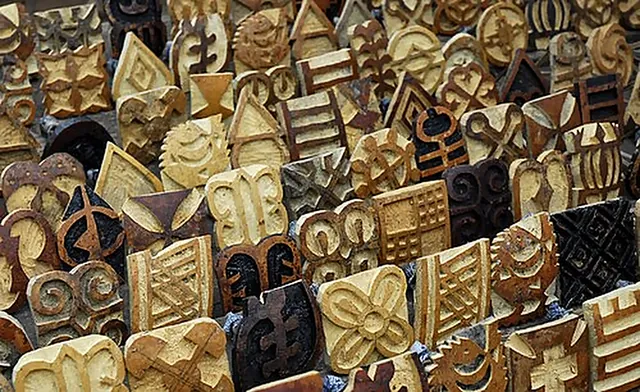
adinkra aduro (adinkra dye); badieNtonso, in Kwabre East District north of Kumasi, is the best-known centre of adinkra printing; Asokwa in Kumasi is another. The dye, adinkra aduro, is made from the bark and roots of the…
Note on the sources19th century to presentTwelve adinkra symbols everyone meets first
Each adinkra symbol has a Twi name and points to a saying. Gye Nyame, 'except God', speaks of God's supremacy: fear nothing but God. Sankofa, 'go back and fetch it', drawn as a bird turning…
Note on the sources19th century to presentMore adinkra symbols: court, home and proverb
Beyond the best-known dozen, the adinkra repertoire is large; one popular index lists about a hundred. Many come from court life. Akoben is the war horn, a call to readiness. Ohene aniwa,…
Note on the sourcesArts and craft
 c. 1400 to c. 1900
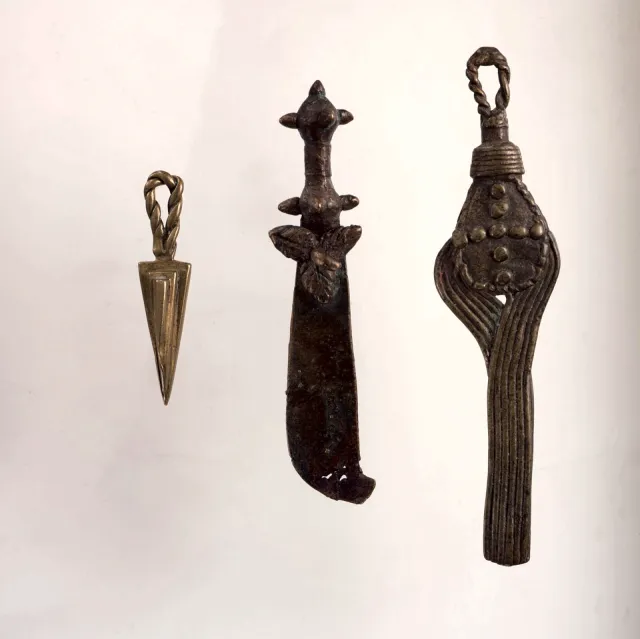
Goldweights: brass weights for a gold-dust economy
abrammuo (also mrammuo)Until the end of the 19th century gold dust was money in Asante, and every trader needed weights to measure it. The weights, abrammuo, are small brass castings made by the lost-wax method.…
Note on the sources19th century and earlierThe gold-weigher's kit and the proverbs in the weights
futuo; nsenia; nsawa; famfaRattray, writing in 1923 as a colonial-era observer, listed what an Asante trader kept in his futuo, the bundle that held his weighing gear: the weights (mrammuo), a pair of scales (nsenia)…
 c. 1400 to present
Lost-wax casting, step by step
Asante brass and gold casting uses the lost-wax (cire perdue) method. Rattray watched it in the early 1920s. The smith models the object in beeswax and adds a wax stalk. He coats the model…
17th to 20th centuryKuduo and forowa: brass vessels for treasure and shea butter
kuduo; forowa (pl. mforowa)Two kinds of brass container are typical of Akan metalwork. The kuduo is cast by the lost-wax method, a lidded bowl or casket often with a hasp for a lock and sometimes a small scene on the…
Note on the sources19th century and earlier to presentSoul-washers' discs
akrafokonmu; akrafo; okra / kra (soul)Among the most recognisable pieces of Asante goldwork is the round pectoral disc called akrafokonmu, usually translated 'soul-washer's badge'. It is cast or hammered gold, worked with a…
18th century to presentGold jewellery and the goldsmiths' guild
adwumfo (goldsmiths); sika (gold)Gold was the mark of rank in Asante. Rattray recorded that gold ornaments were once the preserve of kings, their wives and the greater chiefs, and that only members of the goldsmiths'…
19th century to presentAkua'ba: the disc-headed fertility figure
akua'ba (Akua's child)The akua'ba is a small wooden figure with a large flat round head, a ringed neck, a cylindrical body and short outstretched arms. A woman who wished to conceive, or who was pregnant and…
Note on the sources18th century to presentAhwiaa and the carving of stools
dwa (stool); sese / osese (the stool tree)Ahwiaa, about nine kilometres from Kumasi on the Mampong road, is the town known for wood carving. Its staple is the stool (dwa). An Asante stool is cut from one block of pale soft wood,…
Note on the sources19th century to presentPankrono and Asante pottery
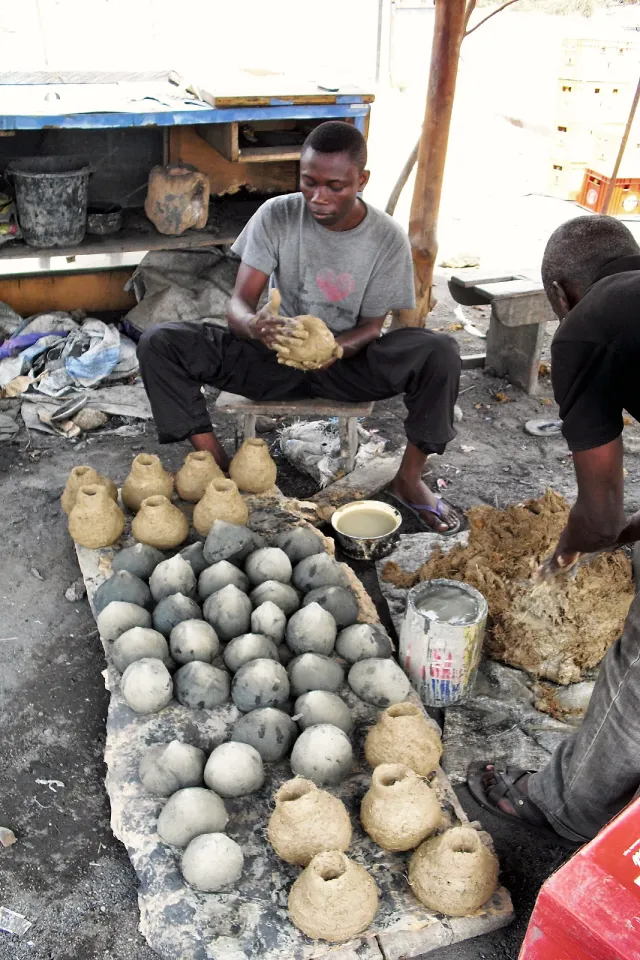
Pankrono, on the Great North Road just beyond Tafo on the northern edge of Kumasi, is the Asante pottery town. A report on Ghana's crafts from the 1960s said it was still making palm-wine…
Regalia
State swords and what each kind does
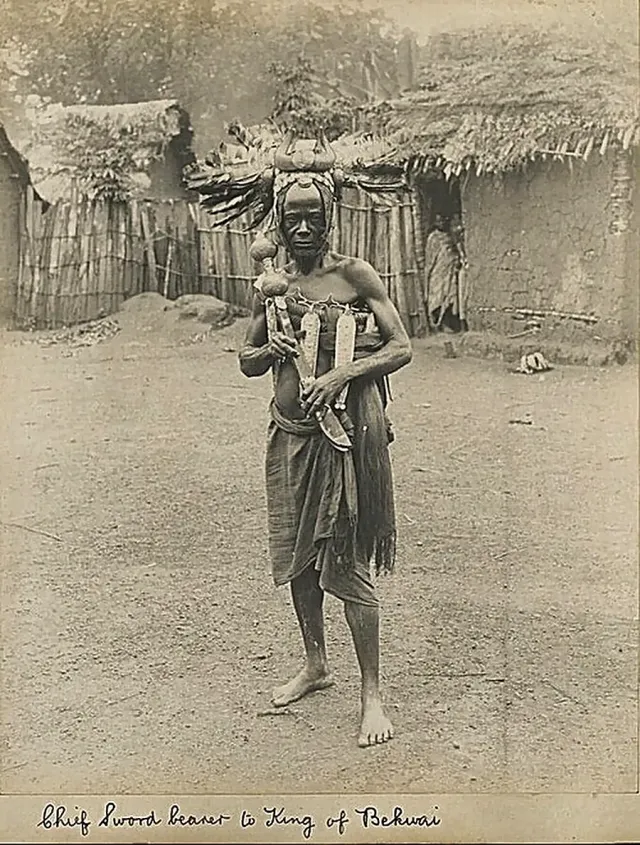
afena; akofena; akrafena; keteanofenaThe curved state sword (afena) is one of the oldest pieces of Asante regalia. It has an iron blade, often blunt and pierced with patterns, a wooden hilt of two globes covered in gold leaf,…
Note on the sourcesc. 1700 to presentMponponsuo and Bosommuru: the oath swords
Mponponsuo; BosommuruTwo swords stand above the rest. Bosommuru (also written Bosomuru) is said to have been taken by Osei Tutu I from a defeated chief, Onoo Adu Gyamfi, and consecrated by the priest Okomfo…
Note on the sources18th century to presentUmbrellas, palanquins and elephant tails
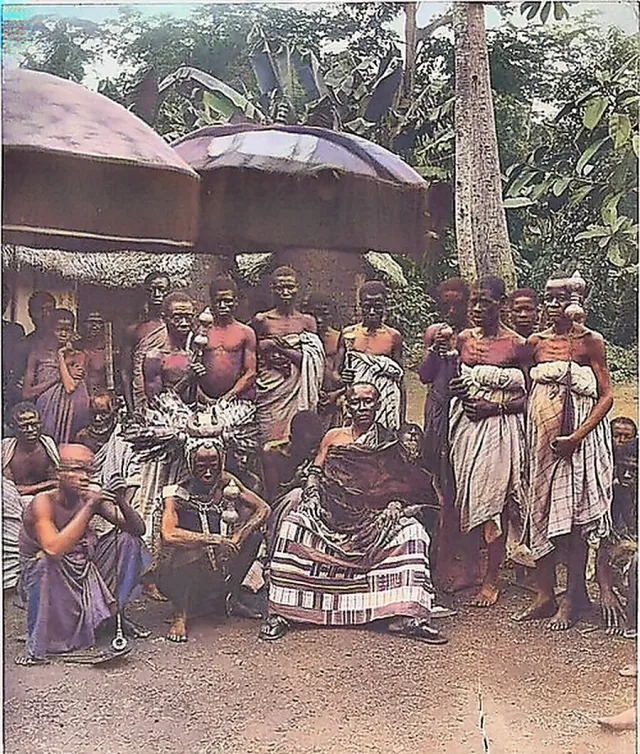
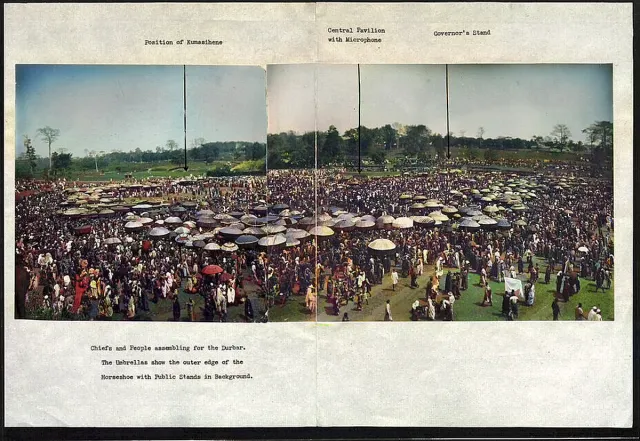
kyinie / bamkyim (state umbrella); apakan (palanquin); mena (elephant tail)A chief in state is seen from far off by his umbrella. State umbrellas are very large, made of silk and other rich cloth, and are twirled and pumped up and down by their bearers to fan the…
Note on the sources19th century to presentThe okyeame and his staff
okyeame (spokesman); okyeame poma (spokesman's staff)A chief does not speak directly in public, and is not spoken to directly. Words pass through the okyeame, usually translated 'linguist' though 'spokesman' or 'counsellor' is nearer. He…
c. 1700 to presentBlackened stools and the stool house
nkonnwa tuntum (black stools); nkonnwafieso (stool house)When a chief who has ruled well dies, the stool he used in life is blackened and kept in a room set apart, the stool house. Wikipedia's Akan art article says the blackening is done with…
Note on the sourcesMusic and dance
Atumpan: the drums that speak Twi
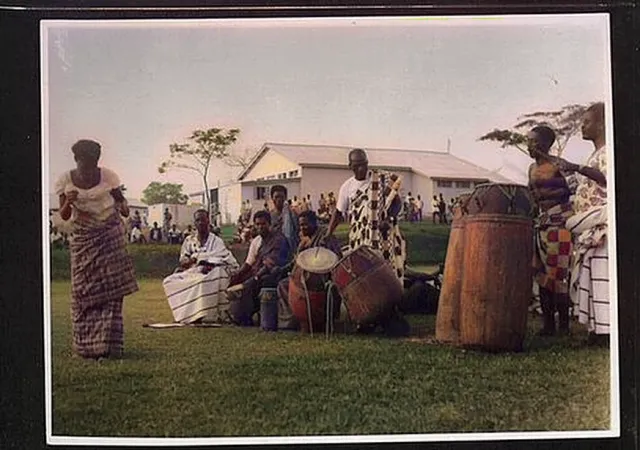
atumpan / ntumpane; okyerema (drummer)The atumpan are a pair of goblet-shaped drums, one tuned low and called male, the other high and called female. Twi is a tone language, and the drummer does not use a code: he plays the…
 18th century to present
Fontomfrom: the great drums of state
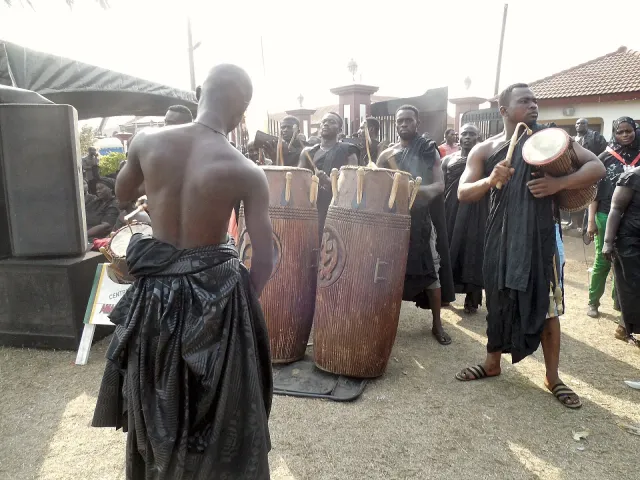
fontomfromFontomfrom is both a drum and the ensemble named after it: very tall drums, some two metres high, played with hooked sticks, together with atumpan, smaller supporting drums and iron gongs.…
Note on the sources19th century to presentAdowa and kete
adowa; keteAdowa is the dance most people associate with the Asante. It is led by women: a lead singer and a chorus, almost always women of middle age, who keep time by clapping and with a single or…
17th century to presentSeperewa: the Akan harp-lute
seperewa / seprewa / sankuThe seperewa is a harp-lute with a wooden box resonator covered in skin, a curved neck and between six and fourteen strings rising from an upright bridge. The player plucks with thumbs and…
Note on the sources1928 to presentKumasi and the guitar: from Yaa Amponsah to Koo Nimo
Guitar-band highlife has deep Asante roots. In June 1928 the guitarist Jacob Sam (Kwame Asare) and his Kumasi Trio recorded 'Yaa Amponsah' in London for Zonophone, among the first highlife…
Note on the sourcesFestivals and calendar
Adaduanan: how the 42-day cycle is built
adaduanan ('forty days'); nnanson; nnawotweAsante ritual time runs on a cycle of 42 days called adaduanan, literally 'forty days'. It is made by running two weeks side by side. One is the familiar seven-day week (nnawotwe, 'eight…
Note on the sourcesancient to presentDabone: the days when the hoe rests
dabone ('bad day'); Fofie; FodwoThe four marked days of the adaduanan are called dabone, 'bad days', meaning days too charged for ordinary work. Farming is forbidden on them; hunting, gathering and communal labour are…
 c. 1700 to present
Akwasidae: the Sunday Adae
Akwasidae (Kwesidae in Rattray)Akwasidae comes round every sixth Sunday, about nine times a year, and is the day on which the Asantehene and every stool-holding chief remember those who sat before them. It has a hidden…
Note on the sourcesc. 1700 to presentAwukudae: the Wednesday Adae
Awukudae (Wukudae; Kupadakuo in Rattray)Awukudae is the smaller Adae, kept on the Wednesday that falls on the day Kuru of the six-day week, eighteen days before the following Akwasidae. Rattray gives it a second name, Kupadakuo,…
Note on the sourcesc. 1700 to presentAdae Kese: the great Adae
Adae KeseAdae Kese, the 'big Adae', is not a separate date in the calendar but an Akwasidae raised to a national occasion. Wikipedia's account links its beginnings to the years after the victory…
Note on the sources18th and 19th centuriesOdwira, the old yam custom of Kumasi
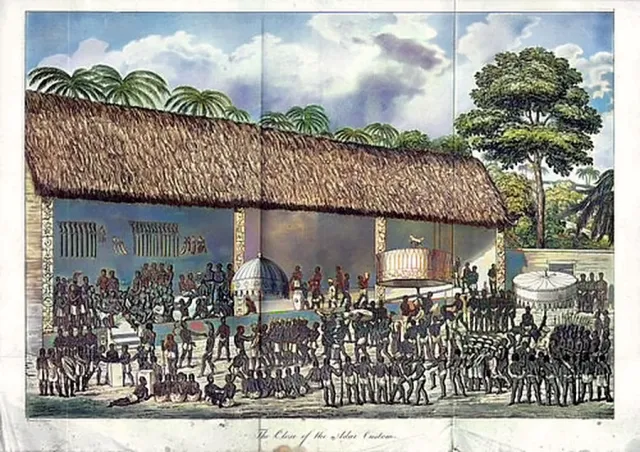
Odwira (purification)In the old kingdom the year turned at Odwira, 'purification', which Europeans called the Yam Custom because the new yam could not be eaten until it was done. Bowdich, in Kumasi in 1817,…
Note on the sourcesLife cycle
Day names: the name the soul brings
kradin (soul name)Every Asante child has a name before any is chosen: the name of the day of the week on which it was born, called kradin, the soul's name. A boy born on Sunday (Kwasiada) is Kwasi or Akwasi…
Note on the sourcesancient to presentOutdooring and the giving of a name
abadinto; din to (name giving)A newborn is kept indoors for its first week. Only on the eighth day is it brought out and named. The explanation usually given is that a child who has lived that long has shown it means to…
Note on the sourcesancient to 20th century; now rareBragoro: a girl's coming of age
bragoro (also brapue)Bragoro was the public rite that made an Asante girl a woman. When a girl had her first period her mother told the queen mother and the older women; in the old form she announced it by…
Note on the sourcesancient to presentMarriage as an agreement between families
aware (marriage)In Asante custom marriage joins two lineages, not just two people, and its core is a series of gifts and acknowledgements, not one ceremony. The man's family approach the woman's family, a…
Note on the sourcesancient to presentAbusua: descent, belonging and inheritance through the mother
abusua (matrilineal clan); ntoro (father's spirit line)An Asante belongs to the abusua of his or her mother. There are eight today: Aduana, Agona, Asakyiri, Asenie, Asona, Bretuo, Ekuona and Oyoko, the last being the clan of the Golden Stool.…
Note on the sourcesancient to presentAyie: funerals
ayie (funeral)No event in Asante life draws more people than a funeral. A person is owed a proper send-off by the abusua, and the lineage head, not the widow or widower, is in charge. Older accounts…
Note on the sourcesLanguage and oral tradition
Asante Twi within the Akan language
Twi; AsanteAsante speak Asante Twi, one of the main varieties of Akan, a Tano language of the Kwa group. Its closest relatives are Akuapem Twi and Fante; all three are mutually intelligible and each…
Note on the sourcesancient to presentMmebusem: the place of proverbs
ebe (proverb), pl. mme; mmebusemTo speak well in Twi is to speak in proverbs. An elder settling a dispute, a spokesman addressing a chief or a mother correcting a child will reach for an ebe and leave the hearer to draw…
Note on the sourcesrecorded 1879 / 1916Eight proverbs about Onyame
Rattray's first chapter gathers sayings about the Supreme Being, Onyame or Onyankopon. English versions here are paraphrases of his translations. 'Obi nkyere abofra Onyame': no one points…
recorded 1879 / 1916Ten proverbs about family, children and chiefs
From Rattray's later chapters, again paraphrased from his translations. On family: 'Abusua ye dom': the family is an army. 'Abusua dua, wontwa': the family tree is not cut down. 'When your…
ancient to presentAnansesem: spider stories
anansesemStories told for pleasure are called anansesem, 'spider stories', whether or not the spider appears in them. Kwaku Ananse is small, greedy and clever, and gets the better of stronger…
Note on the sourcesc. 1700 to presentPraise poetry, minstrels and drum texts
apae (praise poetry); kwadwom; kwadwumfo (minstrels)Around a chief several kinds of formal speech are performed. Rattray described minstrels, kwadwumfo, who stand behind the chief on an Adae and chant in low voices the names and deeds of the…
Note on the sourcesancient to presentPouring libation
nsaguo (pouring drink); mpae (prayer)Libation is prayer spoken aloud while drink is poured on the ground. It is done by an elder, a lineage head or a chief's okyeame at namings, marriages, funerals, the start of a meeting, the…
Note on the sourcesFood and daily life
Fufu
fufuoFufu is the Asante staple and the dish by which other Ghanaians identify them. Boiled cassava and plantain, or cocoyam or yam, are pounded in a wooden mortar (woduro) with a long pestle…
presentAmpesi, eto, soups and stews
ampesi; eto; abenkwan; nkontomireBeside fufu the everyday Asante meal is ampesi: boiled yam, plantain, cocoyam or cassava eaten with a stew. The usual partner is nkontomire (kontomire), a stew of young cocoyam leaves…
ancient to presentPalm wine
nsafufuo ('white drink')Palm wine, nsafufuo, is the sap of the oil palm, drunk fresh and sweet in the morning and stronger and sourer as it ferments through the day. It was the drink of hospitality and of ceremony…
Note on the sourcespresentGreetings, the right hand and respect
akwaaba (welcome)Manners in Asante start with greeting. A person entering a house or joining a group greets first, and a visitor is told 'akwaaba', welcome, and asked 'ete sen?', how are you. Giving,…
Note on the sources1935 to presentAsante Kotoko: the Porcupine Warriors
kotoko (porcupine); 'Kum apem a, apem beba'Asante Kotoko Sporting Club of Kumasi is the football club of the kingdom. It grew from Ashanti United, a side formed in 1926 by a group of young men led by a driver, Kwasi Kumah, which…
Note on the sourcesancient to presentOware and ampe
oware; ampeOware is the board game of the Akan, one of the mancala family. The board has two rows of six cups, and play starts with four seeds in each, forty-eight in all. A player lifts all the seeds…
Architecture
 18th century to present
The courtyard house
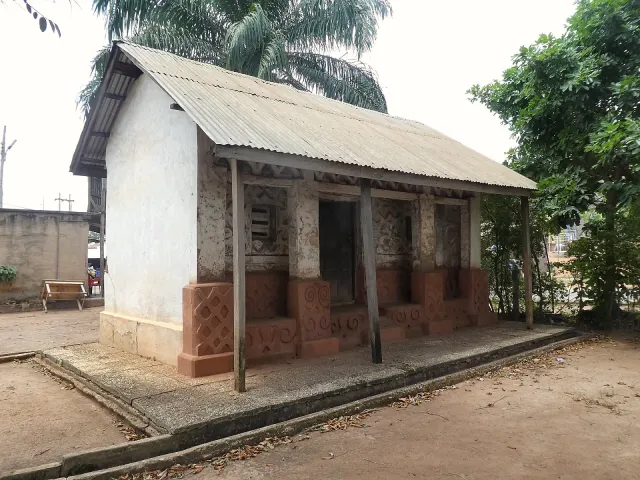
fihankra (compound house); pato (open-fronted room)The traditional Asante house, whether for a family, a chief or a god, is four narrow rectangular buildings set round an open square courtyard and joined at the corners by screen walls.…
18th-19th century; inscribed 1980The Asante Traditional Buildings (World Heritage, 1980)
abosomfie (shrine house)In 1980 UNESCO placed the Asante Traditional Buildings on the World Heritage List under criterion (v), as the last standing examples of the kingdom's architecture. They are ten shrine…
Note on the sources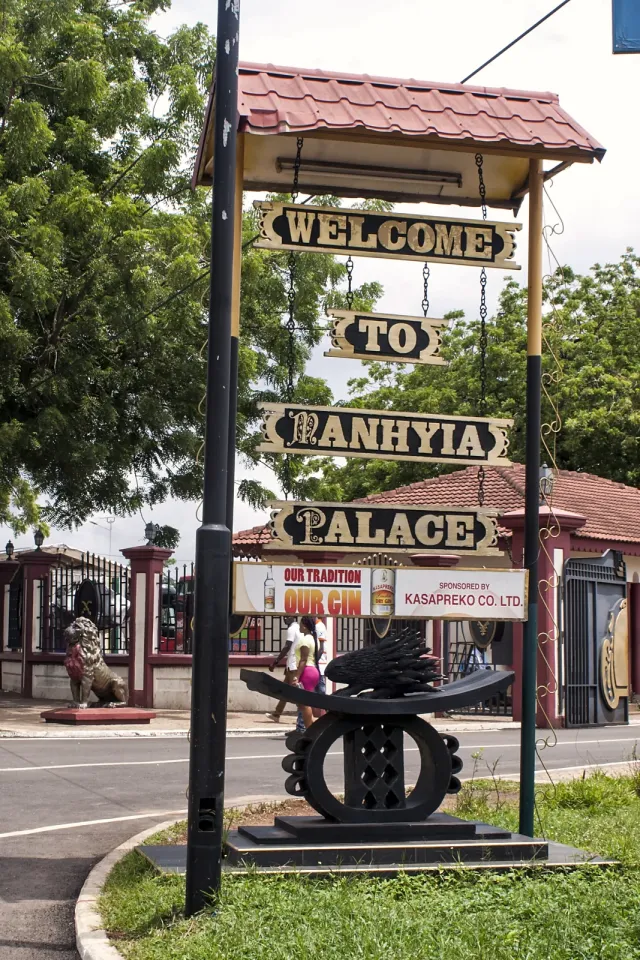 1925 to present
Manhyia Palace and its museum
Manhyia (oman hyia, 'the nation gathers')The old palace of the Asantehene in Kumasi was destroyed in the wars with Britain. When Prempeh I returned in 1924 from exile in the Seychelles he had no official residence. A two-storey…
Note on the sources