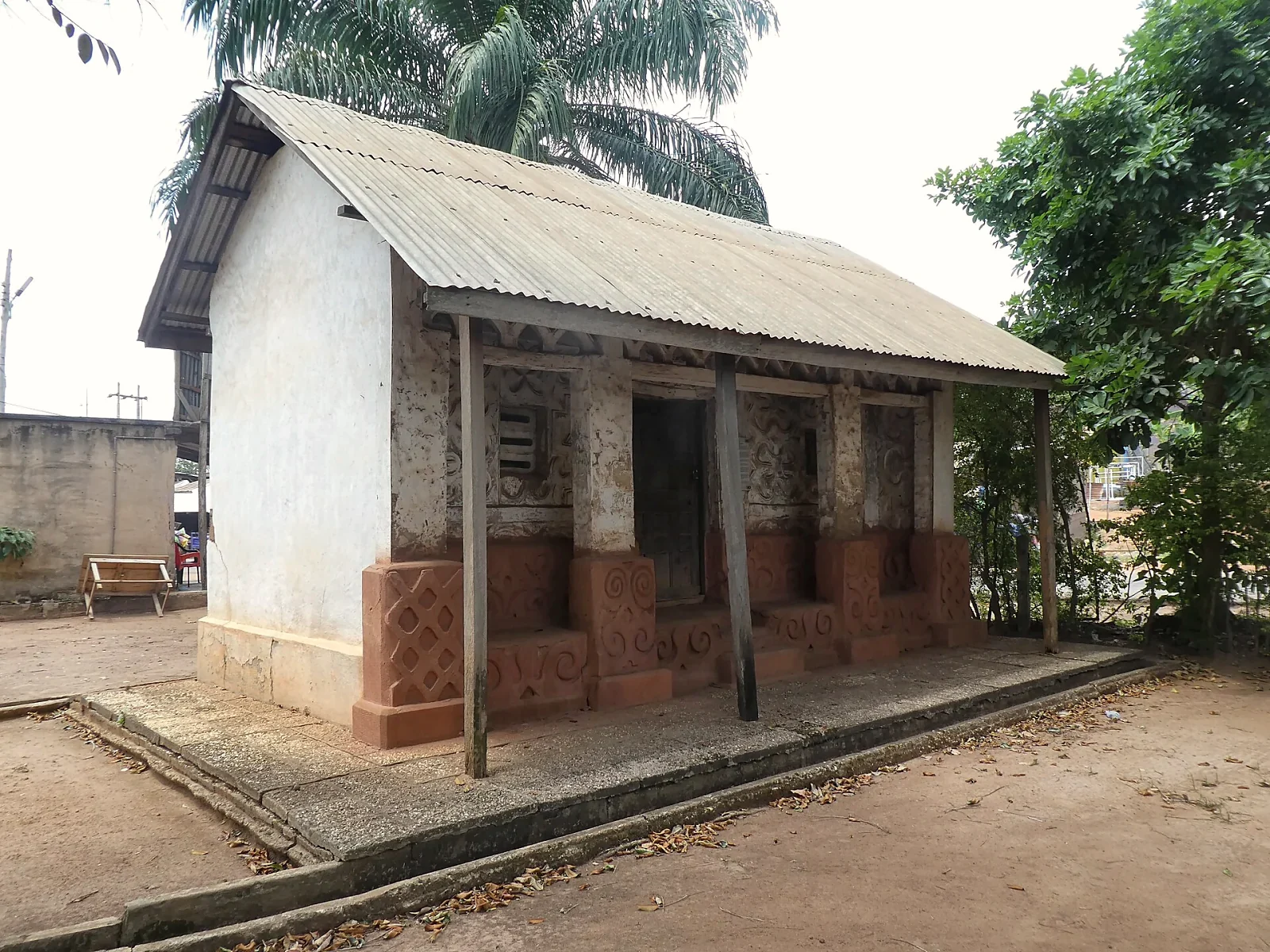
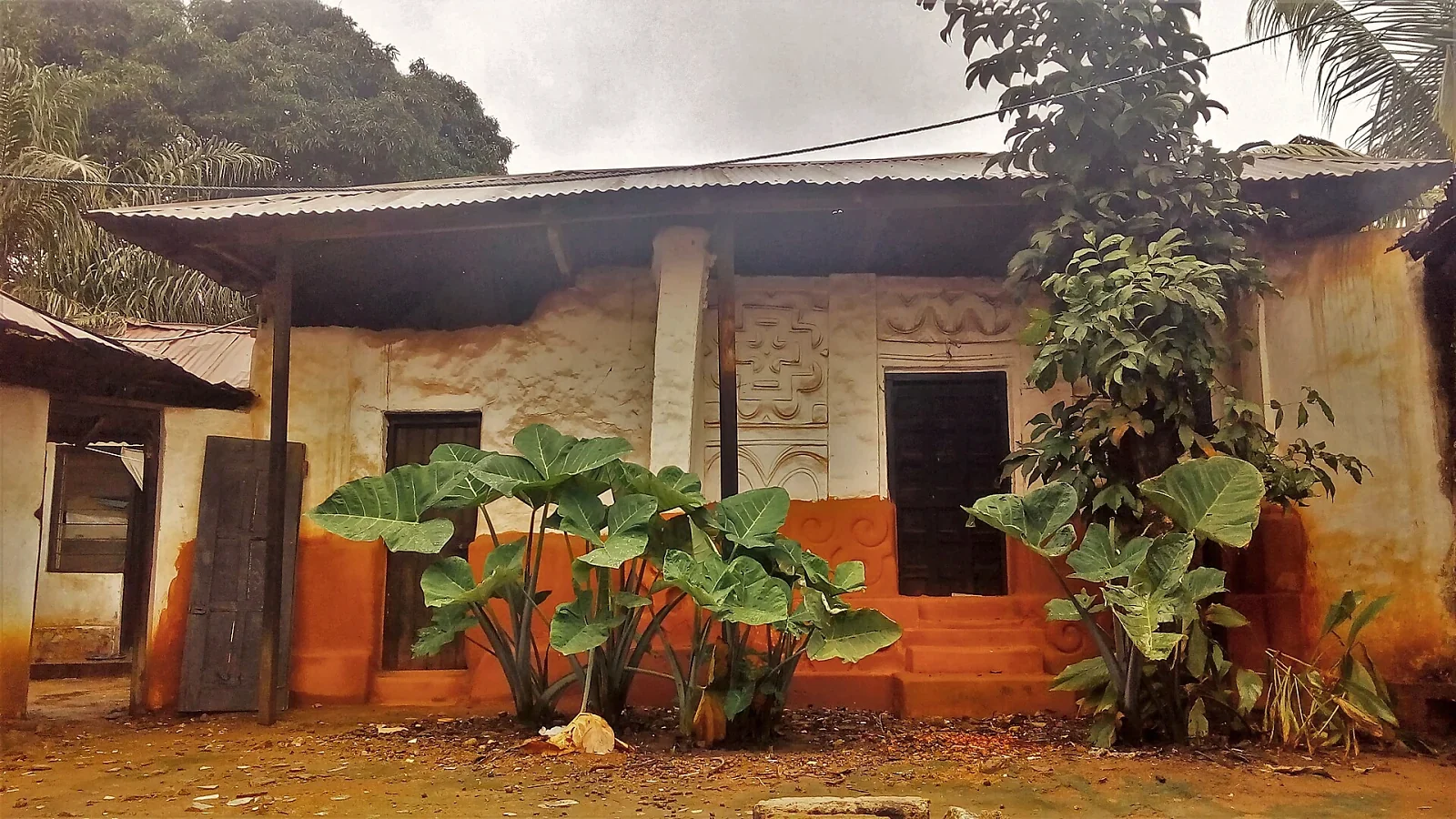
18th-19th century; inscribed 1980
The Asante Traditional Buildings (World Heritage, 1980)
abosomfie (shrine house)
In 1980 UNESCO placed the Asante Traditional Buildings on the World Heritage List under criterion (v), as the last standing examples of the kingdom's architecture. They are ten shrine houses in villages north and east of Kumasi. Among them are those at Besease, Asenemaso and Kentinkrono, and others dedicated to river gods of the Tano family. Almost everything else of old Kumasi was burnt or blown up in the wars with Britain between 1874 and 1900. Each shrine follows the courtyard plan: three open rooms for the drums, the singers and the cooking of offerings, and a fourth, closed room for the god's shrine, which only the priest and attendants enter. The walls carry bold clay reliefs, with spirals and interlace below and animals, birds and plants above, many of them the same signs that are stamped on adinkra cloth and carrying the same sayings. The buildings are earth, timber, bamboo and thatch, and survive only by constant repair; damp, termites and the decline of the old religion are the chief threats. Some are still in use for worship.
UNESCO's own page (whc.unesco.org/en/list/35) could not be opened, so the full official list of ten buildings was not verified; shrine names here come from Wikimedia Commons categories. Wikipedia dates Baden-Powell's destruction of the royal mausoleum to 1895; the expedition entered Kumasi in January 1896.
Key facts
- Inscribed 1980, criterion (v), World Heritage reference 35
- Ten shrine houses near Kumasi
- Three open rooms and one closed shrine room
- Reliefs share motifs with adinkra