The unseen
Belief, shrines and sacred places
Onyame and the earth, the abosom and their shrines, the ancestors and the black stools, the Golden Stool, and the later coming of Islam and Christianity. Older ethnography is labelled as such.
75 sourced entries · every source listed
Cosmology
Onyame, Onyankopon, Odomankoma: the names of the Supreme Being
Onyame / Onyankopon / OdomankomaAsante thought places a single Supreme Being above every other power. The commonest name is Nyame or Onyame; Onyankopon and Odomankoma are used alongside it. Rattray, the colonial…
Note on the sourcesrecorded 1921-22Nyame dua: the forked-branch altar to the sky god
Nyame dua ('God's tree')Rattray reported that almost every compound he visited had a small altar to the Supreme Being. It was a forked branch cut from the tree called Nyame dua, set upright in the ground, with a…
recorded 1921-22Priests and temples of Nyame
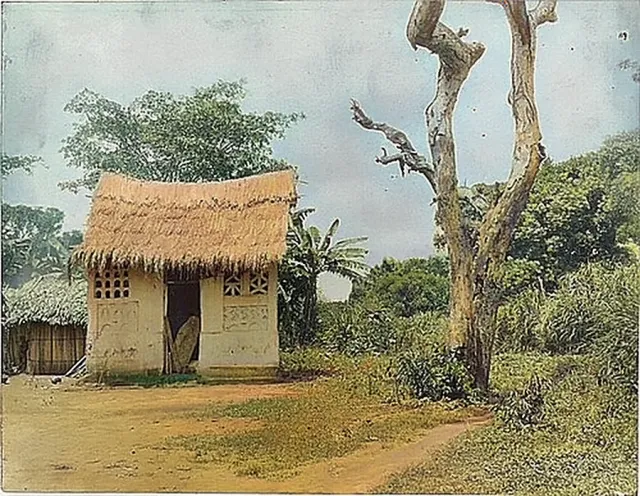
Nyame dan ('house of God')It is often said that the Akan high god has no priests or temples. Rattray recorded otherwise. In the older palaces he was shown small, half-hidden rooms dedicated to the sky god, called…
Note on the sourcesto 1923Was the high god borrowed? Rattray against Ellis
A long argument about Asante religion turns on whether belief in a Supreme Being is old. The earlier writer A. B. Ellis held that Nyankopon was a borrowed idea, a local version of the God…
Note on the sourcestraditional; recorded 1921-22Asase Yaa: the Earth and her Thursday
Asase YaaThe Earth is the second great power in Asante belief. She is called Asase Yaa, Yaa being the name given to a girl born on Thursday, and also Aberewa, the old woman. Rattray records the…
recorded 1921-22A ladder of powers: Nyame, abosom, suman
Nyame, abosom, asumanRattray set out Asante religion as a graded order. At the top is the Supreme Being. Below are the abosom, the gods, most of them tied to rivers and other waters and regarded as children or…
recorded 1817, published 1819The box and the paper: an origin story heard in 1817
Bowdich, in Kumasi in 1817, wrote down a story he said was known from the coast inland and shaped how people explained their place in the world. God made three black men and three white men…
recorded 1921-22Odomankoma's drummer: the spirit world in the drum texts
Odomankoma KyeremaThe talking drums carry some of the oldest statements of Asante belief. Rattray had the drum history of a division transcribed and found that every performance opens with an address to the…
The person
Ntoro: the spirit a father passes on
ntoroEvery Asante person belongs to two groups at once. The mother gives blood and clan; the father gives ntoro. Rattray translated ntoro as 'spirit' and wrote that it was thought to take part…
Note on the sourcesrecorded 1921-22Washing the ntoro
The duty a person owes to the father's spirit was carried out by washing. Rattray recorded that on the weekday belonging to a ntoro its members bathed and marked the body with white clay.…
traditional; recorded 1921-22Mogya: the mother's blood and the clan
mogya; abusuaBlood, mogya, comes from the mother alone. Rattray's informants put it plainly: only a woman can pass blood to descendants, and a man's blood ends with him. Because blood defines the…
traditional; modern philosophical debateOkra and nkrabea: soul and destiny
okra; nkrabeaThe okra is the part of a person that comes from God. Modern Akan philosophers describe it in slightly different ways. Kwame Gyekye calls it the innermost self, identical with life, and…
Note on the sources1817-1872Akrafo: the people who carried the king's soul
akrafo ('soul people')Two nineteenth-century visitors describe a class of court servants bound to the king's okra. Bowdich in 1817 called them Ocras and noted the large gold disc each wore on the chest. He was…
recorded 1921-22Sunsum: the spirit behind a person, a stool and a nation
sunsumSunsum is the Asante word Rattray found hardest to pin down and used most. In a person it is the spiritual element behind character and success, and he noted that it was closely linked with…
Deities (abosom)
The abosom and how they are grouped
abosom (sing. obosom)The abosom are the gods who deal with people directly. They draw their power from Nyame and most are bound to a feature of the land, above all to water. Rattray was told that the great ones…
traditional; visited by Rattray May 1922Ta Kora, the great Tano
Tano / Ta KoraTano is the god of the Tano river and the senior of the Asante and Bono river gods. At his home he is Ta Kora, 'Ta' being the short form of Tano. Rattray went to the village of Tano Oboase,…
Note on the sourcesrecorded 1921-22The children of Tano
AtanoThe Tano gods form a family. Each town along the river and far beyond it may have its own Ta, understood as a son of Ta Kora or as the part of his spirit that lives at that place. At…
traditional; recorded 1921-22Bosomtwe: the god of the lake
BosomtweLake Bosomtwe, south-east of Kumasi, is a god as well as a lake. Twe is counted among the sons of Nyame and gives his name to one of the father-spirit groups, the Bosomtwe ntoro, whose day…
Note on the sourcespresentAntoa Nyamaa
Antoa NyamaaAntoa is a town a short distance north-east of Kumasi, and Antoa Nyamaa is the god of a small river there, reached by a farm path. It is the Asante deity most often named in public life…
1817The gods as Bowdich heard of them in 1817
The earliest detailed outside account of Asante gods is Bowdich's. He wrote that the 'fetishes' were lesser deities living in rivers, woods and mountains, and that their standing rose and…
recorded 1921-22Suman: charms, and how they differ from gods
suman (pl. asuman)A suman is a made thing: an amulet, a bundle, a horn or a string of objects that has been given power and is owned and used by a person. It is the lowest rank in Rattray's ordering of…
1817-1872Written charms on war coats
By the early nineteenth century the most prized charms in Kumasi were Muslim ones: short Arabic texts folded and sewn into leather, cloth, silver or gold cases. Bowdich, who saw the army's…
witnessed April 1922Apo at Techiman: the festival when the chief may be mocked
ApoThe Apo is the yearly festival of the Bono people of Techiman, north of Asante proper, where the Tano gods have their home. Rattray watched it in April 1922. The shrines of the gods, brass…
witnessed 27-31 October 1921Afahye at Ejura: first fruits for ancestors and gods
AfahyeAt Ejura, on the northern edge of Asante, Rattray saw the yearly first-fruits festival called Afahye, held when the new yams were ready. It had two halves. In the first, the chief's…
Ancestors and stools
The blackened stools and the stool house
nkonnwa tuntum / apunnua; akonnua dan (stool house)An Asante office-holder sits on a white wooden stool that is his alone. Rattray recorded what happens to it when a ruler who has governed well dies. The stool is blackened with soot mixed…
recorded 1817, 1870s, 1921; presentAdae: the days of the ancestors
Adae; Akwasidae (Kwesidae); Awukudae (Wukudae)Adae is the recurring day on which the spirits of past rulers are fed and addressed. Rattray derived the word from a term for a resting place: no ordinary work is done. There are two. The…
Note on the sources17 August 1921Inside a Wednesday Adae, 17 August 1921
WukudaeRattray was allowed into a paramount chief's stool house for a Wednesday Adae and wrote down the sequence. The day before, the stools and vessels were scrubbed and a sheep chosen. At dawn…
recorded 1921The queen mother's stools
OhemaaThe queen mother has her own line of ancestors to serve. Rattray recorded that she is custodian of the blackened stools of former queen mothers and holds her own Adae for them on both the…
recorded 1921-22Nsamanfo: the dead as owners of the land
nsamanfo (sing. saman); nananom nsamanfoThe spirits of the dead, the nsamanfo, are not thought of as gone. Rattray was told that they are the real owners of the land and that the living hold it only as their trustees, which is…
1870-1873The king before his predecessors' chairs, 1870s
The Asantehene's first religious duty was to the kings before him. The Basel missionaries who lived as captives in Kumasi watched the routine from outside. Some days before each great Adae…
Priests and practice
Okomfo: the priest a god has chosen
okomfo (pl. akomfo); akomAn okomfo is a person through whom a god speaks. The calling begins with the god, who is said to 'come down upon' someone. The person behaves strangely, may wander into the forest, and…
recorded 1921-22How a god's shrine was made
yawa (brass pan); bosomdan (god's house)The object Europeans called a fetish is, in Rattray's account, a brass pan that serves as a god's dwelling. He was told how one comes into being. A person possessed by a new spirit dances…
1817-1921Drinking the gods: oaths and ordeals
abosom nom; odumGods were witnesses as well as helpers. Rattray saw a dispute settled in 1921 by abosom nom, 'drinking the gods': a priest accused of wrongdoing drank water mixed with a little rum from the…
pre-colonial to colonialBayi: witchcraft beliefs, historically
bayi / bayie; obayifo (pl. abayifo)Bayi is the Twi word usually translated witchcraft: a power to harm that works invisibly. As the belief is described for the Akan, it runs in the mother's line, is mostly though not only…
c. 1655 - c. 1717/19Okomfo Anokye: where did he come from?
Okomfo AnokyeOkomfo Anokye is the priest who, with Osei Tutu, is credited with founding the Asante union at the end of the seventeenth century. Where he came from is disputed. The Akuapem tradition says…
Note on the sourcesc. 1695-1717What Okomfo Anokye is said to have done
The deeds credited to Anokye are of two kinds. Some are constitutional. He is said to have bound the separate Asante states into one union, fixed Kumasi as its capital, set up a council of…
c. 1717-1719Traditions of Anokye's death
There is no agreed account of how Okomfo Anokye died. The traditions summarised in reference works place his death after that of Osei Tutu, between about 1717 and 1719, at Kyirapatre, now…
Note on the sources1817Healers in the early accounts
Early visitors noticed that care of the sick in Asante was bound up with religion but was not the same thing as priesthood. Bowdich, in 1817, wrote that women attached to the gods' houses…
The Golden Stool
The descent of the Golden Stool
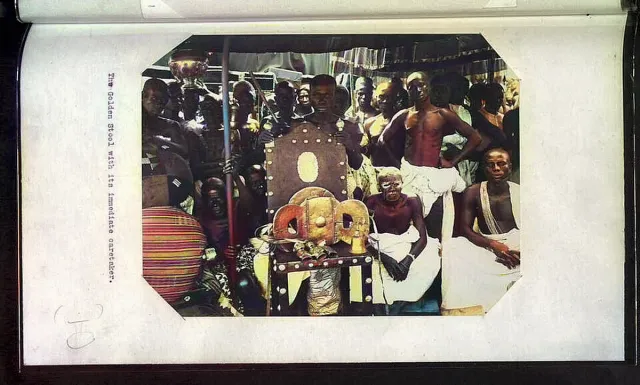
Sika Dwa Kofi ('the Golden Stool born on a Friday')The Golden Stool is called Sika Dwa Kofi, Kofi being the name of a male born on Friday. The tradition as Rattray recorded it in 1921 runs as follows. The priest Anokye announced that Onyame…
Note on the sourcesc. 1700 to presentWhat the Golden Stool is, and the rules that surround it
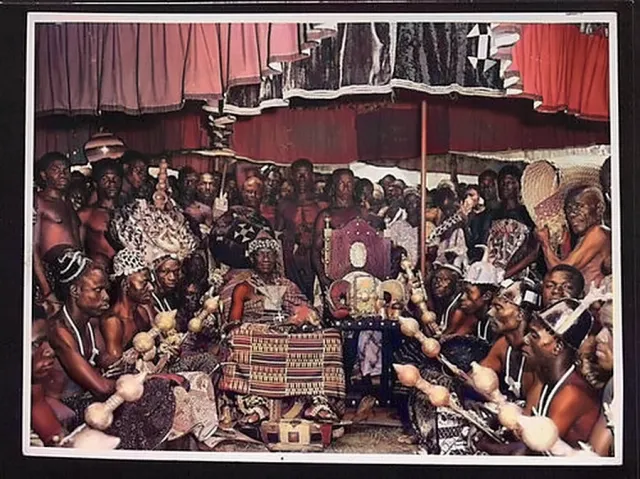
hwedom dwa (the stool's own chair)The Golden Stool is not a throne. It is the shrine of the nation's sunsum, holding together the living, the dead and those not yet born. No one sits on it. Rattray was told that on the…
1701-1818Bells, fetters and masks: what hangs on the stool
The objects attached to the Golden Stool are a record of Asante victories. Rattray's informants disagreed about the bells: some said two brass bells came down with the stool, others that…
Note on the sources1896-19001896 and 1900: the stool hidden, the stool demanded
When a British force entered Kumasi in 1896 and arrested Asantehene Prempeh I, no resistance was offered. Rattray was told why: a war risked the capture of the Golden Stool, and losing the…
Note on the sources19211921: discovery, desecration and a change of policy
In 1921 labourers making a government road came close to digging up the Golden Stool, which lay buried between two large brass pans. Its guardians drove them off with a story that a…
Note on the sources1922The Silver Stool sent to Princess Mary, 1922
A year after the crisis over the Golden Stool the queen mothers and women of Asante had a silver stool made, a copy of the stool of the queen mother of Mampon, and presented it as a wedding…
1935-2024Seeing the Golden Stool
The Golden Stool is kept out of sight and its resting place is known to very few. It is shown to the people only on the gravest occasions. It was used when Osei Agyeman Prempeh II was…
Shrines and sacred places
Asante Traditional Buildings: a World Heritage site
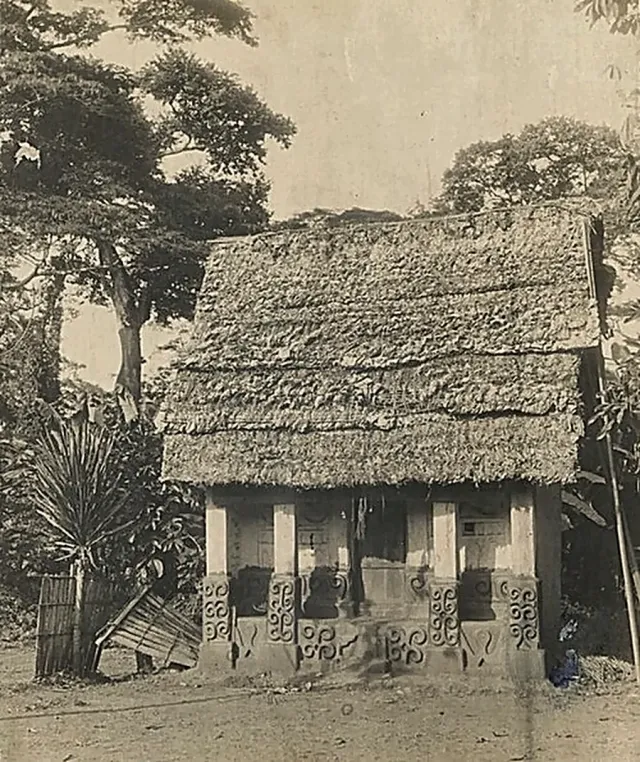
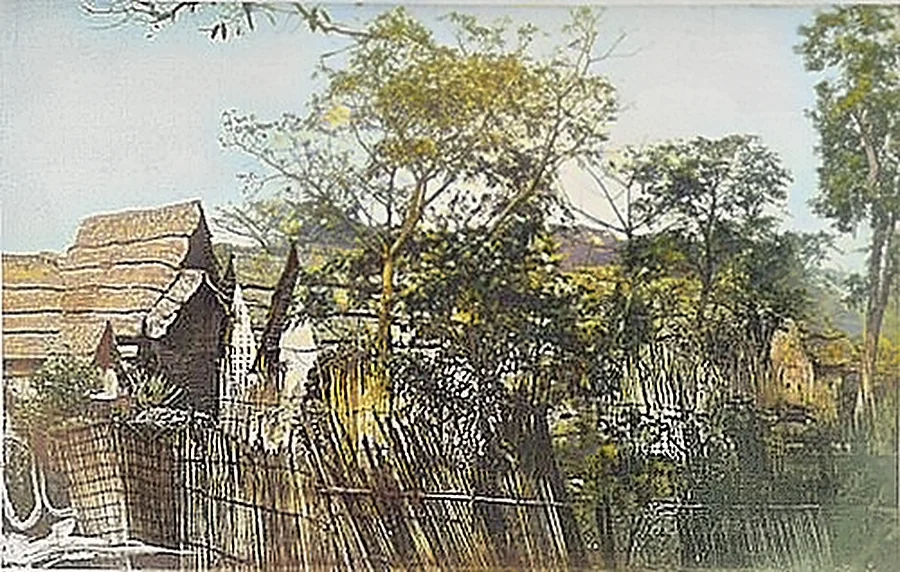
The only standing buildings of pre-colonial Asante are a group of village shrine houses around Kumasi. Ghana protected ten of them as national monuments in 1972, and in 1980 they were…
Note on the sources18th-19th century buildingsThe ten shrine villages and their gods
UNESCO's listing names the property by village: Abirim, Asawase, Asenemaso, Bodwease, Ejisu Besease, Adarko Jachie, Edwenase, Kentinkrono, Patakro and Saaman. Most lie north-east of Kumasi;…
Note on the sources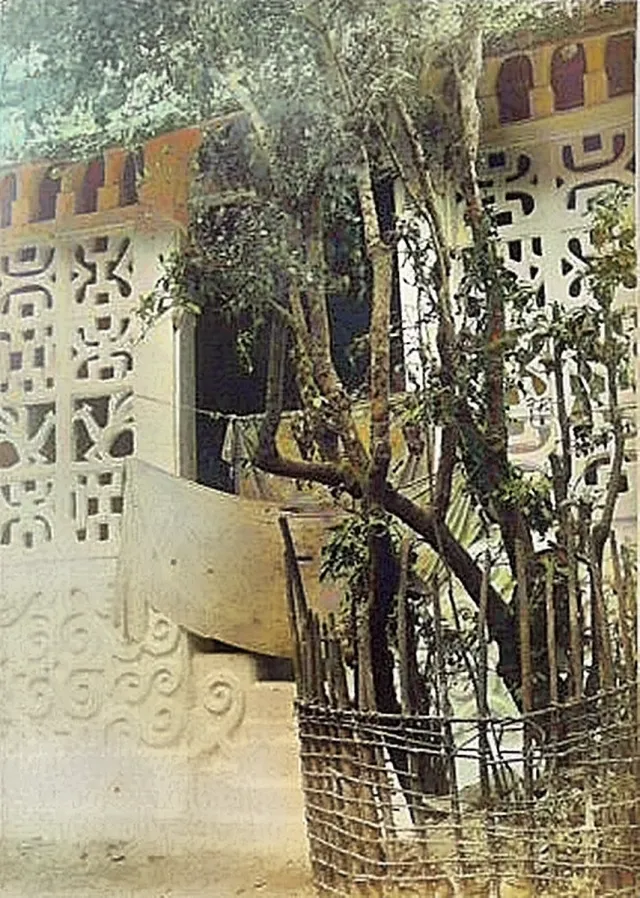 18th-19th century
How a shrine house is laid out
fihankra (courtyard house)An Asante shrine house follows the plan of the ordinary courtyard house, the fihankra: four separate rectangular buildings set round a square open yard, linked by paths and low walls. In a…
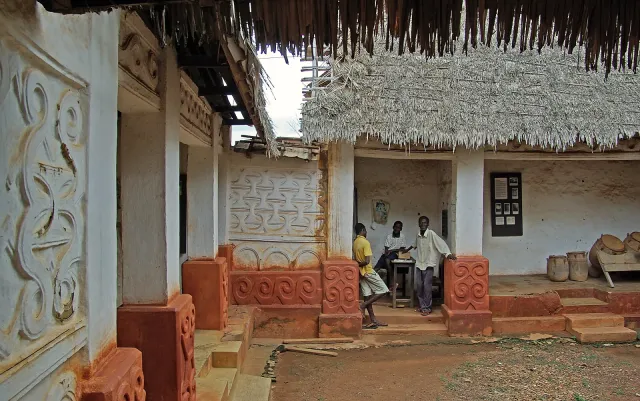 19th century; restored from 2014
The Besease shrine
The shrine house at Besease, beside Ejisu east of Kumasi, is the best known and most visited of the listed buildings. It dates from the nineteenth century. From 2014 the World Monuments…
1970s to presentThe shrine houses today: fewer priests, harder upkeep
When the Ghana Museums and Monuments Board took charge of the surviving traditional buildings in the 1970s there were sixteen. There are now ten, and none is in Kumasi itself. The Board's…
visited May 1922; Gyaman war c. 1818The rock of Tano at Tano Oboase
Tano Oboase ('Tano under the rock')Beyond the temple of Ta Kora lies the place the god is said to inhabit: a range of sandstone cliffs and caves near the head of the Tano river. Rattray was taken there by the priests in May…
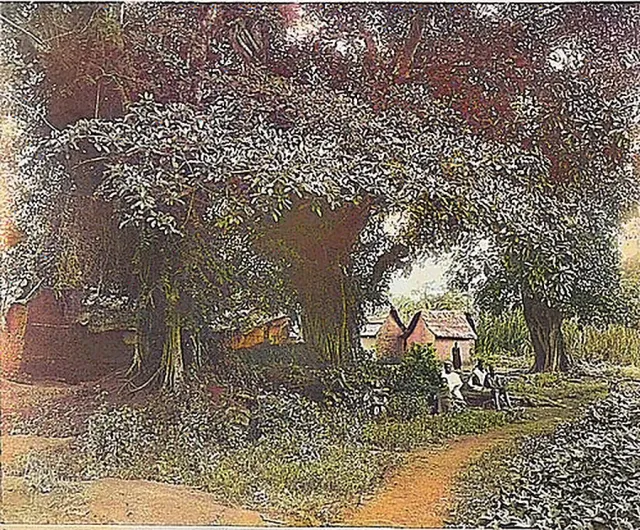 present
Tanoboase Sacred Grove today
The cliffs and forest that Rattray visited in 1922 are now presented to visitors as the Tanoboase Sacred Grove. The Ghana Tourism Authority describes it as the place where the Tano river…
visited 12 December 1921Asantemanso: the grove where the first people came out of the ground
AsantemansoAsantemanso, near Asumegya south of Kumasi, is the place of origin of several Asante clans. The tradition told to Rattray by its queen mother, Abena Firi, who was also its priestess, is…
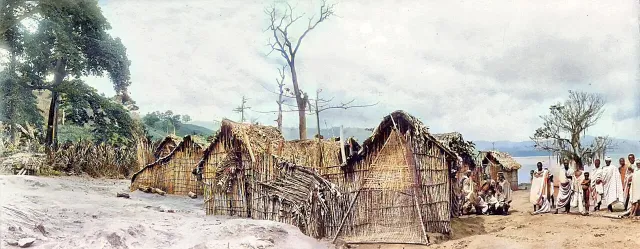 traditional; biosphere reserve 2016
Lake Bosomtwe and the Abrodwum stone
AbrodwumThe lake fills a meteorite impact crater south-east of Kumasi and is ringed by villages. Its chief place of offering in Rattray's time was the Abrodwum stone; white fowls were offered there…
Note on the sourcestradition dated c. 1695; enclosure built 1996The sword of Okomfo Anokye
In the grounds of the Komfo Anokye Teaching Hospital at Bantama in Kumasi the hilt of a sword stands out of the ground. Tradition says the priest Anokye drove it in, declared that no one…
1817-1873Sacred places in nineteenth-century Kumasi
The capital before 1874 was full of sacred points. Bowdich in 1817 saw an offering hung between poles at the entrance to the town and mentions a house called Hunma where sheep were killed…
Royal mausolea
Bantama in 1817: bones, gold and the great brass pan
BantamaBantama, now a suburb of Kumasi, was the burial place of the kings of Asante. Bowdich, the first European to describe it, wrote that only kings were buried there. After a time their bones…
1870-1873Bantama in the 1870s: the kings in their cells
The missionaries Ramseyer and Kuhne, held in Kumasi from 1870, give the fullest description of the mausoleum before its destruction. The remains of the kings, they wrote, were kept in a…
1896-1931The mausoleum burned, and Bantama afterwards
The Bantama mausoleum was destroyed during the British expedition that removed Prempeh I. Its destruction is attributed to Robert Baden-Powell, who served with that force. It is commonly…
Note on the sourceswitnessed 1921-22Repairing a royal burial house at Mampon
Each great Asante state had its own house for the royal dead. Rattray was present when the burial quarters of the rulers of one paramount division, which his table of contents identifies as…
Islam and Christianity
Muslims at the court of Kumasi, 1817
When the British mission entered Kumasi in 1817 it passed a group Bowdich had not expected: seventeen 'Moorish' dignitaries in white satin cloaks and large muslin turbans, with attendants…
1870-1873Muslims in Kumasi in the 1870s
Fifty years after Bowdich the Basel missionaries held in Kumasi found Muslims still an established part of court life under Asantehene Kofi Karikari. They were consulted about omens: the…
19th century to presentZongo: the strangers' quarter
zongo (from Hausa zango)Islam reached what is now southern Ghana mainly through trade, carried by Mande- and Hausa-speaking merchants. Bowdich found Muslims settled in Kumasi by 1817. Later migrants from the…
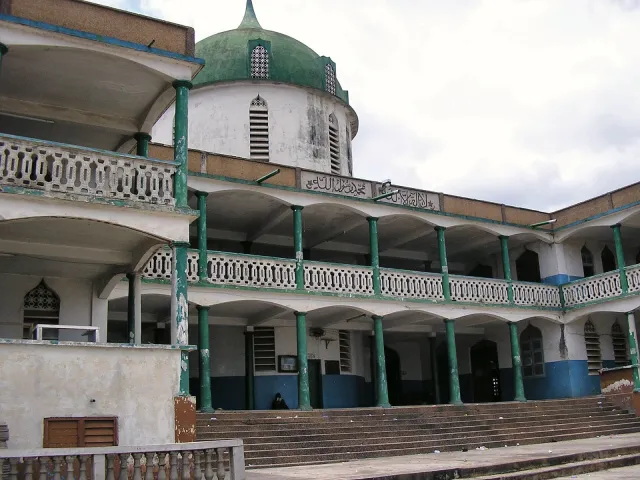 1950s; rebuilt 2020-2023
Kumasi Central Mosque
The Central Mosque of Kumasi is described as the largest mosque in the Ashanti Region. It was first built in the early 1950s for the city's growing Muslim population. In 2020 the then Vice…
1839-1848Thomas Birch Freeman and the first mission to Kumasi
The first Christian mission to Asante was Wesleyan Methodist. Its way was prepared by James Hayford, a Methodist who had been allowed to hold a service in the palace. Thomas Birch Freeman…
1870-1873Captive preachers: Christian worship in Kumasi, 1870-1873
Between Freeman's mission and the colonial period Christian worship in Kumasi was kept up by people who were there against their will or on the king's sufferance. The Basel missionaries…
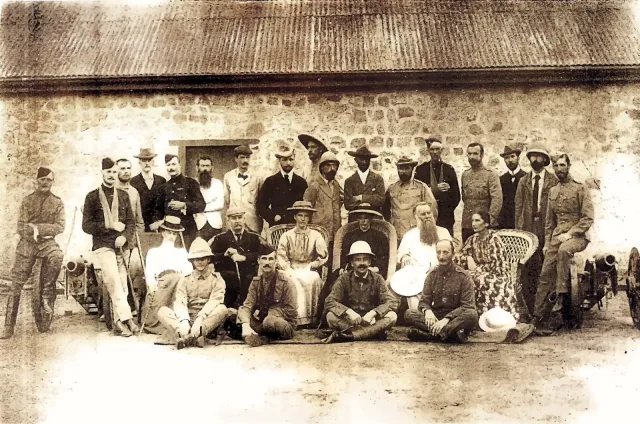 1896-1917
Ramseyer returns: the Basel Mission and the Presbyterian Church
The former captive came back as soon as the British had taken Kumasi. In June 1896 Friedrich and Rosa Ramseyer, with their nephew Edmond Perregaux and the convert Joseph Adjaye, settled in…
1932 to presentThe Catholic Church in Kumasi
The Catholic Church organised Asante as a separate jurisdiction on 2 February 1932, when the Apostolic Vicariate of Kumasi was cut out of the Vicariate of the Gold Coast under Hubert…
20th century to presentAnglicans and the palace
The Anglican Church has a particular tie to the Asante royal house. The present Asantehene, Otumfuo Osei Tutu II, is an Anglican: the Anglican Communion News Service described him so when…
Note on the sources1888 to presentSeventh-day Adventists and the Asante
Seventh-day Adventism reached the Gold Coast in 1888 and found its strongest following among the Asante. A 2014 report put membership in Ghana at almost 400,000 in 1,243 congregations, with…
late 20th century to presentPentecostal and charismatic Christianity
The largest single religious block in the Ashanti Region today is Pentecostal and charismatic. In the 2021 census 1,723,369 people in the region, close to a third of the population, were…
1921 to presentChurch and custom side by side
Christianity and Asante custom have been lived together for more than a century. The earliest evidence is small and telling. Listening to a chief address his ancestors in the stool house in…
Belief today
Religion in the Ashanti Region: the 2021 census
The 2021 Population and Housing Census asked every person in Ghana for a religious affiliation. Table 5.7 of the general report gives the following for the Ashanti Region, out of 5,428,181…
Note on the sources2000-2021What the small number hides
On paper, traditional religion has almost disappeared from Asante. Nationally those who name it as their religion fell from 8.5 per cent in 2000 to 5.2 per cent in 2010 and 3.2 per cent in…
2000 to presentThe Traditional Medicine Practice Council
Practitioners of traditional medicine in Ghana now work under state regulation. The Traditional Medicine Practice Act, Act 575, was passed in 2000 to control and regulate the practice of…