How the kingdom is built
States, stools and chiefs
The states of the union, the divisions of Kumase, the clans, the offices of the court and the people who hold the great stools today.
61 sourced entries · every source listed
Go deeper
The union and its states
The founding states of the union (amantoo)
amantoɔ (the allied founding states); Asante Amantoɔ Num (the five states)Asante began as an alliance of small Akan states that gathered around Osei Tutu of Kumasi and defeated their overlord Denkyira at Feyiase in 1701. The allied states are called the amantoo.…
Note on the sources18th-19th centuriesMetropolitan Asante, provinces and tributaries
Asanteman (the Asante nation)Historians separate the Asante state into rings. At the centre was metropolitan Asante: Kumasi and the founding states around it, an area Ivor Wilks estimated at about 10,000 square miles.…
c. 1700 onwardThe army formation that became the shape of the state
adonten (main body), nifa (right), benkum (left), kyidom (rear), twafo (advance guard), gyaase (household), akwansrafo (scouts)Asante political titles follow the order of battle. The army marched with scouts (akwansrafo) ahead, then an advance guard (twafo), the main body (adonten), a right wing (nifa) and a left…
Note on the sources17th century - presentMampong: the Silver Stool
Mamponghene; Dwete Dwa (Silver Stool)Asante Mampong, north-east of Kumasi, is the senior state after Kumasi. Its ruler, the Mamponghene, occupies the Silver Stool, described in Ghanaian reporting as second only to the Golden…
Note on the sources 17th century - present
Juaben (Dwaben)
Dwabenhene / JuabenheneJuaben, east of Kumasi, is one of the Oyoko founding states and historically the strongest after Kumasi; nineteenth-century observers quoted by Tordoff described its king's power as equal…
Note on the sources17th century - presentKokofu
KokofuheneKokofu, south of Kumasi, is an Oyoko founding state with a close family tie to the Kumasi royal house: the office of Asantehemaa was itself based at Kokofu until Osei Kwadwo moved it to…
Note on the sources17th century - presentBekwai
BekwaiheneBekwai, south of Kumasi on the road to Obuasi, is counted among the five amantoo and among the Oyoko settlements that formed the core of the union. In the 1870s the Basel missionaries…
17th century - presentNsuta
NsutaheneNsuta lies north-east of Kumasi, close to Mampong. It appears in every common list of the founding states: Britannica's account of the rulers who met before the break with Denkyira names…
Note on the sources17th century - presentKumawu and the Aduana states of the east
Kumawuhene; Kodua stoolKumawu, north-east of Kumasi on the edge of the Afram Plains, is the leading Aduana stool in Asanteman. Its black stool is known as the Kodua (or Kodua and Okyere) stool, after the early…
Note on the sources16th century (stool list) - presentOffinso
Offinsohene; ƆfensoOffinso lies north-west of Kumasi and takes its name from the River Ofe. Its stool belongs to the Asona clan. A ruler list published by the Offinso Traditional Council begins in the…
Note on the sources18th century - presentEjisu (Edweso)
Ejisuhene / EdwesoheneEjisu, east of Kumasi on the Accra road, is an Asona stool like Offinso; clan lists place Edweso with Offinso and Kyebi among the principal Asona towns, with a shared origin tradition at…
Note on the sourcesorigin tradition - presentEssumeja (Asumegya) and Asantemanso
Essumejahene / Asumegyahene; AsantemansoEssumeja, near Bekwai, guards Asantemanso, the sacred grove from which several Asante clans say their first ancestors came. Juaben and Kokofu stool histories both begin there, and the…
Note on the sourcespre-1700 - presentAdansi (Fomena)
Adansihene / AdanseheneAdansi, south of Bekwai, is older than Asante: many Akan groups trace their origins to it, and its name is linked to an Akan word for builders. Archaeology at its first capital,…
Note on the sourcesc. 1600 (tradition) - presentAgogo (Asante Akyem)
AgogoheneAgogo is the best-known paramountcy of Asante Akyem, the eastern marches of the Ashanti Region. Its stool is Aduana. Stool tradition, repeated without academic citation, says Aduana people…
Note on the sourcespresentHow many paramountcies? What the sources say
amanhene (paramount chiefs; singular omanhene)No official, current roll of the paramount stools of Asanteman was found online in this research, and the published figures differ. A MyJoyOnline report of February 2015 on the Kumawu case…
Note on the sourcespresentStools outside the Ashanti Region that swear to the Golden Stool
Asanteman is not the same thing as the Ashanti Region. A 2022 MyJoyOnline report described the Asanteman Council as bringing together chiefs from the Ashanti, Bono, Bono East, Ahafo,…
Note on the sourcesParamount stools today
Mamponghene: Daasebre Osei Bonsu III (from January 2026)
MampongheneThe Silver Stool changed hands in 2025-2026. Daasebre Osei Bonsu II, enstooled on 25 August 1996 after his uncle Nana Atakora Amaniampong II abdicated, died on 20 April 2025. He had been…
Note on the sources 1971 - present
Juabenhene: Nana Otuo Siriboe II (since 1971)
JuabenheneNana Otuo Siriboe II is the longest-serving of the senior Asante paramount chiefs. Born Peter Yaw Boakye Amponsah, he was educated at Opoku Ware School and Achimota, studied electrical…
2014 - presentKumawuhene: Barima Sarfo Tweneboah Kodua (since 2014)
KumawuheneThe Kumawu stool was filled in 2014 after about seven years of litigation. The queen mother, Nana Serwaa Amponsah, nominated Dr Yaw Sarfo; three kingmakers rejected him as imposed and…
Note on the sources 1999 - present
Bekwaihene and Kokofuhene
Bekwaihene; KokofuheneTwo of the Oyoko founding stools south of Kumasi are held by long-established chiefs. At Kokofu, Barima Offe Akwasi Okogyeasuo II, a retired educationist, was installed in July 1999 in…
Note on the sources2024 - presentOffinsohene: Nana Dwamena Akenten II (since January 2024)
OffinsoheneAfter the death of Nana Wiafe Akenten III the Offinso stool was vacant for about two years while the choice of successor was contested. The queen mother, Nana Ama Serwaa Nyarko, proposed a…
2014 - presentEssumejahene and Adansihene
Essumejahene; AdansiheneTwo of the southern paramount stools are held by chiefs installed in the last dozen years. Nana Okyere Kusi Ntrama, in private life Yaw Okyere Ntrama, a mining engineer and manager at…
2022-2026Agona and Agogo in 2026: one stool filled, one reported vacant
Agonahene; AgogoheneTwo paramount stools changed in 2026. At Asante Agona, the Ghana News Agency reported in June 2026 that a new Agonahene had been installed and, at an Asanteman Traditional Council meeting…
Note on the sources2025-2026Juansa and Gyadam: two Asante Akyem successions, 2025-2026
Juansahene; GyadamheneTwo successions in Asante Akyem show how a vacancy is settled when it reaches Manhyia. At Juansa, in Asante Akim North, the Asantehene endorsed the selection of Dr Ben Asante, a petroleum…
Note on the sources1937-2026Kenyase No. 2: destoolment of the longest-reigning paramount chief (July 2026)
On Monday 27 July 2026, at a sitting of the Asanteman Council at Manhyia, the Asantehene removed Nana Kwabena Nsia Ababio from the paramount stool of Kenyase No. 2. He had been enstooled in…
Note on the sourcesKumasi divisions and offices
The Kumasi Traditional Council
Kumasiman (the Kumasi state)The Kumasi Traditional Council (KTC) is the statutory council of the Kumasi state, the Asantehene's own paramountcy. Manhyia Archives describes it as the largest traditional council in…
Note on the sourcesc. 1700 - presentThe fekuo: divisions of the Kumasi state
fekuo (plural afekuo): a group or company of office-holdersKumasi's hundreds of stools are grouped into divisions called fekuo. Each is a company of chiefs under a head who answers to the Asantehene, and each has its own divisional council. Unlike…
Note on the sourcesc. 1700 - presentKronti division: the Bantamahene
Krontihene / Kontihene; BantamaheneThe Kronti (Krontire) is the senior division of Kumasi. Its head is the chief of Bantama, a quarter of the city, who is Krontihene of Kumasi and vice-president of the Kumasi Traditional…
Note on the sourcesc. 1700 - presentAkwamu division: the Asafohene
Akwamuhene; AsafoheneThe Akwamu division is paired with the Kronti as the two senior wings of Kumasi. The title recalls the Akwamu kingdom, from which Osei Tutu drew musketmen and military ideas; in the list of…
c. 1700 - presentAdonten, Benkum, Kyidom and Oyoko divisions
Adontenhene; Benkumhene; Kyidomhene; OyokoheneFour Kumasi divisions carry names from the order of battle or from the royal clan. The Adonten is the main body, the centre of the army that leads at the front; the formation of this…
Note on the sources18th century - presentGyaase division and the treasury
Gyaasehene; Gyaasewahene; Sanaahene; Adaka Kese (the Great Chest)The Gyaase is the ruler's household. In war it formed his personal bodyguard; in peace its companies of servants staffed the palace, and out of it grew the financial administration of the…
Note on the sources18th-19th centuries - presentAnkobea and Manwere divisions
Ankobeahene; ManwereheneTwo Kumasi divisions were built around the person of the king. The Ankobea (Ankobia) served as the Asantehene's guard, as special police and as a source of intelligence against rebellion,…
1985 - presentNkosuo: the development division
Nkosuohene (chief for progress or development); Nkosuo fekuoNkosuo means progress. The Nkosuo stool was created by Otumfuo Opoku Ware II as a new office to encourage development in Kumasi and the kingdom. It became a division of the Kumasi state…
Note on the sourcespresentAkyempimhene: head of the king's sons
Akyempimhene; Oheneba (title used by a king's child)Asante descent is matrilineal, so an Asantehene's sons cannot inherit the Golden Stool. One of them instead holds the stool of Akyempimhene. Reference works describe the office as held by a…
Note on the sourceshistoric - presentOkyeame: the spokesmen and their staffs
ɔkyeame (plural akyeame): spokesman, 'linguist'; Akyeamehene (head of the spokesmen)A chief does not speak directly to a gathering: speech passes through the okyeame. The English word linguist is a poor fit, for the okyeame is spokesman, counsel, envoy and master of…
 historic - present
Sword-bearers, heralds and royal messengers
afenasoafo (sword-bearers); nseniefo (heralds; Rattray writes osene for a herald); nhenkwaa (royal servants); asomfo (those who serve); abrafo (executioners, historical)Around every stool stands a body of servants whose posts are themselves offices. The afenasoafo carry the state swords. A sword is a credential: according to Adjaye, sword-bearers travelled…
historic - presentDrummers, horn-blowers, umbrellas and stool-carriers
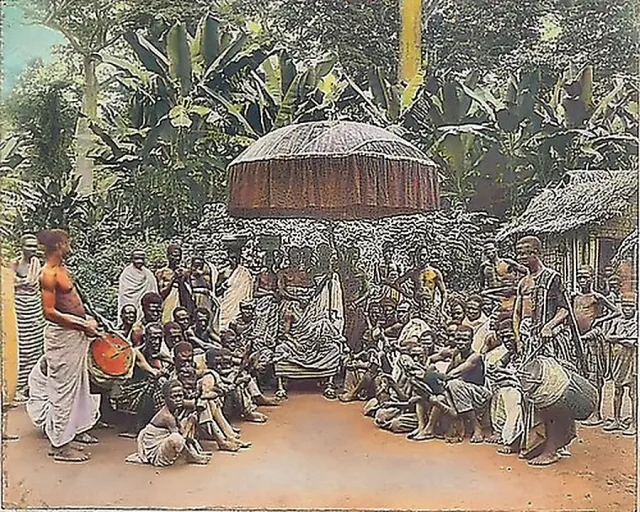
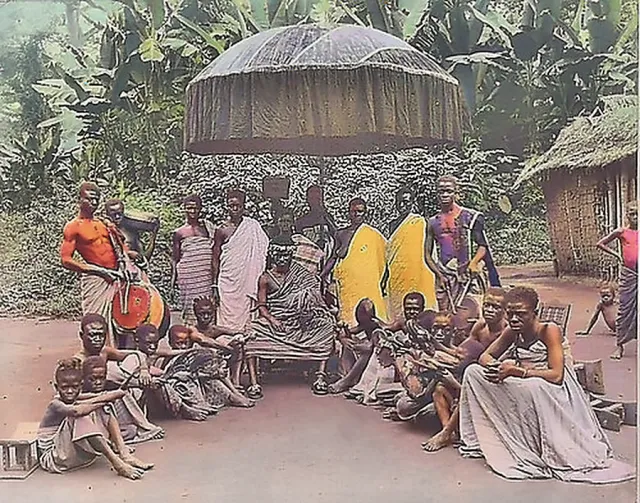
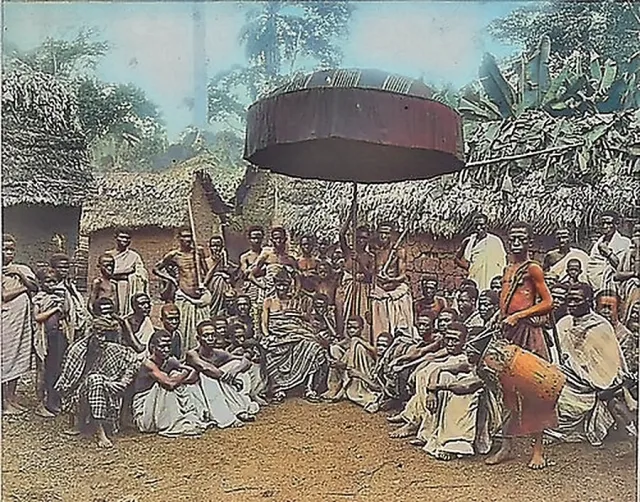
ntumpane / atumpan (talking drums); fontomfrom (state drums); ntahera, asokoben (ivory horns); akonnua dan / nkonnwafie (stool house); Rattray's spellings: kyeniefiafo (umbrella-carriers), akonnuasoafo hene (head stool-carrier)A chief in state is announced before he is seen. Rattray's descriptions of Adae ceremonies in the early 1920s list the instruments: the paired talking drums on which a master drummer…
historic - presentNsumankwaa and akrafo: spiritual offices of the court
Nsumankwaahene (head of the nsumankwaafo, the court's spiritual specialists); akrafo (soul-washers); ɔkɔmfo (priest)Several court offices deal with the unseen side of rule, though the sources opened for this research describe them only briefly. General Akan reference lists describe the Nsumankwaahene as…
Note on the sourcesQueen mothers
The ohemaa: what a queen mother is
ɔhemaa (plural ahemaa): female ruler, 'queen mother'Every Asante stool of any standing is paired with a woman's stool. Its occupant, the ohemaa, is called queen mother in English, but she is not always the chief's birth mother: she is a…
Note on the sources1701 - presentThe Asantehemaa and the making of an Asantehene
AsantehemaaThe Asantehemaa is queen mother of the Golden Stool and the highest female office in Asanteman. Her defining power is to nominate the next Asantehene. According to Wilks, when the stool…
1701 - 2026Fifteen Asantehemaa; Nana Yaa Akyaa II enstooled July 2026
AsantehemaaThe list of Asantehemaa published by Ghanaian media in July 2026 counts fifteen: Nyaako Kusiamoa (1701-1722), Nkatia Abamo (1722-1740), Akua Afriyie (1740-1768), Konadu Yiadom I…
Note on the sources2014-2026Queen mothers and kingmaking in practice, 2014-2026
ɔhemaa; abusuapanin (head of the lineage); adehyeɛ (royals)Recent successions show both the strength and the limits of the queen mother's nomination. At Kumawu in 2014 the Asanteman Council upheld the queen mother's nominee against three…
Clans (abusua)
Abusua: the matrilineal clans
abusua (matrilineal clan or family); mogya (blood); abusuapanin (lineage head); odikro (village head)Every Asante belongs by birth to the abusua of his or her mother. Rattray equated abusua with mogya, blood, and recorded the saying that one clan is one blood. The clan is exogamous: two…
Note on the sourceshistoric - presentThe eight clans: totems and the stools they own
akyeneboa (clan emblem animal, 'totem')Each clan has an emblem animal, its akyeneboa, and is identified with certain stools. Oyoko: the falcon or hawk (akroma); the Golden Stool itself, Kumasi, Kokofu, Juaben, Nsuta and Bekwai.…
Note on the sourcespresentClan greeting responses
'Yaa ... nana' (formal reply to a greeting, naming the greeter's clan)A custom still observed in formal settings is that the reply to a greeting names the greeter's descent group. The person greeted answers 'Yaa' followed by an epithet and 'nana'. The…
Note on the sourceshistoric - presentMatrilineal descent, succession and inheritance
agyapadeɛ (heirloom, inherited lineage property; Rattray writes agyapadie)Office and lineage property pass through women to men. Rattray set out the rule as he found it in the early 1920s: a man's heirs are of his own clan, in order his mother's brother, his…
historicNtoro: what comes from the father
ntorɔ (father's spirit-line); sunsum (spirit, personality); ɔkra (soul)Alongside the mother's blood, an Asante receives from the father a spiritual inheritance called ntoro. Rattray translated it roughly as spirit and described the ntoro groups as a second set…
Note on the sourcesCouncils and law
The old councils: Asantemanhyiamu and the Kumasi council
Asantemanhyiamu (assembly of the Asante nation); Asante Kotoko (the porcupine, a name for the nation and its council)Before colonial rule the kingdom was governed by two bodies whose relationship was never fully settled. The Asantemanhyiamu, the assembly of the nation, brought together the Asantehene, the…
Note on the sources1896-1950From the Ashanti Confederacy Council (1935) to the Asanteman Council (1950)
Asanteman NhyiamuAfter Prempeh I was exiled in 1896 the British dealt with each state separately and treated the kingship as abolished. Prempeh returned in 1924 and was recognised only as Kumasihene in…
Note on the sourcespresentThe Asanteman Council today
Asanteman Council; AsantemanhyiamuThe Asanteman Council is the assembly of the Asantehene, the Asantehemaa and the chiefs who owe allegiance to the Golden Stool, above all the paramount chiefs, together with the senior…
Note on the sourceshistoric - presentThe Great Oath and the oath system
Ntam Kɛseɛ (the Great Oath; the palace writes Ntamkesie); ntam (oath)Oaths hold the Asante political order together at every level. A new chief takes an oath before his elders at enstoolment, and it is for breaking that oath that he can later be removed.…
Note on the sources1902 - presentChiefs' courts from 1902 to today
asennie (court); nhyiamu (council)When Asante was annexed, the Ashanti Administration Ordinance of 1902 created a Chief Commissioner's Court, District Commissioners' Courts and native tribunals for the principal chiefs. In…
Note on the sourceshistoric - presentDestoolment: how and why a chief is removed
A stool is held on conditions. At enstoolment a chief hears the admonitions of his elders and swears to observe them; those who made him can unmake him. Tordoff lists the classic grounds…
historic - presentWhat a stool is: white stools, black stools and stool names
akonnua / adwa (stool); apunnua (blackened stool, Rattray's spelling); akonnua dan (stool house); sunsum (spirit); Sika Dwa Kofi (the Golden Stool)In Asante an office is a stool. To take office is to be enstooled; to lose it is to be destooled; land, regalia and debts belong to the stool and not to the person. The carved wooden seat…
Note on the sourcespresentStool lands in outline
Most land in Asante is stool land: it belongs to a stool and is held by its occupant as trustee for the people. Article 267 of the 1992 Constitution writes this into national law. Stool…
Chieftaincy in modern Ghana
Chieftaincy in the 1992 Constitution (Chapter 22)
Chapter 22 of Ghana's 1992 Constitution, articles 270 to 277, sets the legal frame for all chiefs. Article 270 guarantees the institution of chieftaincy together with its traditional…
1992 - presentChiefs and party politics: article 276
Article 276 of the Constitution states that a chief shall not take part in active party politics, and that a chief who wishes to stand for Parliament must first abdicate his stool or skin.…
1969 - presentNational and Regional Houses of Chiefs and the Chieftaincy Act 2008
Ghana's chiefs are organised in three statutory tiers: traditional councils, a Regional House of Chiefs in each region, and the National House of Chiefs. The detailed rules are in the…
Note on the sources1896-1935Without a king: 1896-1935
Kumasihene (chief of Kumasi)The modern legal position of Asante chiefs was shaped by four decades in which the union officially did not exist. In 1896 the British removed Agyeman Prempeh I to the Seychelles, and the…
1959-2019The Ashanti Region and the making of Brong-Ahafo, Bono, Bono East and Ahafo
Colonial Ashanti became one of the regions of independent Ghana. Its north-western part contained Bono states and Ahafo towns, some of them conquered by Asante in the eighteenth century. On…
Note on the sources1959 - presentAllegiance beyond the regional border: the Dormaa, Techiman and Tuobodom questions
Several stools in Bono, Bono East and Ahafo swear allegiance to the Golden Stool, while some neighbouring paramount chiefs reject any Asante claim. Three flashpoints recur in the reporting.…
Note on the sources