31 January - 4 February 1874
Amoaful and Odaso, 31 January - 4 February 1874
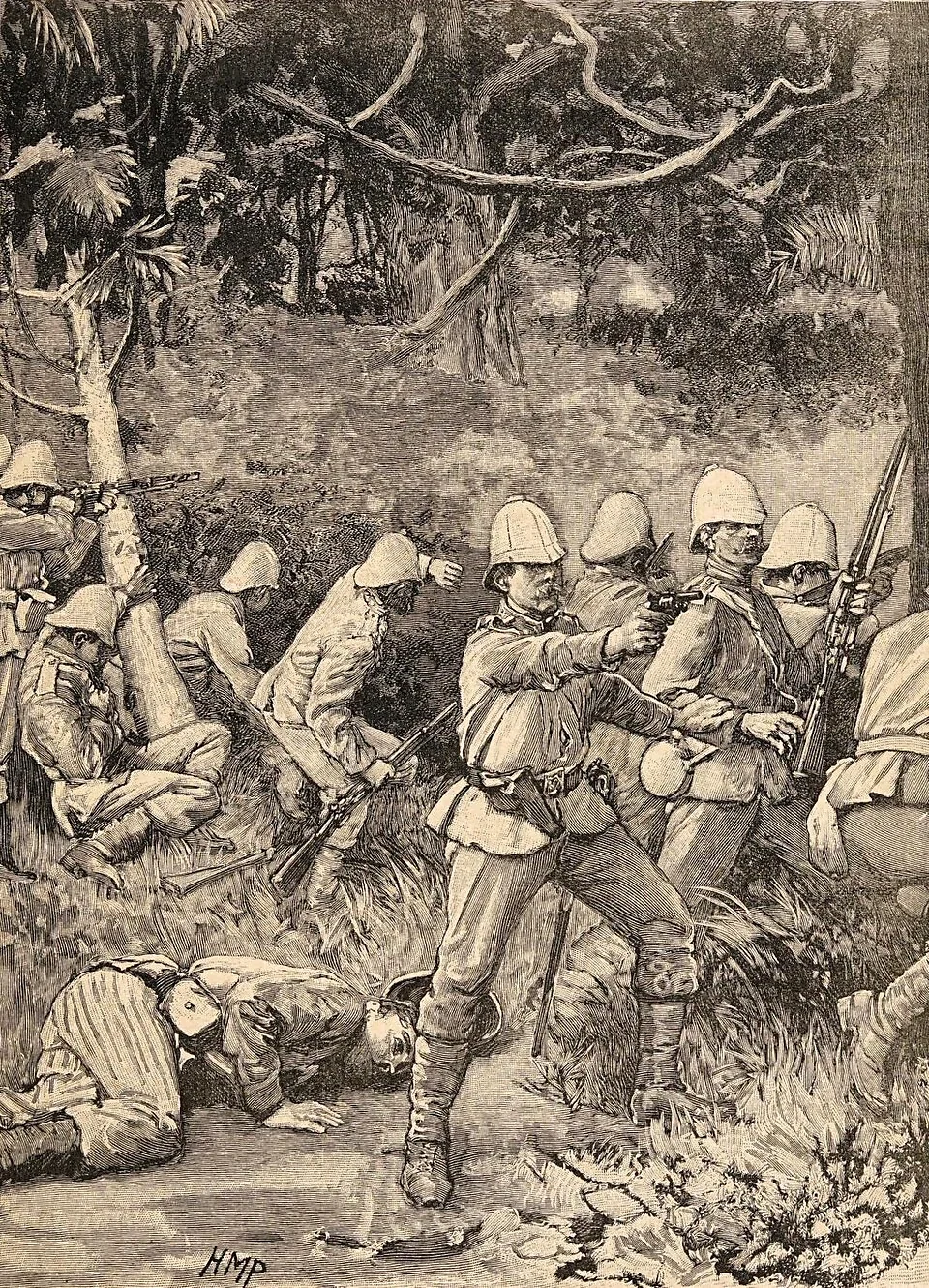
The Asante command, led by the veteran Asamoa Nkwanta with Amankwatia, chose not to defend the Adansi hills and instead prepared a position in thick forest around the village of Amoaful (Amoafo). Wolseley, after pausing four days at Fomena, attacked on 31 January 1874 with about 1,500 British and 700 African troops advancing on a front some six hundred yards wide. The Asante fought their customary enveloping battle, pressing both flanks and the rear for most of the day, but their trade muskets, loaded with slugs, wounded far more often than they killed, while Snider rifles, artillery and rockets did great execution. The Black Watch finally cleared the village with the bayonet. British loss was four dead and roughly two hundred wounded; British officers estimated Asante dead at two to three thousand, among them Amankwatia. The army regrouped behind the Oda (Ordah) river. On 3 February Wolseley brushed aside a last request for delay, and on 4 February forced the crossing at Odaso (Ordashu) in a second hard fight. That evening, about half past five, the Highlanders marched into a largely abandoned Kumasi.
Wikipedia calls Odaso a 'smaller battle two days later', i.e. 2 February; Fuller and Edgerton place the decisive crossing on 4 February. Casualty figures for Amoaful differ slightly between Edgerton (4 dead, about 200 wounded) and Wikipedia (4 dead, 194 wounded).
Key facts
- Amoaful fought 31 January 1874; Amankwatia was killed there.
- Wikipedia: at Amoaful 3 Europeans killed and 165 wounded, 1 African killed and 29 wounded.
- Odaso fought 4 February 1874; Kumasi entered about 5.30 p.m. the same day (Fuller).
- Edgerton: 1,500 British and 700 African troops engaged at Amoaful.