c. 1800/1801 - January 1824
Osei Bonsu (Osei Tutu Kwame), Asantehene at the height of the empire
Bonsu - whale, the greatest creature of the sea
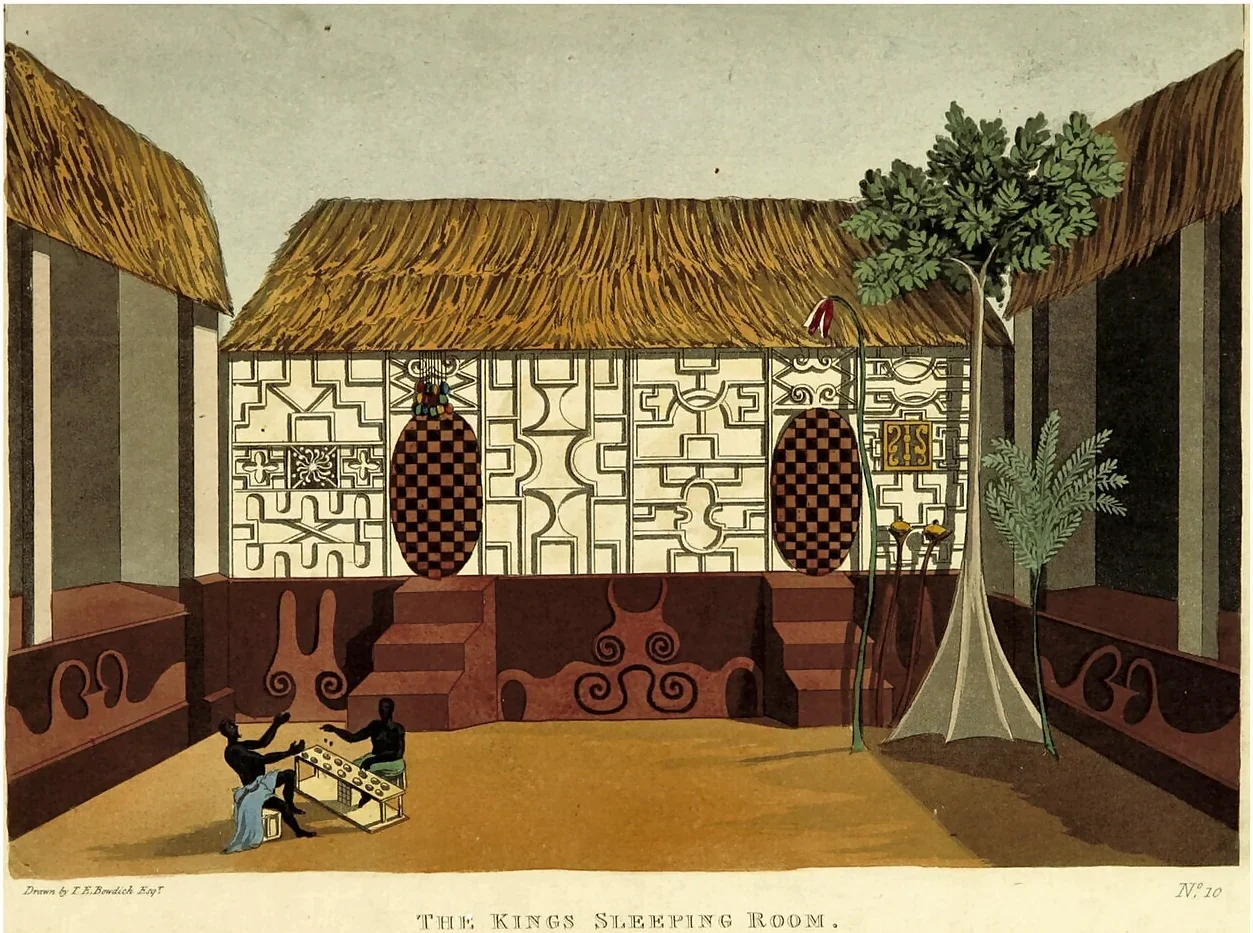
Osei Tutu Kwame, remembered as Osei Bonsu, came to the Golden Stool at the opening of the nineteenth century after the short reign of Opoku Fofie, and ruled until his death in Kumasi in January 1824. The byname Bonsu, 'whale', is explained as a boast that his armies had carried Asante power down to the sea. His reign opened with a rising in the north-west in favour of the deposed Osei Kwame, which was crushed, followed by some five years of peace. From 1806 his armies repeatedly marched to the coast against the Fante and their allies, and in 1818-19 he personally led the reconquest of Gyaman. At home he rebuilt several of the great roads radiating from Kumasi, drew literate Muslims into the court's secretariat (a Muslim school in Kumasi had about seventy pupils by 1819), and built a stone 'Aban' palace completed in 1822. He received the first formal European embassies to Kumasi: the Dutch envoy Huydecoper in 1816, the British mission of James and Bowdich in 1817 and Consul Dupuis in 1820. British merchants who knew him spoke well of him before a House of Commons committee. He died just as the first war with Britain was breaking out.
Accession is given as 1800 (Edgerton), 1800 or 1801 (most sources per Wikipedia) or 1804. Wikipedia gives his death as 21 January 1824, the same day it gives for the battle of Nsamankow; Edgerton says only that he died before Katamanso, probably not yet fifty.
Key facts
- Preceded by Opoku Fofie and succeeded by Osei Yaw Akoto.
- A Muslim school in Kumasi had about 70 pupils by 1819.
- The Aban stone palace was finished in 1822; the British blew it up in 1874.
- He commissioned an Arabic chronicle that Dupuis saw in 1820; it does not survive.