c. 1700 - 1820
Muslims at court and the Nsumankwaa
Nsumankwaa - the 'department of medicines'; Nsumankwahene - its head; asuman - charm, amulet
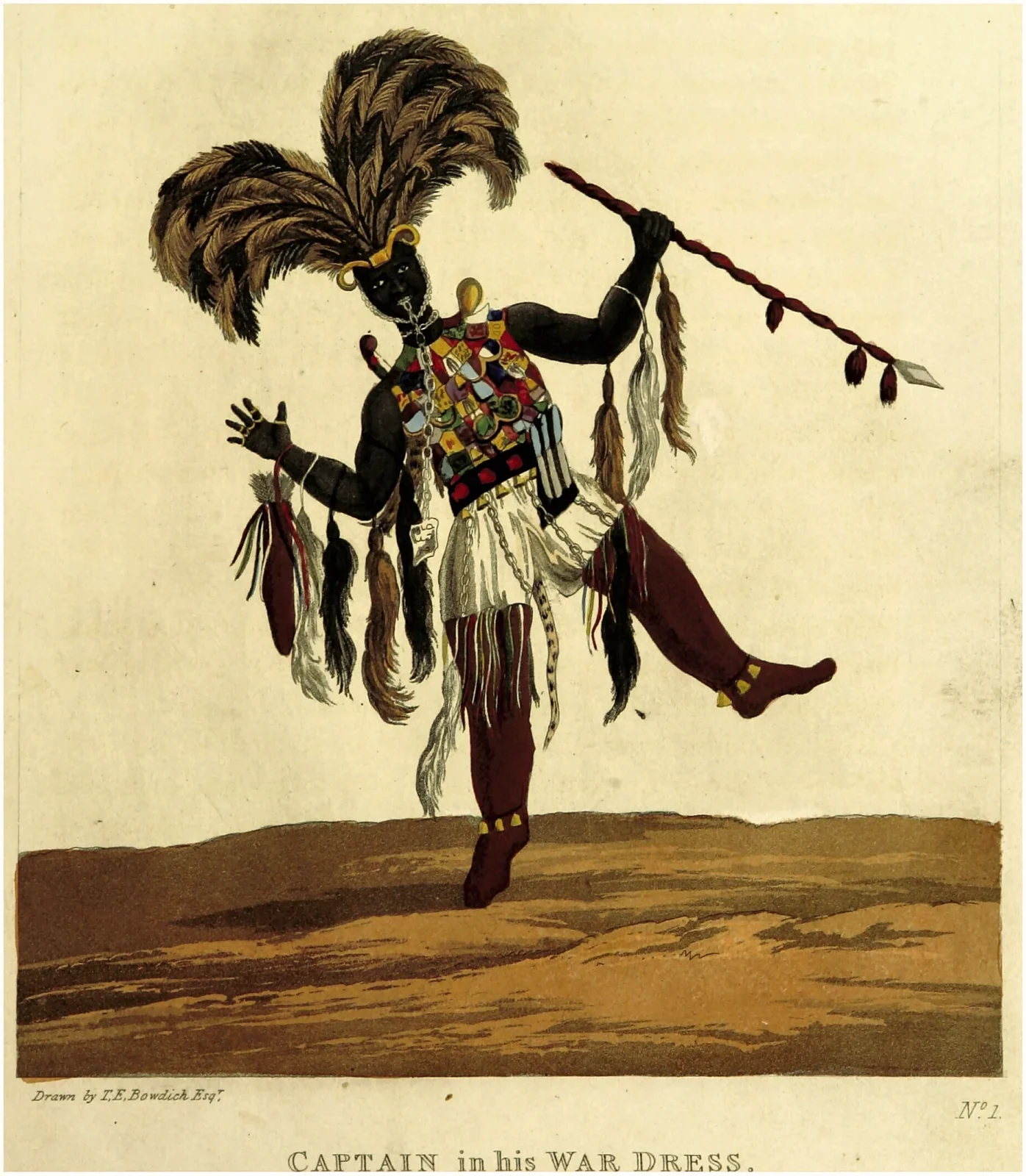
A small community of Muslims lived at the Asante court from the time of the state's founding around 1700. They were Dyula, Mande-speaking Muslims of the kind long settled in trading towns such as Begho, later joined by men from Gonja, Dagbon and Mamprusi. Akyeampong notes that Muslims first found a patron at Mampong under its chief Safo Katanka, the father of Osei Kwame, and that they were valued as ritual experts who gave spiritual protection to king and state. They were attached to the Nsumankwaa, the royal department of medicines, whose head, the Nsumankwahene, is said to have been created by Opoku Ware. Bowdich in 1817 described the high prices paid for 'Moorish' written charms and for war coats covered with them. Muslims were also the court's men of letters. They kept records in Arabic, and it was from their manuscripts that Dupuis compiled his history of the kings in 1820. Under Osei Bonsu literate Muslims served as secretaries, a school in Kumasi had about seventy pupils by 1819, and a history of the dynasty in Arabic was commissioned, now lost. Yet Islam at the centre was limited: Osei Kwame's supposed leaning towards it was held against him when he was deposed.
Sources differ on how far Islam reached into the court: Dupuis's Muslim informants presented Osei Kwame as a near-convert, while Bowdich was told he was removed for neglecting the capital. I did not find a source I could open that explains the term 'Asante Nkramo' used for the hereditary Kumasi Muslim community.
Key facts
- Muslims were present at the Asante court from about 1700.
- They were attached to the Nsumankwaa as ritual specialists and makers of protective charms.
- Dupuis's 1820 history of the kings was based on Arabic records kept by Kumasi Muslims.