c. 1690s - 1800
How the army was organised
adonten - main body; twafo - advance guard; kyidom - rear guard; nifa - right wing; benkum - left wing; gyaase - household guard; akwansrafo - scouts; Kontihene - senior general; asafo - company
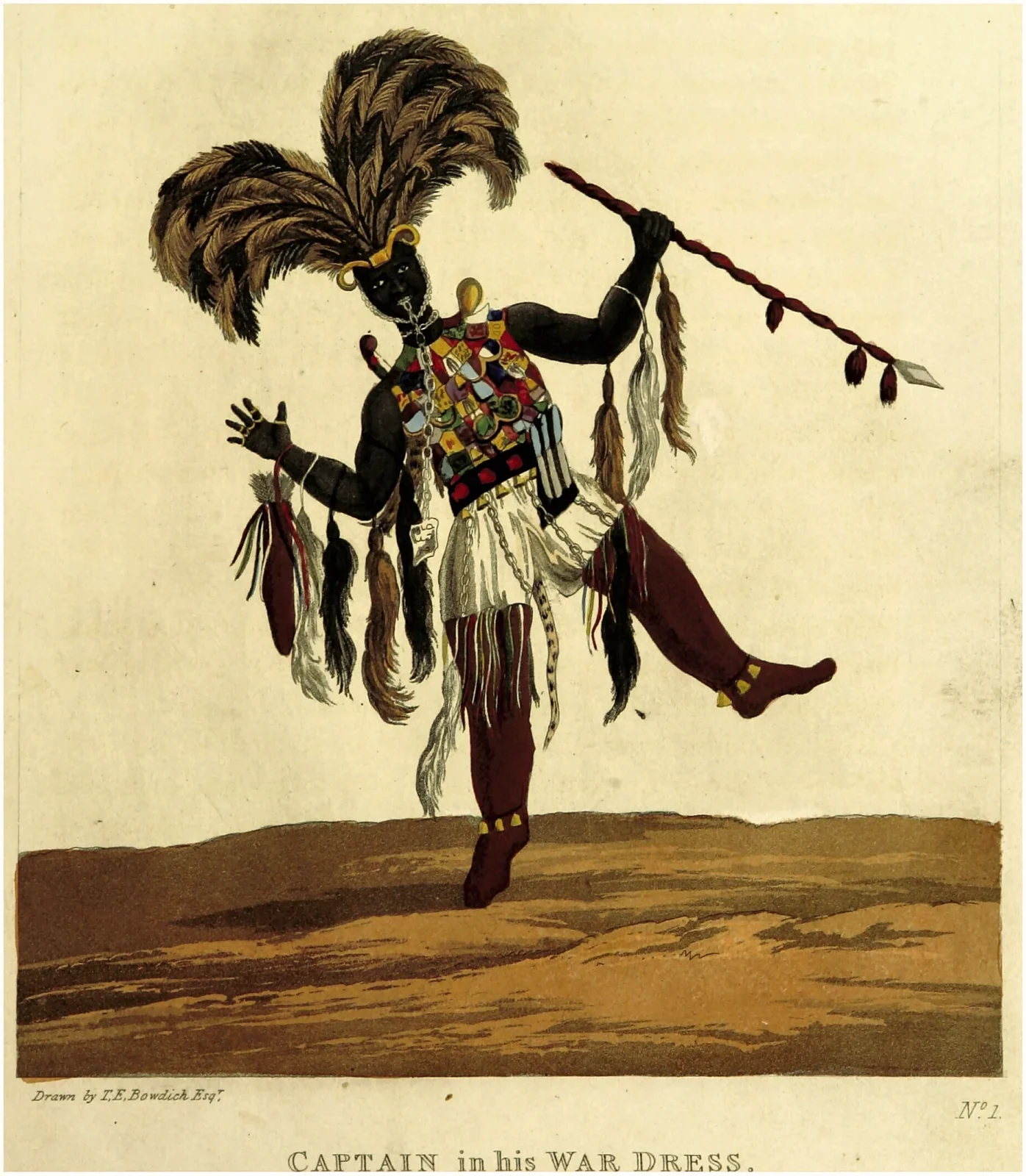
Asante's army was a citizen force organised on a fixed plan that doubled as the political map of the state. Tradition says Osei Tutu reorganised the Kwaman forces just before the Denkyira war on a model learned in Akwamu and Denkyira. The host marched and fought in set divisions: scouts ahead, an advance guard, the main body, the king's household guard, a rear guard, and right and left wings, which made encirclement the classic Asante manoeuvre. Each division was the charge of a particular stool, so that a chief's title was also his place in the line; the Bantamahene, as Kontihene, was the senior commander in Kumasi, an office first held by the Denkyira-born Amankwatia. Reindorf describes the companies formed by successive kings from captives and dependants, each with its flag, drums, horns and war shrine, and the rituals and oaths that preceded a campaign. A small core of trained gun-men was supplemented by levies from the towns and by contingents from allies and tributaries, including northern archers. There was no cavalry, because horses could not survive in the forest. Adult men paid a war tax when the army took the field.
Key facts
- The army was arranged as scouts, advance guard, main body, household guard, rear guard and two wings.
- The Bantamahene held the senior Kumasi command as Kontihene; the first was Amankwatia.
- Horses could not survive in the forest, so there was no cavalry.