c. 1700 to present
The form of the Golden Stool: bells, fetters and its own chair
Sika Dwa Kofi; hwedom dwa
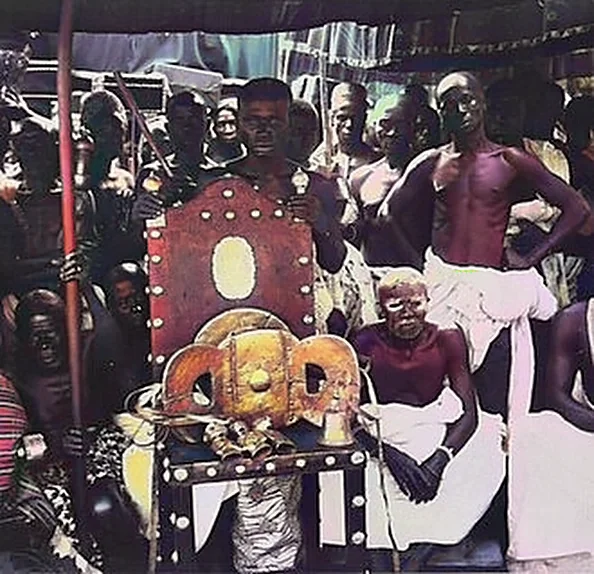
The Golden Stool, Sika Dwa Kofi, is an ordinary-shaped stool hung with bells, never sat on, resting on its own chair.
- Literal meaning
- the golden stool born on a Friday
- The saying
- Fetters on a stool are there to bind the owner's soul to it (Rattray).
- Stands for
- the nation's soul, never touched to the ground
- What it shows
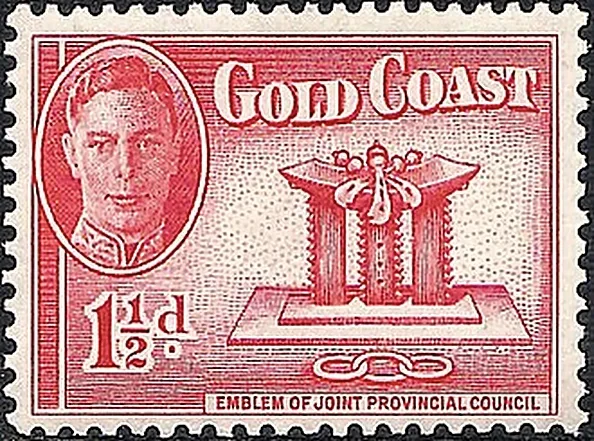
- An ordinary-shaped Asante stool with a curved seat on a central support over a flat base, about 46 cm high, hung with bells and cast gold ornaments.
- Where it is used
- It is never sat on and never touches the ground; on state occasions it lies on its side on its own chair, the hwedom dwa, under its own umbrella.
- Also written
- hwedom dwa
- How sources differ
- The dimensions come from an unreferenced Wikipedia passage and could not be confirmed in a primary source.
The Golden Stool, Sika Dwa Kofi, 'the golden stool born on a Friday', has the shape of an ordinary Asante stool: a curved seat on a central support over a flat base. Published measurements give it as about 46 cm high with a seat about 61 cm wide and 30 cm deep. It is hung with bells, and with cast gold ornaments that were stripped from it when it was robbed in 1921. Rattray, who recorded that event, explains one class of ornament: fetters on a stool are there to bind the owner's soul to it, and he found the same fetter motif on a shrine wall, on a kuduo and on goldweights. Ordinary blackened stools also carry bells, fastened to 'the ears', the small knobs under the wings of the seat. The Golden Stool never touches the ground and is never sat on. On state occasions it lies on its side on a chair of its own beside the king, the hwedom dwa, and under its own umbrella.
The dimensions come from an unreferenced passage on Wikipedia and could not be confirmed in a primary source.
Key facts
- Full name Sika Dwa Kofi: the Golden Stool born on a Friday
- About 46 cm high, seat about 61 x 30 cm (as published)
- Fetters on a stool bind the owner's soul to it (Rattray 1923)
- Rests on its own chair and under its own umbrella