The shop › Stools and carving
Stools and carving
Stools, linguist staffs, akuaba figures and combs, carved from one block.
Carvers of Ahwiaa and the carving towns.
Sellers
No verified seller in this aisle yet
Sellers are checked before they are listed, and the shop has not opened. If you make or trade in this, yours could be the first stall here.
Looking for something?
People often ask for: A stool of a named design · An akuaba figure · A staff top or a carved panel.
Know what you are buying
Ahwiaa and the carving of stools
Ahwiaa, about nine kilometres from Kumasi on the Mampong road, is the town known for wood carving. Its staple is the stool (dwa). An Asante stool is…
Ahwiaa: the carvers' town
Ahwiaa, a few kilometres north of Kumasi on the Mampong road, is the woodcarving town of Asante. Reference and tour sources describe it simply as a…
Duafe: the wooden comb
Duafe is a wooden comb, a prized possession of an Akan woman. Sources differ on emphasis. Willis's Adinkra Dictionary, as reported by adinkra.org,…
The parts of an Asante stool
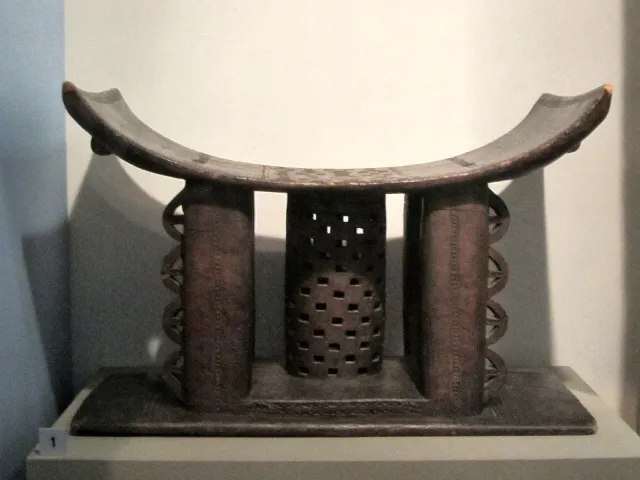
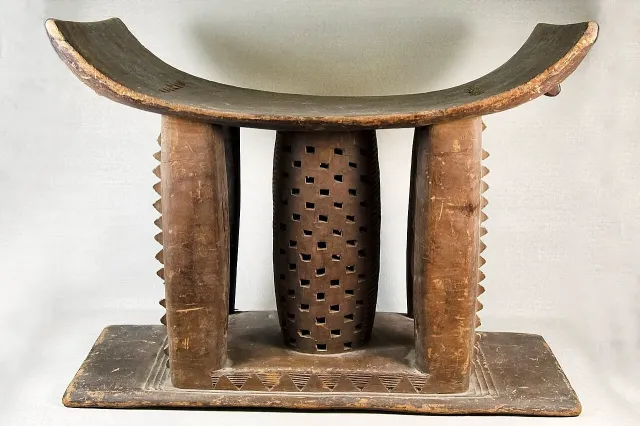
A conventional stool is carved from one block of pale sese wood. It has a rectangular base with incised steps, a central support that carries the…
Mmaa dwa: the woman's stool
Rattray (1927) recorded that a man generally gave his wife this stool when he married. Its support is a hollow central column pierced in a…
Kotoko dwa: the porcupine stool
Rattray lists a Kotoko stool twice. One, he says, could be owned only by paramount chiefs. The other is the 'porcupine stool' sat on by members of…
Kontonkowori: the stool only the Asantehene may have
Rattray assigns this design to the Asantehene. Carvers at Ahwiaa described it to Hale as a specially elaborate kotoko dwa, 'the kotoko dwa of all…
Esono dwa: the elephant stool
A stool whose support is a carved elephant. Rattray says it was used only by the King of Asante. Hale found one, over fifty years old, kept for a…
Sakyi dua koro: the stool with a single support
Rattray translates the name as the stool with the single centre support and says it was used only by the priesthood.
38 entries in all. The full story is under Culture.